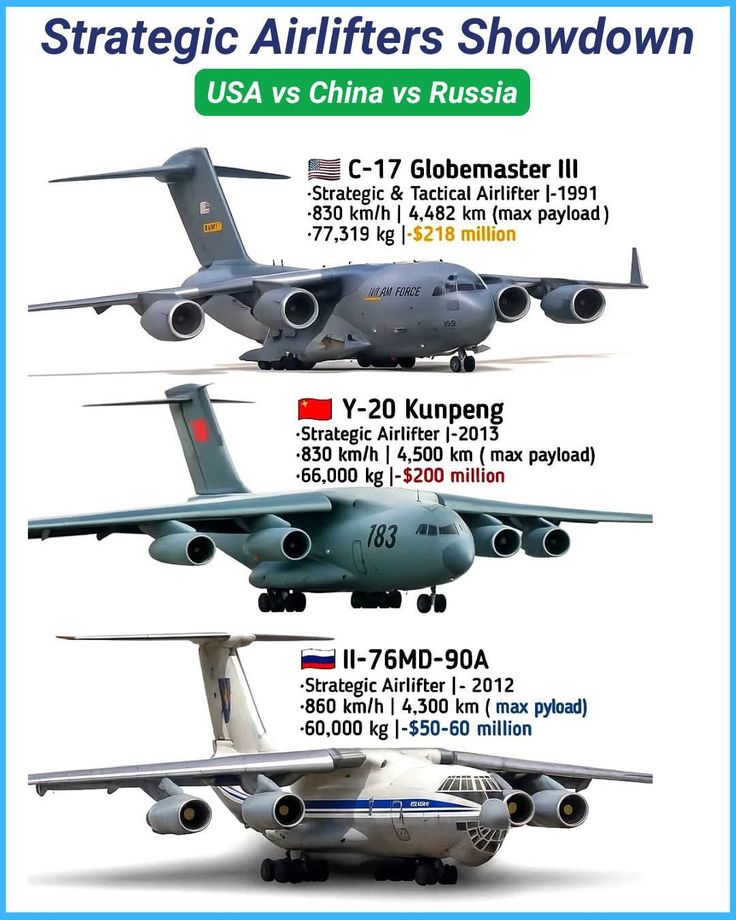
Strategic Airlifters Showdown: USA’s C-17 Globemaster III vs. China’s Y-20 Kunpeng vs. Russia’s Il-76MD-90A – A Detailed Visual and Technical Comparison Tutorial (2026 Edition)

Description: In-Depth Guide to the Leading Strategic Transport Aircraft from the USA, China, and Russia – Design Features, Performance Specs, Payload Capabilities, Operational Roles, and Geopolitical Context
This dynamic infographic, titled “Strategic Airlifters Showdown”, pits three major heavy military transport aircraft against each other in a vertical profile comparison: the American Boeing C-17 Globemaster III, the Chinese Xi’an Y-20 Kunpeng, and the modernized Russian Ilyushin Il-76MD-90A. The layout highlights key stats overlaid on high-resolution side views of each aircraft, with national flags, entry-into-service years, maximum payload figures, cruise speeds, ranges at max payload, and approximate unit costs.
The aircraft are presented in descending order:
- C-17 Globemaster III (USA, 1991 entry) – Shown in U.S. Air Force gray livery with four engines and distinctive high T-tail, labeled with 77,319 kg max payload (though official figures reach 77,519 kg / 170,900 lb), ~830 km/h speed, 4,482 km range at max payload, and ~$218 million cost.
- Y-20 Kunpeng (China, 2013 entry) – Depicted in PLAAF green-gray camouflage, emphasizing its wide-body design inspired by the Il-76 but with modern lines; stats list 66,000 kg max payload, 830 km/h speed, 4,500 km range at max payload, and ~$200 million cost.
- Il-76MD-90A (Russia, 2012 modernized entry) – Illustrated in classic Aeroflot/Russian Air Force white-blue scheme with four engines and high-wing configuration; noted with 60,000 kg max payload, 860 km/h speed, 4,300 km range at max payload, and $50–60 million cost.
This post acts as a professional tutorial, breaking down the infographic step by step, providing accurate 2026-updated specifications in a comparison table, explaining design philosophies, mission capabilities, and strategic implications for global air mobility.
Step 1: Visual Analysis – Decoding the Infographic
The graphic uses a blue-bordered frame with bold title text and a “USA vs China vs Russia” subtitle to frame the geopolitical rivalry. Each aircraft profile is scaled similarly for direct visual comparison:
- Note the C-17’s advanced high-lift wings and thrust-reversing engines for short/rough-field performance.
- The Y-20’s wider fuselage (optimized for Chinese armored vehicles like Type 99 tanks) and cleaner lines from domestic WS-20 engines in newer variants.
- The Il-76MD-90A’s traditional high-wing design with upgraded PS-90A-76 engines for improved efficiency and noise compliance.
Pro tip: Profile views allow quick assessment of wingspan, fuselage volume, and engine placement—key to understanding payload volume and short-field capabilities.
Step 2: Historical and Design Context
These aircraft represent the pinnacle of strategic airlift in their respective nations:
- C-17 Globemaster III: Developed in the 1980s–1990s to replace older transports; excels in strategic and tactical roles with unmatched short/rough-field performance (can operate from 1,064 m runways).
- Y-20 Kunpeng (“Chubby Girl” nickname): China’s first indigenous heavy transport, entering service 2013–2016; bridges Il-76 capability with modern avionics and growing WS-20 turbofan integration for better efficiency.
- Il-76MD-90A: Deep modernization of the 1970s Il-76 design (original Soviet workhorse); features new engines, glass cockpit, and composite wing elements for extended life and performance.
All support troop/equipment deployment, humanitarian aid, aerial refueling (variants), and rapid global response.
Step 3: Updated Specifications Comparison Table (2026 Figures)
Compiled from official sources (USAF, PLAAF reports, Russian MoD, and defense analyses); ranges are approximate at max payload unless noted.
| Aircraft | Country | Entry Year | Approx. Unit Cost | Max Payload | Cruise Speed | Range at Max Payload | Ferry Range (no payload) | Max Takeoff Weight | Engines | Key Strengths |
|---|---|---|---|---|---|---|---|---|---|---|
| C-17 Globemaster III | USA | 1991 | ~$218–250M | 77,519 kg (170,900 lb) | 830 km/h (Mach 0.74–0.79) | ~4,480–4,500 km | ~11,500 km (6,200 nmi) | 265,352 kg | 4 × Pratt & Whitney F117-PW-100 | Short/rough-field ops, versatility, reliability |
| Y-20 Kunpeng | China | 2013 | ~$160–200M | 66,000 kg (145,500 lb) | 830 km/h (Mach 0.75) | ~4,500 km | ~7,800–9,000 km | 220,000 kg | 4 × WS-20 (or D-30KP-2 earlier) | Rapid production growth, tank transport (e.g., Type 99) |
| Il-76MD-90A | Russia | 2012 (mod) | ~$50–60M | 60,000 kg (132,000 lb) | 860 km/h | ~4,000–4,300 km | ~6,300–7,800 km | 210,000 kg | 4 × PS-90A-76 | Cost-effective, rugged ops, ongoing production |
Notes: All support aerial refueling for extended range. C-17 leads in payload and short-field performance; Y-20 offers strong value and fleet expansion; Il-76MD-90A remains economical with upgrades.
Step 4: Capabilities and Mission Roles – Tutorial Breakdown
- Payload & Cargo Flexibility:
- C-17: Largest payload; carries M1 Abrams tanks side-by-side, 102 paratroopers, or massive airdrops.
- Y-20: Optimized for Chinese heavy equipment (e.g., two Type 15 or one Type 99 tank); growing tanker (YY-20) variants.
- Il-76MD-90A: Reliable for 60-ton loads; excels in austere environments with minimal support.
- Range & Speed:
- All cruise ~830–860 km/h; C-17 and Y-20 edge out in practical strategic reach with refueling.
- Ferry ranges allow global deployment (C-17 unlimited with refueling).
- Operational Advantages:
- C-17: Best short/rough-field capability and proven in conflicts (Iraq, Afghanistan).
- Y-20: Rapid Chinese fleet buildup (50+ in service by 2025–2026); domestic engines reduce foreign dependency.
- Il-76MD-90A: Lower cost, high production continuity; rugged for contested or unpaved strips.
Step 5: Geopolitical & Future Outlook (2026)
As of early 2026, the C-17 remains the gold standard for versatility (257 built, widespread exports). China’s Y-20 fleet expands aggressively to support Indo-Pacific ambitions. Russia’s Il-76MD-90A sustains production amid sanctions, focusing on domestic and allied needs. Emerging programs (e.g., potential next-gen designs) may shift balances soon.
Use this guide to explore further: Review flight sims (e.g., MSFS C-17 mods), official fact sheets, or defense journals. Which airlifter’s capabilities best suit modern logistics challenges? Share your insights in the comments!