Ka-52 Alligator vs. AH-64 Apache: Head-to-Head Comparison of Russia’s Coaxial Attack Helicopter and America’s Legendary Gunship – Detailed Specs, Design Philosophy & Combat Capabilities (2026 Edition)

Description: A Comprehensive Tutorial Comparing the Kamov Ka-52 “Alligator” and Boeing AH-64 Apache – Visual Breakdown, Performance Metrics, Armament, Survivability, and Operational Realities
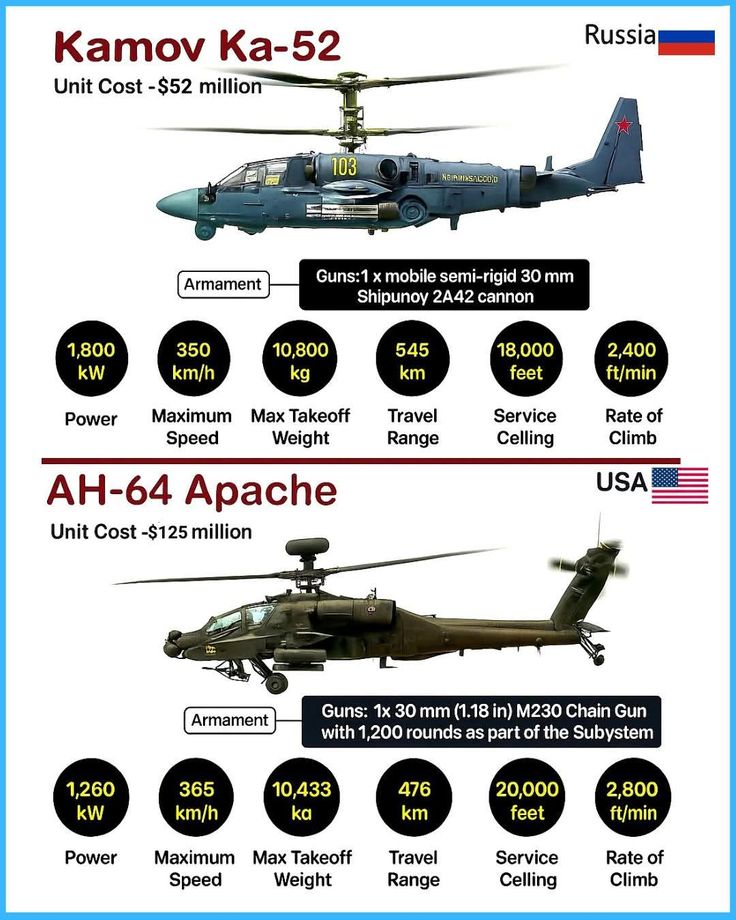
This high-contrast infographic delivers a clear, side-by-side technical comparison of two of the world’s most formidable dedicated attack helicopters: Russia’s Kamov Ka-52 Alligator and the United States’ Boeing AH-64 Apache (most commonly the AH-64E Guardian variant in frontline service). The layout uses profile views, national flags, unit costs, and circular stat badges to highlight key performance figures, armament details, and design contrasts at a glance.
Key visual elements include:
- Ka-52 (top) – Shown in blue-gray naval camouflage with red star markings, coaxial contra-rotating rotors, side-by-side seating, and pronounced ejection-seat housings.
- AH-64 (bottom) – Depicted in standard U.S. Army olive-drab with mast-mounted radar, tandem cockpit, and distinctive nose-mounted chain gun.
- Circular badges summarizing engine power, top speed, maximum takeoff weight, combat range, service ceiling, and rate of climb.
- Armament callouts focusing on each helicopter’s primary cannon: the Ka-52’s mobile 2A42 30 mm Shipunov cannon vs. the Apache’s fixed M230 30 mm Chain Gun.
This post serves as an in-depth tutorial-style guide. We’ll analyze the infographic step by step, explain the design philosophies behind each platform, provide a structured side-by-side specification table (updated for 2026 data), discuss strengths/weaknesses in key mission areas, and cover real-world combat performance and modernization status.
Step 1: Understanding the Visual Layout and Design Contrasts
The infographic employs a vertical split with the Ka-52 above a dividing line and the AH-64 below, emphasizing national and doctrinal differences:
- Coaxial rotors (Ka-52) → No tail rotor → higher power-to-weight, superior agility, better low-speed control, and reduced vulnerable tail boom.
- Tandem cockpit (AH-64) → Pilot/gunner separation → optimized crew workload and survivability sequencing.
- Side-by-side cockpit (Ka-52) → Improved situational awareness and crew coordination, especially in complex terrain.
- Mast-mounted radar (AH-64E) vs. millimeter-wave radar + electro-optical targeting (Ka-52) → Different approaches to long-range targeting and fire control.
Pro tip: When comparing rotorcraft visuals, pay attention to rotor configuration first—it drives maneuverability, noise signature, and mechanical complexity more than any other single feature.
Step 2: Core Specifications – Side-by-Side Table (2026 Figures)
Data reflects latest publicly available and manufacturer-reported figures for frontline variants (Ka-52M / AH-64E Guardian).
| Parameter | Kamov Ka-52 Alligator (Russia) | Boeing AH-64E Apache Guardian (USA) | Notes / Advantage |
|---|---|---|---|
| Unit Cost (flyaway est.) | ~$52 million | ~$125 million (incl. sensors & upgrades) | Ka-52 significantly cheaper |
| Crew | 2 (side-by-side) | 2 (tandem) | Different ergonomics & workload |
| Engines | 2 × Klimov VK-2500 turboshafts (~2,400 shp ea.) | 2 × GE T700-GE-701D (~1,994 shp ea.) | Ka-52 higher total power |
| Power (total) | ~1,800 kW (displayed figure; ~4,800 shp combined) | ~1,260 kW (displayed; ~4,000 shp combined) | Ka-52 higher installed power |
| Maximum Speed | 310–350 km/h (displayed 350 km/h) | 293–365 km/h (displayed 365 km/h) | Roughly comparable; varies by load/altitude |
| Max Takeoff Weight | 10,800 kg | 10,433 kg | Very close |
| Combat Range | ~460–545 km (internal fuel; displayed 545 km) | ~476 km (internal; displayed 476 km) | Similar; both extend with tanks |
| Service Ceiling | 5,500 m (~18,000 ft) | 6,100 m (~20,000 ft) | Apache higher ceiling |
| Rate of Climb | ~12–14 m/s (~2,400 ft/min displayed) | ~13–15 m/s (~2,800 ft/min displayed) | Apache slight edge |
| Primary Cannon | 1 × 30 mm 2A42 Shipunov (mobile, 460 rds) | 1 × 30 mm M230 Chain Gun (fixed, 1,200 rds) | Ka-52 turret more flexible; Apache higher ammo |
| Typical Missile Load | Vikhr, Ataka, Igla-V, LMUR | Hellfire (laser/radar), Spike-ER/Spike NLOS | Both carry 12–16 ATGMs |
| Survivability Features | Ejection seats, armored cockpit, IR suppression | Armored seats, redundant systems, radar warning | Ka-52 unique ejection; Apache battle-proven redundancy |
| Fleet Size (active est.) | ~130–150 (incl. modernized Ka-52M) | ~800+ (global, mostly U.S. Army) | Apache far more numerous |
Step 3: Design Philosophy & Mission Fit
- Ka-52 Alligator
- Coaxial rotor → exceptional agility, hover efficiency, and ability to perform flat turns and sideways flight at high speed.
- Side-by-side seating + ejection seats → crew survivability prioritized (first combat ejection from helicopter in Ukraine conflict, 2022–2025).
- Lower cost + simpler maintenance → suited to high-attrition environments.
- Primary role: close air support, anti-tank, armed reconnaissance in contested airspace.
- AH-64 Apache
- Tandem cockpit + mast-mounted Longbow radar (on AH-64E) → superior “fire-and-forget” capability and hunter-killer tactics.
- Proven battle record (Gulf War, Iraq, Afghanistan, Ukraine aid packages) → unmatched reliability data.
- Higher unit cost reflects advanced sensors, networked warfare integration, and extensive U.S. Army sustainment ecosystem.
- Primary role: deep anti-armor strikes, escort, armed overwatch, often as part of combined-arms operations.
Step 4: Armament & Targeting Systems
Both helicopters mount 30 mm cannons as signature weapons, but delivery differs:
- Ka-52 2A42 → Turret traverses ±110° horizontally and +10°/-45° vertically → can engage targets without pointing the nose (ideal for pop-up attacks or urban environments).
- AH-64 M230 → Fixed under fuselage → requires nose-on alignment, but carries double the ammunition and has extremely high reliability.
Missile suites are comparable in anti-tank capability, though Apache’s radar-guided Longbow Hellfire gives an edge in adverse weather or beyond-line-of-sight engagements.
Step 5: Real-World Performance & Modern Status (2026)
- Ka-52 → Extensively combat-tested in Ukraine (2022–present); suffered significant losses but demonstrated high maneuverability, effective anti-tank strikes, and resilience when tactics adapted. Ka-52M upgrade (2024–2026) adds new radar, countermeasures, and LMUR missiles.
- AH-64E → Continues global service; upgraded with improved engines, Link 16 datalink, and multi-spectral sensors. Exported widely (Poland, Australia, India, etc.). Minimal combat losses due to superior tactics and electronic warfare support.
Conclusion – Which Is “Better”?
There is no universal winner. The Ka-52 offers superior agility, lower cost, and ejection seats—advantages in high-threat, resource-constrained conflicts. The AH-64E Apache provides unmatched sensor fusion, battle-proven reliability, and integration into Western networked warfare—ideal for high-intensity combined-arms operations.
Use this tutorial as a foundation: cross-reference with flight simulator recreations (DCS World Ka-52 & AH-64 modules), official fact sheets, or recent combat footage analyses. Which platform’s design philosophy aligns more with future warfare in your view? Share your thoughts below!