Ultimate Strategic Bomber Comparison: B-1B Lancer, B-2 Spirit, B-52H Stratofortress, Tu-160 Blackjack, and Tu-95MS Bear – A Detailed Visual and Technical Tutorial (2026 Update)

Description: In-Depth Guide to the World’s Premier Strategic Bombers – Design Evolution, Capabilities, Costs, and Modern Operational Status
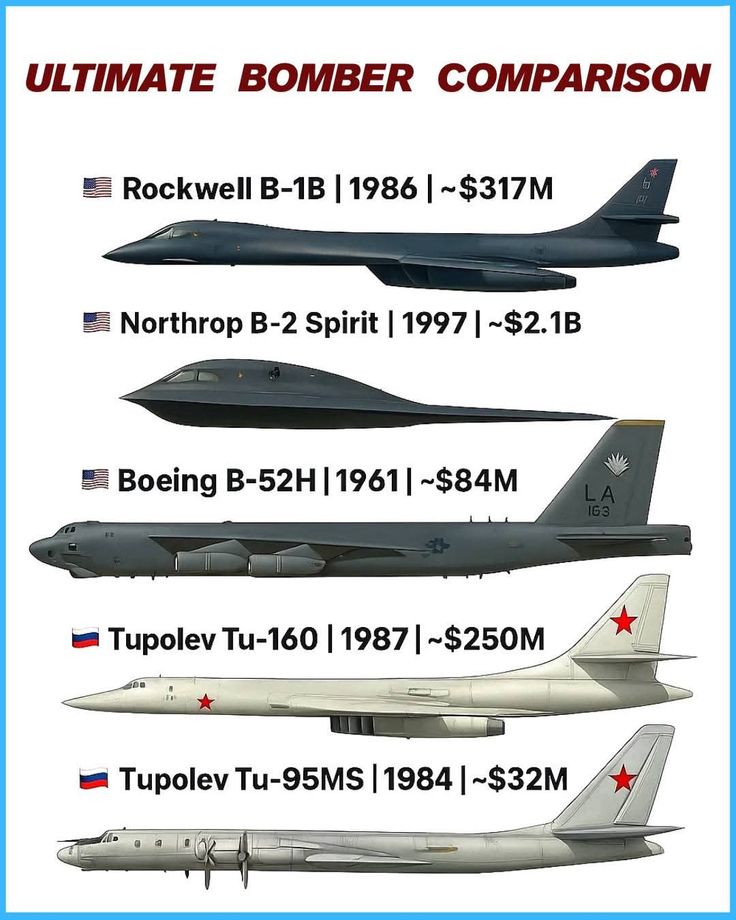
This visually striking infographic, titled “ULTIMATE BOMBER SPIRIT COMPARISON”, presents a side-by-side lineup of five iconic strategic bombers from the United States and Russia. Arranged vertically with national flags, entry-into-service years, and approximate unit costs (in USD), the image highlights dramatic differences in design philosophy—from stealthy flying wings to supersonic variable-sweep wings and enduring turboprop classics. The composite uses realistic renders showing each aircraft in profile, emphasizing size, shape, and distinctive features like swing wings (B-1B, Tu-160), all-wing stealth (B-2), swept wings with eight engines (B-52), and contra-rotating propellers (Tu-95).
The bombers featured are:
- Rockwell B-1B Lancer (USA, 1986, ~$317 million) – Supersonic variable-sweep penetrator in dark camouflage.
- Northrop B-2 Spirit (USA, 1997, ~$2.1 billion) – Iconic flying-wing stealth bomber.
- Boeing B-52H Stratofortress (USA, 1961, ~$84 million) – Legendary eight-engine long-range workhorse with distinctive underwing pods.
- Tupolev Tu-160 Blackjack (Russia, 1987, ~$250 million) – Massive supersonic “White Swan” with swing wings.
- Tupolev Tu-95MS Bear (Russia, 1984, ~$32 million) – Turboprop-powered missile carrier with four massive contra-rotating propellers.
This post functions as a professional tutorial, walking you through the image’s elements step by step, providing historical context, key specifications in a comparison table, operational roles, and 2026 status updates. Ideal for defense analysts, aviation historians, or enthusiasts studying global strategic airpower.
Step 1: Visual Breakdown – Interpreting the Infographic
The layout uses a blue-bordered frame with bold red title text for emphasis. Each bomber includes:
- Flag emoji and manufacturer/nickname.
- Service entry year.
- Approximate flyaway or program unit cost (note: costs are historical estimates and vary by source/inflation).
- Clean profile silhouettes scaled for comparison—note the Tu-160 and B-1B’s variable geometry, B-2’s minimal RCS shape, B-52’s massive wingspan, and Tu-95’s propeller-driven silhouette.
Pro tip: Profile views facilitate direct size and aerodynamic comparisons. The B-2 appears smallest due to its compact flying-wing design optimized for stealth over visible size.
Step 2: Historical and Design Context
These aircraft represent Cold War legacies evolving into modern strategic tools:
- B-1B Lancer: Developed as a low-altitude nuclear penetrator; shifted to conventional precision strike post-Cold War.
- B-2 Spirit: Pure stealth platform for penetrating defended airspace; limited production due to extreme cost.
- B-52H Stratofortress: Iconic survivor from the 1950s; continuous upgrades extend life into the 2050s+.
- Tu-160 Blackjack: Soviet supersonic response to B-1; largest combat aircraft by payload/speed.
- Tu-95MS Bear: Turboprop descendant of 1950s design; excels in long-endurance cruise missile launches.
All remain dual-capable (nuclear/conventional) and integral to nuclear triads.
Step 3: Comprehensive Specifications Comparison Table (2026 Data)
Data compiled from public sources (e.g., USAF fact sheets, manufacturer info, defense analyses); approximate values.
| Aircraft | Country | Entry Year | Approx. Unit Cost | Max Speed | Range (unrefueled) | Payload (max) | Engines | Crew | Fleet Size (2026 est.) | Key Role/Status |
|---|---|---|---|---|---|---|---|---|---|---|
| B-1B Lancer | USA | 1986 | ~$317M | Mach 1.25 | ~5,900 mi | 75,000 lb | 4 × GE F101 turbofans | 4 | ~45 | Conventional precision strike; sustained to 2040+ |
| B-2 Spirit | USA | 1997 | ~$2.1B | Mach 0.95 | ~6,900 mi | 40,000 lb | 4 × GE F118 turbofans | 2 | 19-20 | Stealth penetration; retiring ~2032 for B-21 |
| B-52H Stratofortress | USA | 1961 | ~$84M | Mach 0.86 | ~8,800 mi | 70,000 lb | 8 × PW TF33 (upgrading to Rolls-Royce F130) | 5 | 76 | Long-range standoff; B-52J upgrades ongoing to 2050s+ |
| Tu-160 Blackjack | Russia | 1987 | ~$250M | Mach 2.05 | ~7,600 mi | 88,000 lb | 4 × NK-32 turbofans | 4 | ~20 (incl. modernized Tu-160M) | Supersonic standoff; production resuming slowly |
| Tu-95MS Bear | Russia | 1984 (MS) | ~$32M | ~510 mph | ~9,300 mi | ~44,000 lb | 4 × Kuznetsov NK-12 turboprops | 6-7 | ~45-55 | Cruise missile carrier; enduring despite vulnerabilities |
Notes: Range/payload vary by mission/loadout. Stealth reduces B-2’s detectability significantly. Tu-160 holds records for speed/payload among bombers.
Step 4: Capabilities and Roles – Tutorial Analysis
- Stealth vs. Speed vs. Endurance:
- B-2 excels in penetrating advanced defenses undetected (low RCS via shape/materials).
- Tu-160 and B-1B prioritize supersonic dash for evasion.
- B-52 and Tu-95 focus on standoff (launch missiles from afar) and global reach via refueling.
- Payload & Weapons:
- Tu-160 leads in raw capacity (e.g., Kh-101/102 cruise missiles).
- B-1B carries largest conventional load.
- B-2 specializes in precision (e.g., JDAMs, Massive Ordnance Penetrator).
- B-52/Tu-95 launch long-range cruise missiles (AGM-86, Kh-55/101).
- Modern Relevance (2026):
- USAF transitions: B-21 Raider replaces B-2; B-52J upgrades (new engines/radar) ensure longevity; B-1B sustains conventional ops.
- Russia: Tu-160M modernization + limited new builds; Tu-95MS remains key for standoff but faces attrition risks.
- All face evolving threats (hypersonics, advanced SAMs), shifting emphasis to standoff munitions.
Step 5: Key Takeaways and Future Outlook
This comparison underscores U.S. emphasis on stealth/integration vs. Russia’s focus on speed/raw power and cost-effectiveness. With B-21 emerging and Russia’s PAK DA in development, the era of these Cold War icons continues but evolves.
Use this as a launchpad: Study flight sims, official fact sheets, or defense reports for deeper insights. Which bomber’s design philosophy impresses you most? Comment below!