Fossil Discovery: How Paleontologists Find and Excavate Fossils
Introduction
Paleontologists uncover the ancient past through careful fieldwork that combines geological knowledge, patience, and precise techniques. The process begins with prospecting—searching for promising sites—and progresses to meticulous excavation, documentation, and protective packaging for transport to labs. This methodical approach ensures fossils are recovered with as much contextual information as possible, including their exact position, surrounding rock layers, and associated remains, which are vital for understanding evolutionary history and ancient environments.
Discovering and excavating fossils is labor-intensive, often conducted in remote, arid regions where sedimentary rocks erode to reveal bones or shells. Teams use a range of tools from simple brushes to heavy equipment, always prioritizing minimal damage to delicate specimens.
For a great visual introduction to the entire process, watch this educational video: How are dinosaur fossils discovered and collected? | AMNH (shows prospecting, initial exposure, and jacketing).

(Eroded badlands landscape ideal for fossil prospecting, with colorful rock formations where fossils often weather out on the surface.)
Step 1: Prospecting – Finding Potential Fossil Sites
Paleontologists start by identifying areas with sedimentary rocks of the right age and type, often using geological maps to target exposures like river valleys, cliffs, quarries, or badlands. These locations allow erosion to naturally reveal fossils without deep digging.
Once on site, teams hike slowly while scanning the ground for bone fragments, teeth, or shell pieces eroding out (“float”). Promising clues lead to closer inspection of outcrops or layers.

(Paleontologist prospecting in a desert badlands setting, carefully brushing away sediment to examine potential fossil surfaces.)
Step 2: Initial Exposure and Assessment
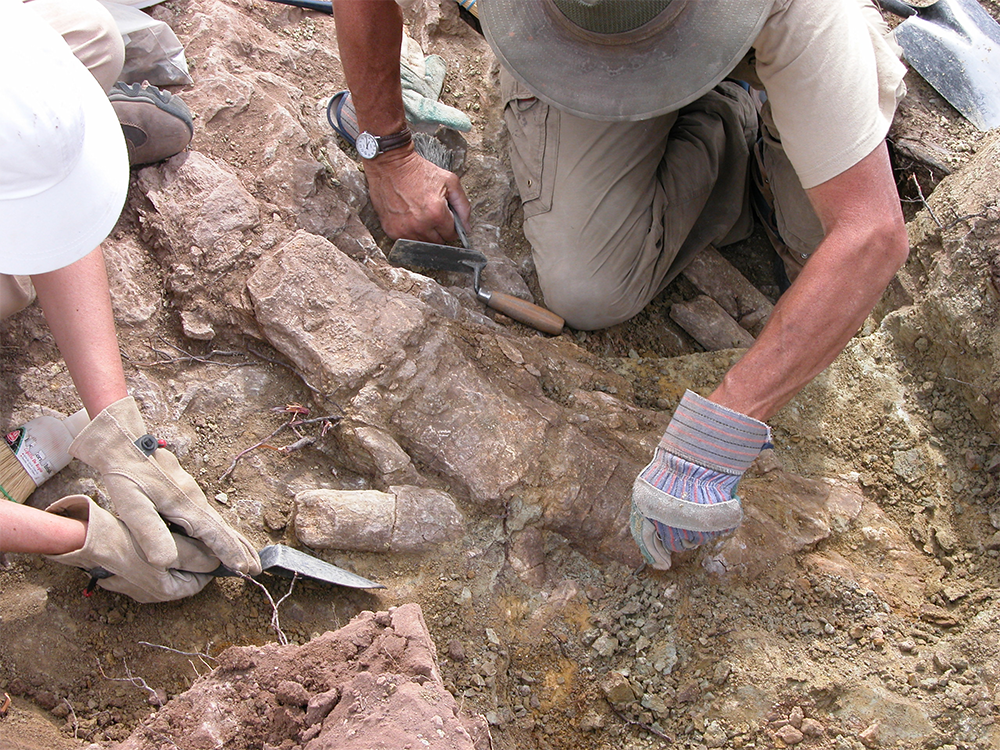
When a fossil fragment is spotted, paleontologists brush away loose dirt to reveal more of the specimen. They use small tools like awls, dental picks, chisels, and rock hammers to carefully remove overlying rock without harming the fossil. Special glue stabilizes cracks.
The team exposes enough to determine the fossil’s extent—whether it’s a single bone or part of a larger skeleton—and decides if it’s worth full excavation.

(Close-up of paleontologists using precise hand tools like trowels and brushes to gently uncover a large fossil bone in the field.)
Step 3: Excavation and Jacketing
For significant finds, a trench is dug around the fossil to create a pedestal of surrounding rock. The exposed surface is mapped, photographed, and gridded for spatial records.
To protect fragile fossils during removal, teams apply a plaster jacket: strips of burlap soaked in plaster of Paris are layered over the specimen and pedestal, often reinforced with wooden supports. Once hardened, the block is undercut, flipped, and jacketed on the bottom side too.
Large specimens may require heavy tools like jackhammers or even helicopters for transport.
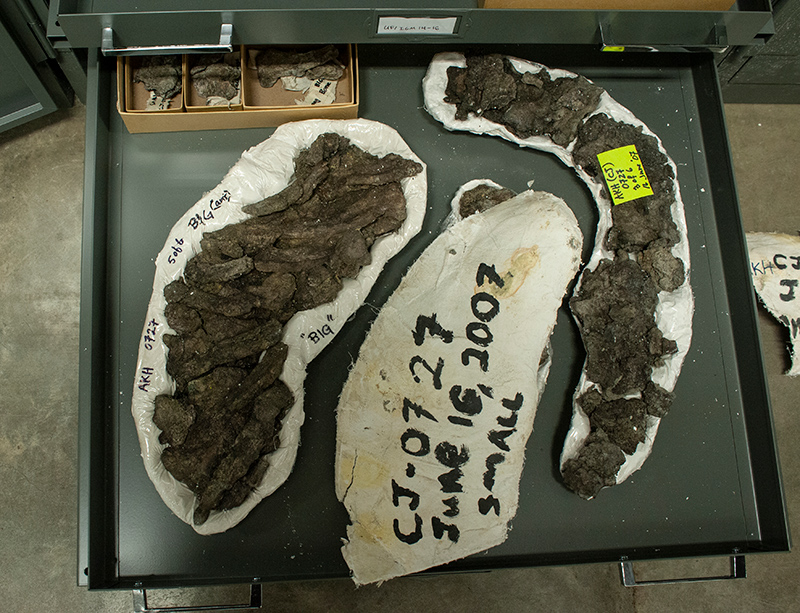
(Team applying plaster bandages to jacket a fossil in the field, creating a protective cast for safe transport.)
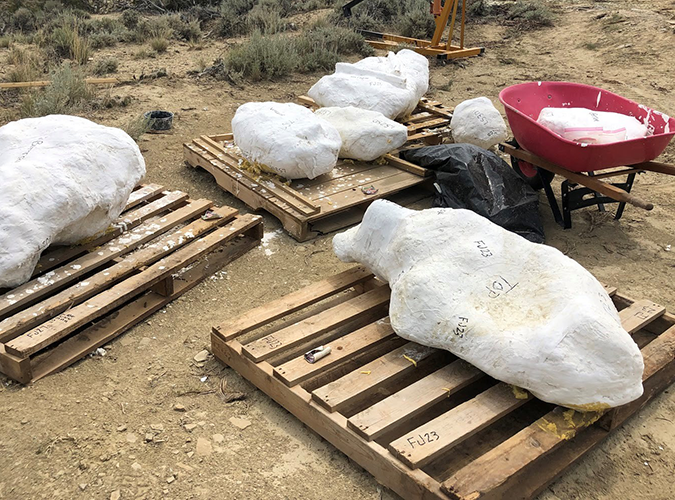
(Multiple large plaster-jacketed fossils ready for transport, secured on wooden pallets in a desert dig site.)
Step 4: Transport and Lab Preparation
Jacketed fossils are carefully packed and shipped to museums or labs. There, preparators use air scribes, needles, and micro-tools to remove remaining matrix under controlled conditions, repairing fragments and revealing fine details.
This lab phase can take months or years, turning field finds into display-quality specimens or research material.
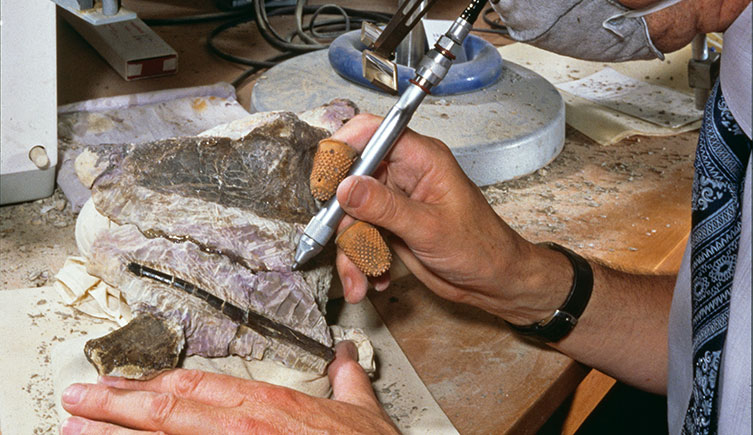
(Fossil preparator in a lab using an air scribe to delicately clean rock matrix from a dinosaur bone.)
Tools of the Trade
Paleontologists rely on a mix of rugged and delicate tools:
- Prospecting: Rock hammers, picks, brushes
- Excavation: Awls, dental picks, trowels, chisels, glue
- Jacketing: Plaster bandages, burlap, water, supports
- Safety: Gloves, hats, GPS, notebooks for documentation
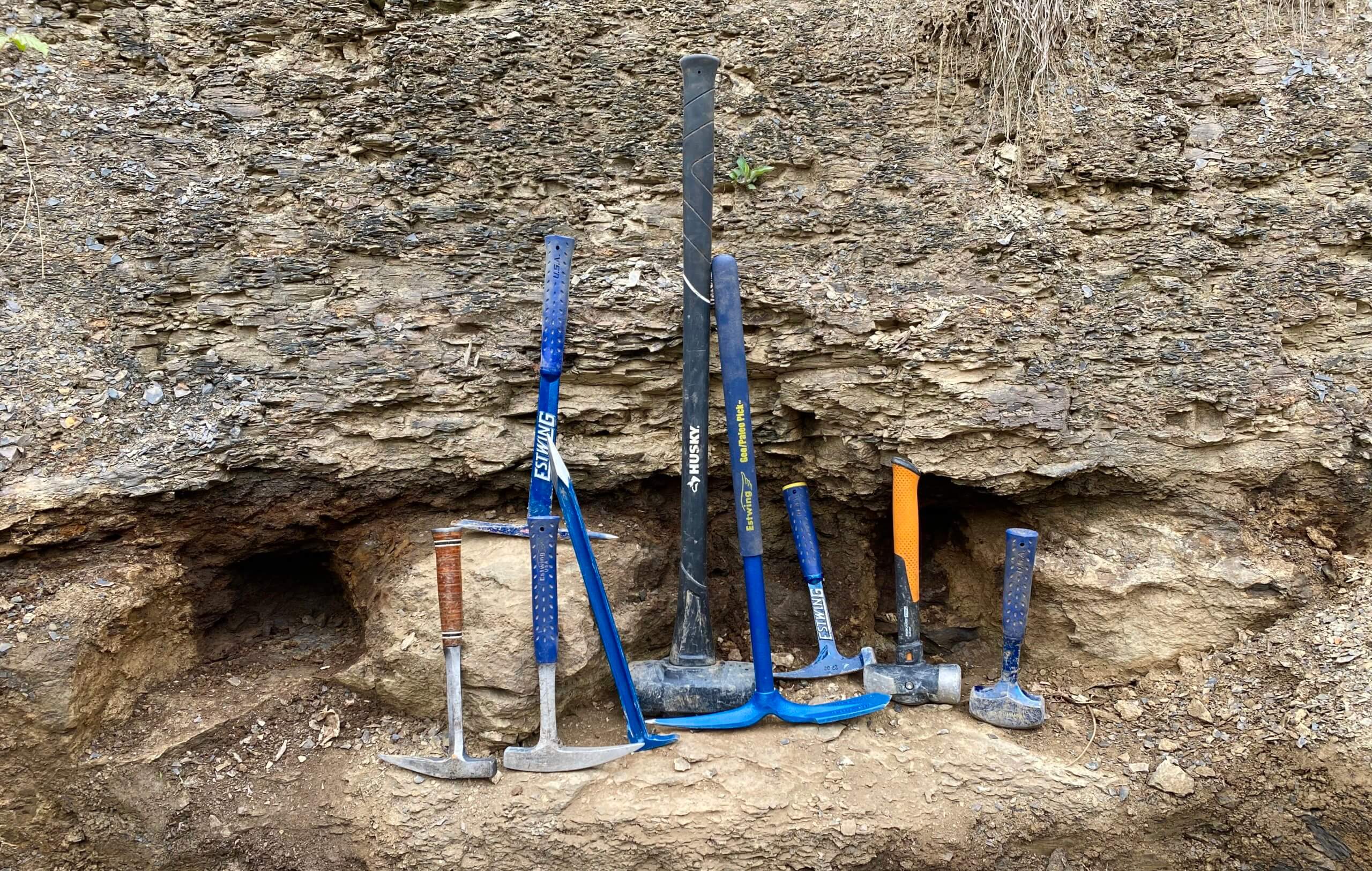
(Array of paleontology tools including rock hammers, picks, and chisels laid out against a sedimentary rock exposure.)
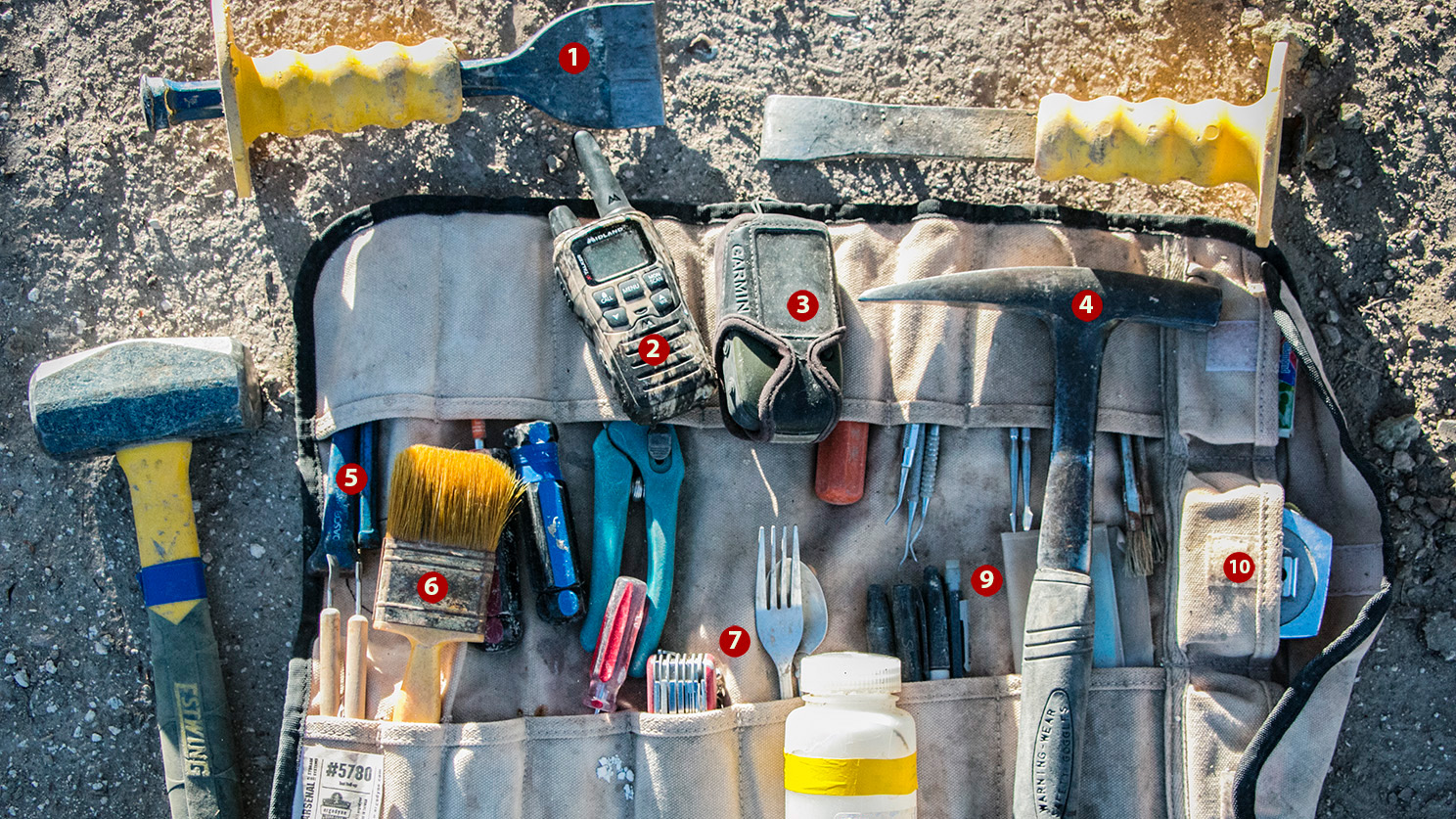
(Organized paleontologist field kit displaying brushes, picks, GPS devices, hammers, and other essential excavation tools.)
Conclusion
Finding and excavating fossils demands scientific expertise, physical endurance, and respect for the irreplaceable record of life. Each discovery adds to our understanding of Earth’s history, from evolutionary transitions to ancient climates. Modern techniques continue to evolve, but the core process—prospecting, careful exposure, protective jacketing, and detailed documentation—remains the foundation of paleontology.
For an in-depth look at real fieldwork, watch: Episode 4: Ask Our Experts: How Do We Dig Up Fossils? (paleontologists explain tools and safe digging methods in the field).