SU-57 vs. F-22: An In-Depth Visual Comparison of Russia’s and America’s Premier Fifth-Generation Stealth Fighters

Description: A Comprehensive Guide to Understanding the SU-57 and F-22 Through Visual Analysis
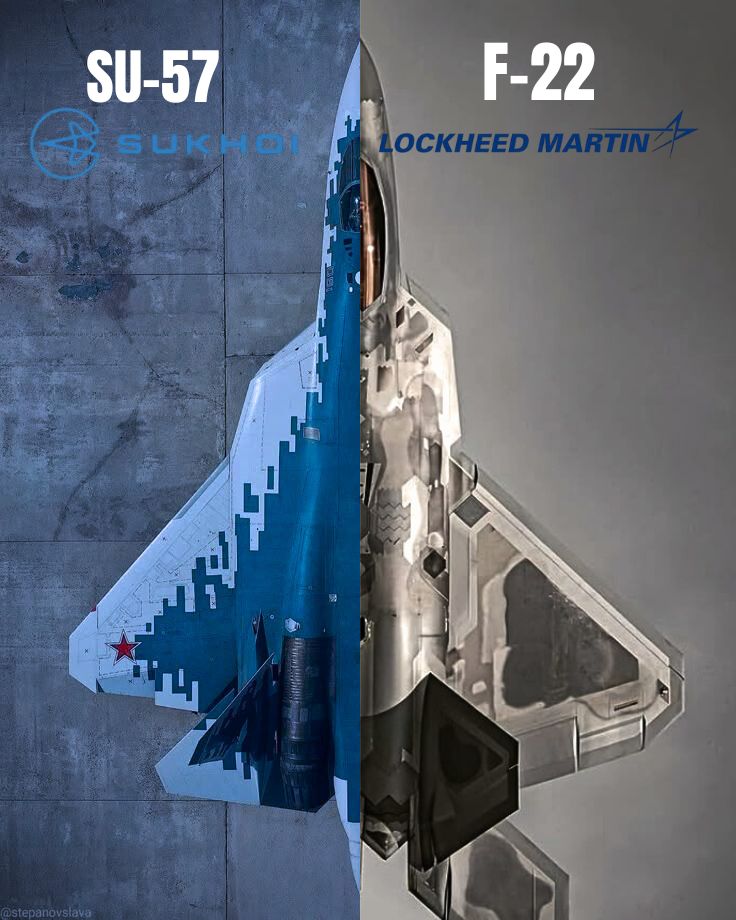
Welcome to this detailed exploration of two of the world’s most advanced fighter jets: the Russian Sukhoi SU-57 (also known as the Felon) and the American Lockheed Martin F-22 Raptor. This guide is inspired by a striking side-by-side image that juxtaposes these aircraft in a dramatic, pixelated artistic style, highlighting their design philosophies, technological prowess, and geopolitical significance. Whether you’re an aviation enthusiast, a military analyst, or simply curious about modern aerial warfare, this post will serve as a tutorial-like breakdown, walking you through the key aspects step by step. We’ll start with an overview of the image itself, then delve into historical context, technical specifications, performance comparisons, and future implications. By the end, you’ll have a thorough understanding of how these jets stack up, all grounded in the visual elements depicted.
Step 1: Analyzing the Image – Visual Breakdown and Artistic Elements
The image you’re seeing (or referencing) is a high-resolution composite that splits the frame vertically down the middle, creating a mirrored effect between the SU-57 on the left and the F-22 on the right. This design choice emphasizes symmetry and contrast, symbolizing the ongoing rivalry between Russian and U.S. aerospace engineering.
- Left Side: Sukhoi SU-57
- The aircraft is rendered in a vibrant blue camouflage with pixelated patterns, evoking a digital or cyber-inspired aesthetic. This could represent the jet’s advanced electronic warfare capabilities or simply an artistic nod to modern stealth technology.
- Key visual details include the red star insignia on the tail, indicative of Russian Air Force markings, and the Sukhoi logo prominently displayed at the top. The jet is shown from a frontal three-quarter view, showcasing its twin-engine configuration, canard foreplanes (small wings near the nose for enhanced maneuverability), and thrust-vectoring nozzles for superior agility.
- The background is a textured concrete wall, adding a gritty, industrial feel that aligns with Russia’s robust military heritage.
- Right Side: Lockheed Martin F-22
- In contrast, the F-22 appears in a sleek, metallic gray stealth coating with angular facets designed to minimize radar cross-section. The pixelation here is subtler, blending into shadows, which visually underscores its emphasis on invisibility over raw power.
- The Lockheed Martin logo sits atop, and the jet is depicted similarly from the front, highlighting its single-seat cockpit, internal weapons bays (to maintain stealth), and distinctive trapezoidal wings. The exhaust nozzles are integrated smoothly, reflecting advanced heat-signature reduction.
- The shared concrete backdrop unifies the image, but the color shift from blue to gray creates a thematic divide, perhaps symbolizing Cold War-era tensions in a modern context.
This artistic rendering, credited to @stepanoslav (likely an digital artist or aviation illustrator), isn’t just eye candy—it’s a tutorial in visual storytelling. It invites viewers to compare shapes, sizes, and styles at a glance. To replicate this analysis yourself, start by zooming in on high-res versions: note how the SU-57’s design prioritizes supermaneuverability (e.g., its forward-swept canards), while the F-22’s focuses on all-aspect stealth (e.g., its sawtooth edges on control surfaces).
Step 2: Historical Context – The Evolution of Fifth-Generation Fighters
To fully appreciate the image’s subjects, let’s trace their origins like a step-by-step history lesson.
- Development of the SU-57:
- Initiated in the early 2000s under Russia’s PAK FA (Prospective Aeronautical Complex of Front-line Aviation) program, the SU-57 first flew in 2010. It was designed as a successor to the SU-27 family, incorporating lessons from Soviet-era agility with modern stealth.
- Key milestones: Prototype testing in 2011, combat deployment in Syria (2018) for real-world evaluation, and full production starting in 2019. As of 2026, Russia has deployed around 20-30 operational units, with exports to countries like Algeria and India under consideration.
- Geopolitical angle: The SU-57 represents Russia’s push to counter Western air superiority, especially amid tensions in Ukraine and the Indo-Pacific.
- Development of the F-22:
- Born from the U.S. Advanced Tactical Fighter (ATF) program in the 1980s, the F-22’s maiden flight was in 1997, entering service in 2005. It was a collaborative effort between Lockheed Martin, Boeing, and Pratt & Whitney.
- Milestones: Production capped at 187 units in 2011 due to high costs (over $150 million per jet), but it has seen action in operations like Inherent Resolve against ISIS. By 2026, upgrades include enhanced sensors and integration with sixth-gen concepts like NGAD (Next Generation Air Dominance).
- Strategic role: The F-22 embodies U.S. doctrine of air dominance, with no exports allowed to maintain technological edge.
Pro Tip: When studying aviation history, cross-reference sources like Jane’s Defence Weekly or official manufacturer sites. This image captures the essence of this rivalry, much like historical posters compared WWII fighters.
Step 3: Technical Specifications – A Side-by-Side Comparison
For a tutorial-style deep dive, let’s use a structured table to compare key specs. These are based on publicly available data as of 2026; note that classified details (e.g., exact radar cross-sections) remain secretive.
| Aspect | Sukhoi SU-57 | Lockheed Martin F-22 |
|---|---|---|
| Manufacturer | Sukhoi (United Aircraft Corporation, Russia) | Lockheed Martin (USA) |
| First Flight | 2010 | 1997 |
| Entry into Service | 2020 | 2005 |
| Length | 20.1 m (66 ft) | 18.9 m (62 ft) |
| Wingspan | 14.1 m (46 ft) | 13.6 m (44.6 ft) |
| Height | 4.6 m (15.1 ft) | 5.1 m (16.7 ft) |
| Empty Weight | 18,000 kg (39,683 lb) | 19,700 kg (43,430 lb) |
| Max Takeoff Weight | 35,000 kg (77,162 lb) | 38,000 kg (83,500 lb) |
| Engines | 2 × Saturn AL-41F1 turbofans (with thrust vectoring) | 2 × Pratt & Whitney F119-PW-100 turbofans (with thrust vectoring) |
| Max Speed | Mach 2.0 (2,140 km/h; 1,330 mph) | Mach 2.25 (2,414 km/h; 1,500 mph) |
| Combat Radius | 1,500 km (932 mi) | 850 km (528 mi) on internal fuel |
| Service Ceiling | 20,000 m (65,617 ft) | 20,000 m (65,617 ft) |
| Armament | Internal bays for up to 6 missiles; external hardpoints for additional weapons (e.g., R-77, Kh-59 missiles) | Internal bays for 6 AMRAAM missiles + 2 AIM-9; 20mm cannon |
| Stealth Features | Reduced radar cross-section (RCS) via composite materials and S-duct intakes; estimated RCS 0.1-1 m² | Superior all-aspect stealth with RCS ~0.0001 m²; radar-absorbent materials |
| Avionics | N036 Byelka AESA radar; IRST for passive detection | AN/APG-77 AESA radar; advanced sensor fusion |
| Crew | 1 (single-seat) | 1 (single-seat) |
| Unit Cost | ~$35-50 million | ~$150 million (production cost) |
| Number Built | ~76 (including prototypes, as of 2026) | 195 (including prototypes) |
This table highlights the SU-57’s edge in range and cost-effectiveness versus the F-22’s superior stealth and speed. To analyze specs like this in your own research, start with reliable databases like the Federation of American Scientists or Scramble Magazine, and verify with recent updates.
Step 4: Performance and Capabilities – Operational Insights
Building on the visuals, let’s tutorialize their real-world strengths.
- Stealth and Survivability:
- The F-22’s angular design (evident in the image’s sharp edges) makes it nearly invisible to radar, allowing first-strike advantages. Tutorial tip: Stealth is about more than shape—it’s radar-absorbent coatings and internal weapons to avoid drag.
- The SU-57, while stealthy, relies on speed and maneuverability; its canards (visible in the pixelated blue) enable post-stall maneuvers like the Pugachev’s Cobra.
- Maneuverability and Speed:
- SU-57’s 3D thrust vectoring (nozzles twisting in the image) allows supermaneuverability at airshows. Step-by-step: In dogfights, this means tighter turns—practice visualizing with flight sims like DCS World.
- F-22 matches with 2D vectoring but excels in supercruise (sustained supersonic without afterburners).
- Sensors and Weapons:
- Both feature AESA radars for multi-target tracking. The SU-57’s side-mounted arrays provide 360-degree coverage, a feature the image’s frontal view hints at through its nose design.
- Weapons: F-22 focuses on air-to-air dominance; SU-57 is multirole, including ground strikes.
Step 5: Future Implications and Geopolitical Context
As of 2026, the F-22 remains unmatched in stealth, but the SU-57’s production ramps up amid global tensions. This image symbolizes a shifting balance—Russia’s affordable exports vs. U.S. high-tech exclusivity. For further study, explore upgrades: SU-57M with new engines, F-22’s Block 40 enhancements.
In conclusion, this visual comparison isn’t just art; it’s a gateway to understanding fifth-gen aviation. Use this guide as a starting point—dive deeper with simulations, documentaries, or museum visits. If you have questions or want to compare other jets, comment below!