The Evolution of Iconic U.S. Fighter Jets: From WWII Legends to Modern Masters – P-38 to F-35, P-47 to A-10, P-61 to F-117

Description: A Detailed Tutorial on the Legacy and Technological Progression of American Fighter Aircraft Through Namesake Lineages
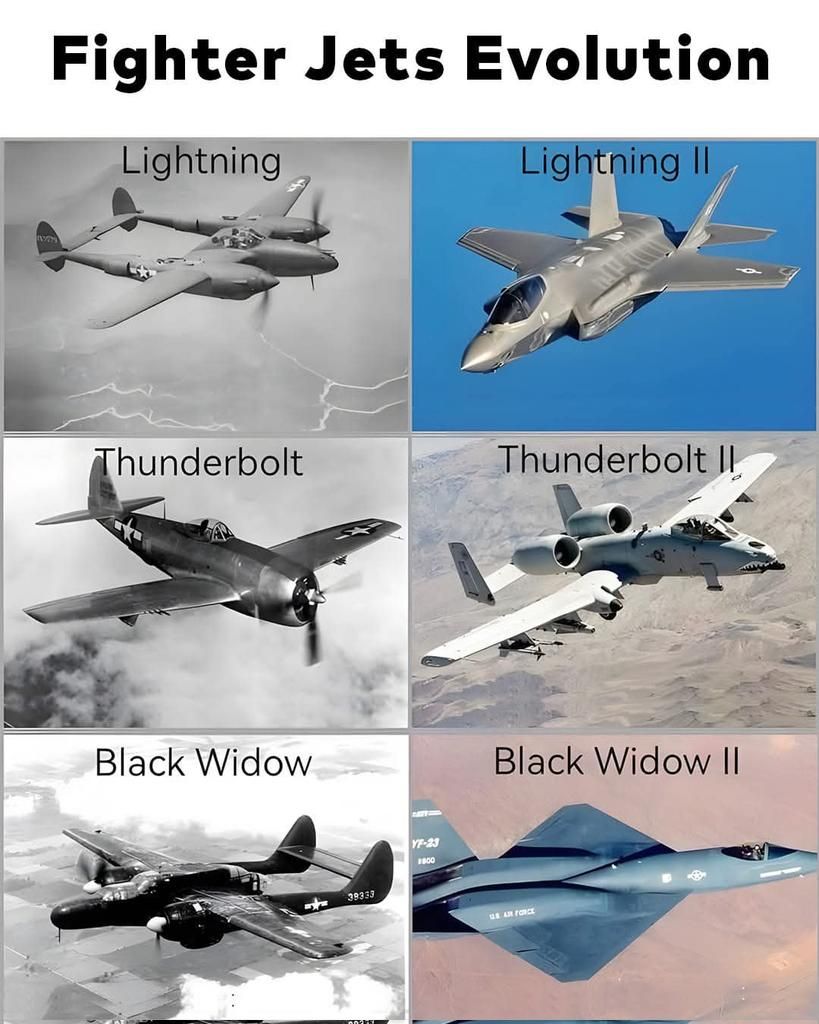
This post explores the remarkable evolution of U.S. fighter aviation as captured in this striking comparative image. By pairing three legendary World War II aircraft with their modern counterparts sharing the same evocative names, it demonstrates how design philosophies, engineering challenges, and battlefield requirements have transformed over decades. We’ll break it down step by step—like a comprehensive tutorial—covering historical context, key design features, performance contrasts, and operational legacies. This visual and analytical guide is ideal for aviation enthusiasts, historians, students of military technology, or anyone interested in how yesterday’s innovations inspire today’s cutting-edge fighters.
Step 1: Understanding the Visual Structure and Symbolism
The image employs a symmetrical 3×2 grid to create instant visual impact:
- Historical aircraft (left column) appear in timeless black-and-white, evoking nostalgia and the era of analog warfare.
- Modern successors (right column) burst in full color, symbolizing advanced materials, digital systems, and stealth coatings.
- Each pair shares a thematic name, underscoring deliberate homage by designers and the U.S. military to honor proven performers while pushing boundaries.
Pro tip for analysis: When viewing similar composites, zoom in on silhouettes—note how twin-boom designs (P-38, P-61) give way to blended-wing or faceted stealth shapes, and how propellers yield to turbofans or afterburning engines.
Step 2: Lightning Lineage – P-38 Lightning to F-35 Lightning II
- P-38 Lightning (1941–1945 operational peak): Lockheed’s innovative twin-engine, twin-boom heavy fighter excelled in the Pacific theater. It featured a central nacelle for the pilot and armament (including a concentrated battery of machine guns and cannons), achieving top speeds around 414 mph (666 km/h) and serving in interception, ground attack, and reconnaissance roles. Over 10,000 built; aces like Richard Bong scored heavily with it.
- F-35 Lightning II (operational since 2015+): Lockheed Martin’s fifth-generation stealth multirole fighter, with variants for Air Force (A), STOVL Marine (B), and carrier Navy (C). It boasts sensor fusion, network-centric warfare, internal weapons bays for low observability, and Mach 1.6+ supercruise capability in some profiles. Unit cost varies by variant (~$80–110 million); thousands planned across allies.
- Evolution highlights: From twin-piston engines and manual controls to a single Pratt & Whitney F135 turbofan with advanced thrust vectoring (in F-35B), radar-absorbent materials, and helmet-mounted displays. The name revival in 2006 honors the P-38’s pioneering spirit in multi-mission versatility and technological edge.
Tutorial exercise: Compare range—P-38 ~1,300 miles with drop tanks vs. F-35’s internal-fuel combat radius of 600+ nautical miles—illustrating shifts from long-range escort to stealthy penetration strikes.
Step 3: Thunderbolt Lineage – P-47 Thunderbolt to A-10 Thunderbolt II
- P-47 Thunderbolt (1943–1945): Republic’s massive single-engine fighter-bomber, nicknamed “Jug,” was famed for durability (radial engine survived heavy damage) and firepower (eight .50-cal machine guns). Top speed ~433 mph (697 km/h); excelled in ground attack and bomber escort over Europe.
- A-10 Thunderbolt II (1977–present): Fairchild Republic’s (now Boeing) dedicated close air support platform, built around the 30mm GAU-8 rotary cannon (1,174 rounds, titanium “bathtub” armor for pilot protection). Twin TF34 turbofans enable low/slow flight; subsonic but highly maneuverable at treetop level.
- Evolution highlights: Shared emphasis on toughness and ground-attack primacy. The P-47’s rugged radial evolved conceptually into the A-10’s redundant systems and titanium armor. The name pays tribute to the P-47’s WWII ground-pounding legacy, with the A-10 proving invaluable in conflicts from Desert Storm to modern counter-insurgency.
Tutorial comparison: Firepower focus—P-47’s machine guns and bombs vs. A-10’s cannon (designed to defeat Soviet armor) plus precision-guided munitions today. Survivability remains key: both absorb punishment that would down lesser aircraft.
Step 4: Black Widow Lineage – P-61 Black Widow to F-117 Nighthawk (as “Black Widow II”)
- P-61 Black Widow (1944–1950s): Northrop’s pioneering night fighter, the first U.S. aircraft designed specifically for all-weather/night interception. Twin-engine, twin-boom with airborne radar, four 20mm cannons, and dorsal turret; claimed ~127 aerial victories, including V-1 buzz bombs.
- F-117 Nighthawk (1983–2008 operational): Lockheed’s groundbreaking stealth attack aircraft (often mislabeled “fighter” due to “F” designation). Faceted design minimized radar cross-section; internal bays for precision-guided bombs. No guns or air-to-air capability—pure stealth strike platform.
- Evolution highlights: From radar-guided night interception to full-spectrum stealth denial of detection. The “Black Widow II” moniker (unofficial but evocative) links the P-61’s nocturnal stealth pioneering to the F-117’s radar-evading faceting. (Note: Some sources apply “Black Widow II” to the YF-23 prototype, but the image aligns with F-117’s stealth legacy.)
Tutorial insight: Night/all-weather ops advanced from onboard radar + human eyes to passive stealth + infrared/EO targeting, revolutionizing survivability in contested airspace.
Step 5: Broader Lessons in Fighter Evolution
This image encapsulates generational shifts:
- Propulsion: Piston → jet/turbofan.
- Stealth/Survivability: Armor + speed → low-observable shaping + materials.
- Avionics: Basic radar → sensor fusion, data links, AI-assisted targeting.
- Roles: Specialized (night fighter, ground attack) → multirole dominance.
As of 2026, these legacies continue: F-35 expands globally, A-10 receives upgrades amid retirement debates, and stealth principles influence sixth-generation programs like NGAD.
Use this as a starting point—explore flight simulators (e.g., DCS World), visit museums (P-38/P-61 examples exist), or review declassified docs for deeper dives. Share your thoughts: Which evolution surprises you most?