Art Warm-Ups: 5 Exercises to Get Your Creativity Flowing Before You Draw
Before you dive into your main drawing project, it’s always a good idea to warm up your hands, eyes, and mind. Just like an athlete stretches before a workout, artists benefit from exercises that loosen up their muscles and get their creative juices flowing. These warm-ups aren’t about creating a masterpiece; they’re about building confidence, improving control, and having fun!
Let’s get started with five effective warm-up exercises:
1. Continuous Line Drawing
This exercise is fantastic for improving hand-eye coordination and getting comfortable with your drawing tool. The goal is to draw an object or scene without lifting your pen or pencil from the paper.
How to do it:
-
Choose a simple object in your surroundings (a cup, your hand, a plant).
-
Place your drawing tool on the paper.
-
Begin drawing the contours of the object, letting your eye guide your hand.
-
Resist the urge to lift your pen! If you need to move to another part of the object, find a path to connect the lines.
-
Don’t worry about perfection; focus on the flow and observation.
Why it works: It forces you to really look at your subject and simplifies complex forms into a continuous movement.
Here’s an example of what a continuous line drawing might look like:
2. Scribble Warm-Up
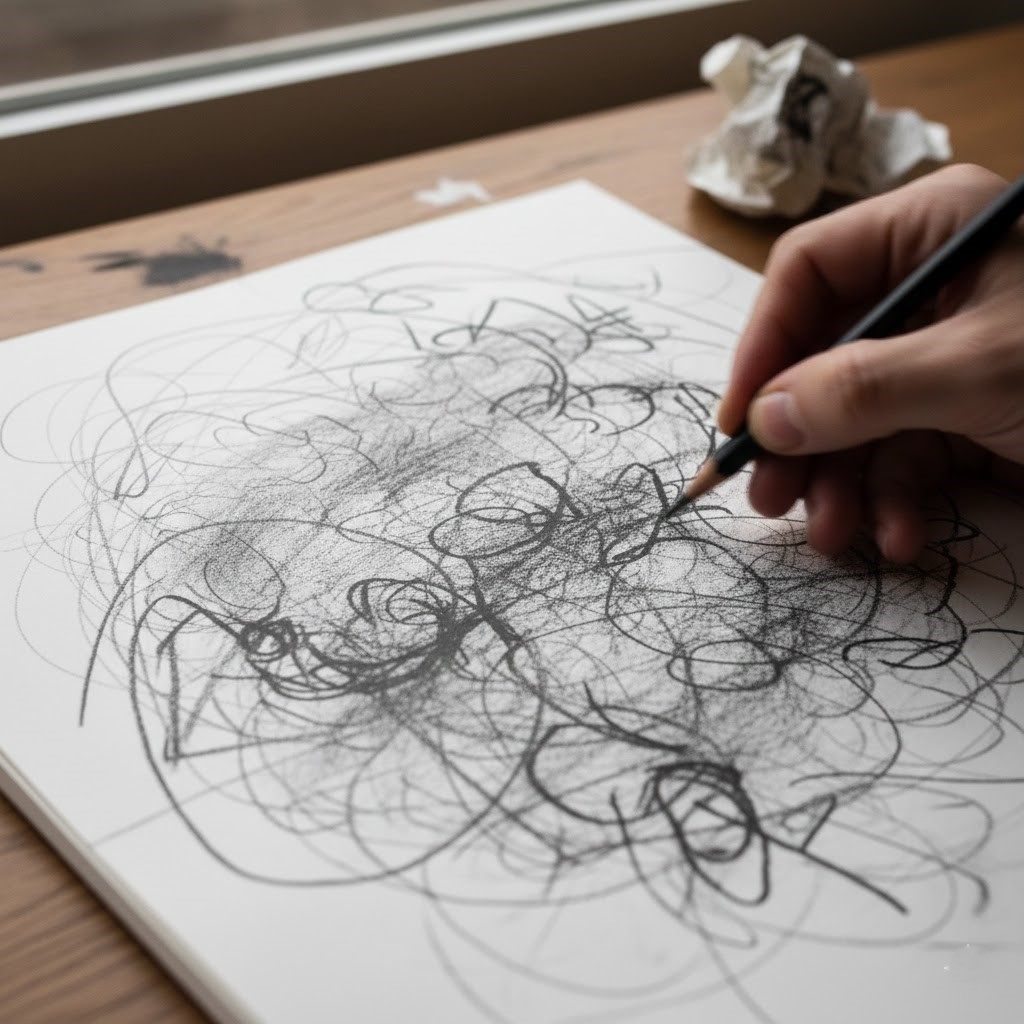
Sometimes, you just need to make a mess! The scribble warm-up is about letting go of precision and focusing on movement and pressure.
How to do it:
-
Take your drawing tool and just start scribbling on a piece of paper.
-
Vary your pressure: draw light, feathery lines and then press down for dark, bold ones.
-
Make large, sweeping gestures across the page, and then smaller, tighter marks.
-
Experiment with different speeds.
-
You can even try to form abstract shapes or textures within your scribbles.
Why it works: It releases tension, helps you explore the full range of your drawing tool, and gets your arm and wrist moving freely.
Imagine your page filling up with energetic, varied scribbles like this:

3. Basic Shape Repetition
This exercise is fantastic for developing consistency, control, and muscle memory. It’s all about drawing simple shapes repeatedly.
How to do it:
-
Circles: Draw rows of circles. Try to make them as round and consistent as possible. Then, try drawing them freehand, varying their size.
-
Squares/Rectangles: Practice drawing squares and rectangles, aiming for straight lines and accurate corners.
-
Parallel Lines: Draw parallel lines, trying to keep the distance between them consistent. Try both vertical, horizontal, and diagonal lines.
-
Hatching/Cross-Hatching: Practice creating even shading with hatching (parallel lines) and cross-hatching (intersecting parallel lines).
Why it works: It builds foundational drawing skills, improves precision, and helps you gain better control over your strokes.
Here’s an illustration of basic shape repetition for practice:

4. Mirror Drawing (Non-Dominant Hand)
This is a fun and challenging exercise that really gets your brain working! It’s about developing ambidexterity and breaking out of your usual drawing habits.
How to do it:
-
Take two pencils or pens, one in each hand.
-
Place them on a piece of paper, ideally with a folded line down the middle or two separate sheets.
-
Simultaneously draw the same simple shape or line with both hands, mirroring each other’s movements. For example, both hands draw a circle outwards from the center, or both draw a wavy line.
-
You can also try drawing different shapes with each hand, though this is much harder!
Why it works: It activates different parts of your brain, improves coordination, and helps you become more aware of your drawing movements. It’s also a great way to challenge yourself!
Imagine the coordination required for this: