Unveiling the Tyrannosaurus Rex: A Comprehensive Guide to the King of Carnivores Exhibit at the American Museum of Natural History

Description: An In-Depth Educational Exploration
Welcome to this detailed tutorial-style guide on one of the most iconic dinosaur exhibits in the world: the Tyrannosaurus rex skeleton, often hailed as the “King of Carnivores,” prominently displayed at the American Museum of Natural History (AMNH) in New York City. Based on the captivating image provided, which showcases a dramatically posed fossil skeleton in a glass-enclosed display with a lush prehistoric backdrop and an informative placard, we’ll delve into every aspect of this remarkable specimen. This guide is designed like a step-by-step tutorial to help you understand the history, science, and cultural significance of T. rex, whether you’re a student, educator, paleontology enthusiast, or casual visitor planning a museum trip. We’ll break it down into structured sections for easy navigation, complete with key facts, visual descriptions, and insights to enhance your appreciation of this prehistoric predator.
Step 1: Visual Analysis of the Exhibit – What the Image Reveals
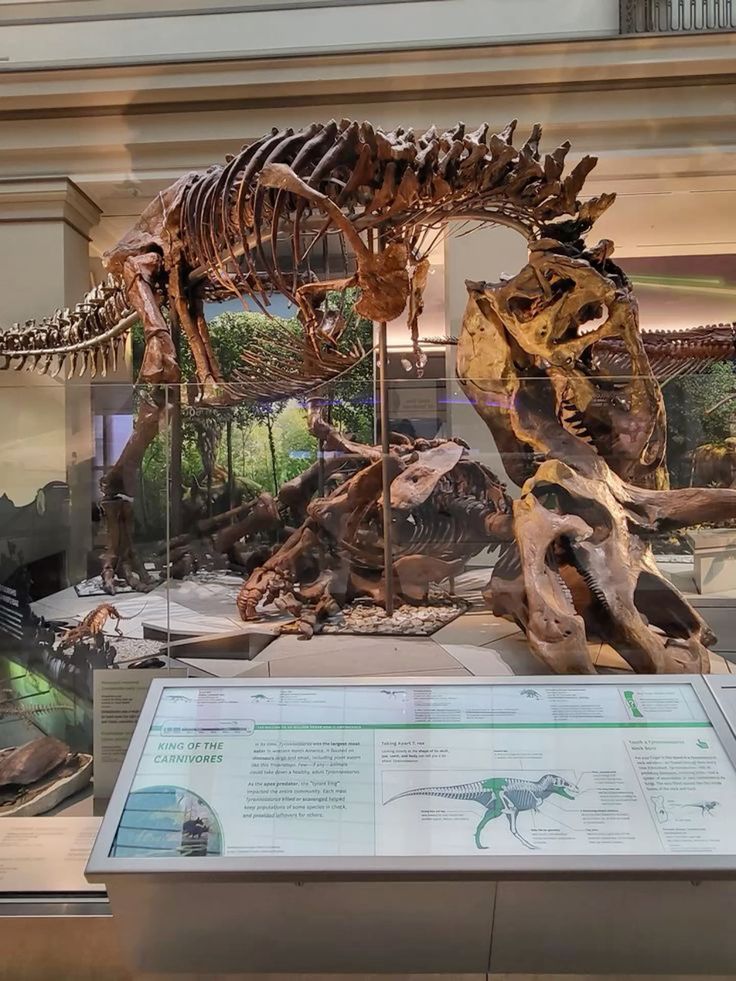
Start by examining the image closely, as it captures the essence of the T. rex display in the Hall of Saurischian Dinosaurs at the AMNH. The skeleton is mounted in a dynamic, stalking pose: its massive skull is lowered near the ground, jaws agape revealing sharp, serrated teeth, while its long tail extends backward for balance, and one foot is slightly raised as if mid-stride. This posture, adjusted by museum scientists for accuracy, conveys the agility and predatory nature of T. rex rather than the outdated upright stance seen in early reconstructions.
The fossil appears brownish in tone, indicative of real bone material preserved over millions of years, suspended with subtle supports to maintain its form. In the foreground, a detached skull rests on the exhibit floor, allowing visitors a close-up view of the powerful jaws and eye sockets. Surrounding the skeleton is a diorama-like background featuring green foliage and a misty prehistoric landscape, evoking the Late Cretaceous environment where T. rex roamed.
At the base, a digital placard reads “KING OF THE CARNIVORES,” accompanied by diagrams highlighting the dinosaur’s anatomy, such as its skeletal structure, bite force, and comparisons to other species. Smaller elements include a model of a smaller dinosaur or prey item nearby, emphasizing T. rex’s role as an apex predator. This setup not only educates but immerses viewers, making it a highlight for over a million annual visitors. If you’re viewing this on a website, imagine standing before this 40-foot-long behemoth – the image’s perspective from below accentuates its intimidating scale, with the spine arching gracefully and tiny forelimbs dangling comically short.

Step 2: Historical Context – Discovery and Assembly of the Specimen
To fully appreciate the exhibit, let’s trace its origins like a historical tutorial. The story begins in 1902 when legendary fossil hunter Barnum Brown, working for the AMNH, unearthed the first T. rex skeleton in Hell Creek, Montana. This initial find was partial, but in 1908, Brown struck gold at Big Dry Creek, Montana, discovering a nearly complete specimen (cataloged as AMNH 5027) with an exceptionally preserved skull. To extract it, the team even used dynamite, revealing what Brown described as a “magnificent specimen.”
Assembly at the museum was a pioneering effort. In 1915, the skeleton was first mounted in the Hall of Saurischian Dinosaurs in an upright pose, supported by metal rods to bear its several-ton weight. This was the only complete T. rex on display worldwide for nearly 25 years, captivating the public and influencing early media. By the late 20th century, advances in paleontology led to a remounting in the current stalking position, reflecting better understanding of dinosaur biomechanics – head low for hunting, tail as a counterbalance.
Key tutorial tip: When researching dinosaur history, always cross-reference primary sources like museum archives. The AMNH’s T. rex has shaped pop culture, inspiring Charles Knight’s illustrations, films like King Kong (1933) and Fantasia (1940), and even the design in Michael Crichton’s Jurassic Park novel, where the cover art drew from this very skeleton’s unique “bump” on the ectopterygoid bone.
Step 3: Physical Characteristics – Anatomy Breakdown
Now, let’s dissect the T. rex’s anatomy as if conducting a virtual lab tutorial, using the image as our reference point. T. rex, meaning “tyrant lizard king,” was one of the largest theropod dinosaurs, measuring up to 40 feet (12 meters) in length, 12 feet (3.7 meters) tall at the hips, and weighing 7-9 tons. The exhibit skeleton is about 45% real fossils from AMNH 5027, with casts filling in gaps – for instance, the humerus and femur are replicas from the 1902 find.
Focus on the skull in the image: It’s 4 feet (1.2 meters) long, armed with 60 conical teeth up to 8-12 inches (20-30 cm) long, serrated like steak knives for tearing flesh. The bite force was immense – around 12,800 pounds per square inch, three times that of a lion and capable of crushing bone. Notice the tiny arms? Each is about 3 feet (1 meter) long with two clawed fingers, likely used for grasping during mating or rising from a resting position, not for hunting.
The body structure reveals agility: A long, muscular tail (visible arching in the image), powerful hind legs with three-toed feet (sculpted based on Allosaurus references but accurately proportioned), and a barrel-shaped chest supported by robust ribs. Evidence of life’s battles includes fused vertebrae at the neck and lower back, plus healed broken ribs, suggesting injuries from fights or falls. Modern reconstructions, informed by this fossil, depict T. rex as svelte and possibly feathered in youth, with adults potentially sporting wiry fluff for insulation.
Tutorial exercise: Compare this to other dinosaurs. T. rex’s skull features large fenestrae (openings) for lighter weight and muscle attachment, unlike the solid skulls of herbivores like Triceratops, which it preyed upon.
Step 4: Scientific Facts and Insights – Evolutionary and Behavioral Details
Building on the basics, this section serves as an advanced tutorial on T. rex paleobiology. T. rex lived 68-66 million years ago during the Late Cretaceous Period in what is now western North America, thriving in forested river valleys. As an apex predator, it hunted large herbivores like Edmontosaurus and Triceratops, using ambush tactics with speeds up to 12-25 mph (19-40 km/h) in short bursts – not a marathon runner, but a powerful sprinter.
Fascinating facts from studies of AMNH 5027 and other specimens:
- Growth and Lifespan: T. rex grew rapidly, reaching full size by age 20, with a lifespan of about 28-30 years. Juveniles were slender and fast, while adults bulked up for dominance.
- Senses: Binocular vision (forward-facing eyes) provided depth perception for hunting, and a keen sense of smell rivaled modern vultures.
- Diet and Hunting: Coprolites (fossilized feces) contain crushed bone, confirming it swallowed chunks whole. Debates rage on whether it was a pure predator or scavenger – evidence like bite marks on prey bones supports active hunting.
- Extinction: T. rex vanished in the Cretaceous-Paleogene event, likely from an asteroid impact, marking the end of non-avian dinosaurs.
Unique to this exhibit: The ectopterygoid bone “bump” in the jaw, a natural variation like a birthmark, enhances bite force understanding and has become a cultural icon.
Tutorial tip: For deeper study, use tools like CT scans (as done on T. rex fossils) to reveal brain size – about walnut-sized, but with enlarged olfactory regions for tracking prey.
Step 5: Cultural and Educational Significance – Why This Exhibit Matters
As we wrap up this tutorial, consider the broader impact. The AMNH T. rex isn’t just a fossil; it’s a gateway to science education. Seen by millions, it sparks curiosity in STEM fields, from biology to geology. Its influence extends to media – think Godzilla or Jurassic World – often drawing directly from this mount.
If posting this on a website, include calls to action: Visit the AMNH (open daily 10 AM–5:30 PM) for an in-person experience, or explore virtual tours. For educators, incorporate activities like sketching the skeleton from the image or debating T. rex behaviors in classrooms.
In summary, the “King of the Carnivores” exhibit encapsulates the awe of paleontology. By following this guide, you’ve gained a professional-level understanding of T. rex, from its Montana origins to its museum majesty. Whether inspired by the provided image or planning a visit, remember: This dinosaur reminds us of Earth’s dynamic history and the thrill of discovery. For more resources, consult AMNH publications or peer-reviewed journals on tyrannosaurids.