Mastering Fabric Structure in Drawing: A Comprehensive Tutorial

Elevate your artistic skills with our detailed tutorial on rendering fabric structure, inspired by an intricate reference image from zheng. Designed for artists of all levels, this guide offers a professional, step-by-step approach to capturing the texture, folds, and movement of fabric in various forms. As of 03:45 AM EST on Saturday, November 15, 2025, this lesson provides practical techniques to enhance your figure drawing and still-life sketches with realistic fabric representation, making it an essential resource for both beginners and advanced artists.
Understanding Fabric Structure and Movement
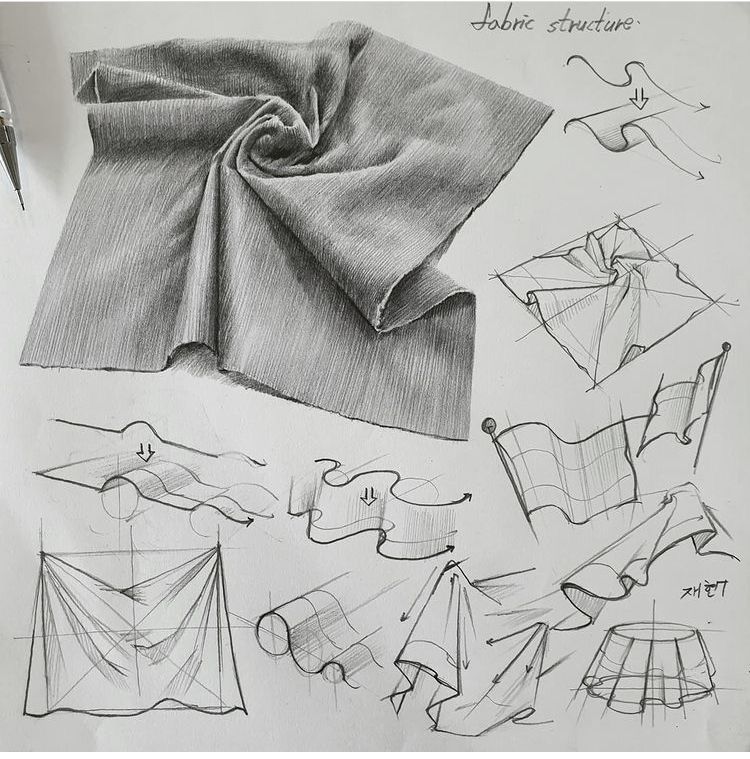
The tutorial begins with an exploration of fabric’s natural behavior, using a real cloth sample and detailed sketches to illustrate key principles. The reference image features a twisted fabric piece, showcasing how light and shadow define its texture, alongside sketches of draped, rolled, and flag-like forms. Annotations highlight the direction of folds and the importance of understanding tension points, such as where fabric bends over edges or stretches across surfaces. This foundational knowledge sets the stage for accurately depicting fabric in dynamic poses or static compositions.
Step-by-Step Drawing Process
- Observe the Base Shape: Start by studying the fabric’s overall form, as seen in the twisted cloth example, noting its primary curves and folds.
- Sketch Initial Guidelines: Draw light lines to map the outer edges and key fold directions, using the reference’s arrows to guide the flow, as shown in the draped fabric sketch.
- Define Folds and Tension: Add detailed lines to represent major folds, following the natural creases and tension points, such as those on the rolled fabric or flag examples.
- Incorporate Texture: Use cross-hatching or stippling to replicate the fabric’s texture, mirroring the shaded areas in the real cloth and sketch variations.
- Refine and Shade: Enhance depth with gradual shading, adjusting for light sources and overlap, as demonstrated in the conical and flat fabric sketches.
Practical Tips for Artists
- Use References: Regularly consult the real fabric and sketch examples to study fold patterns and light effects.
- Practice Flow: Focus on drawing continuous, flowing lines to capture the fabric’s movement, as seen in the flag and drape sketches.
- Experiment with Angles: Try different perspectives, like the twisted or rolled forms, to understand how fabric behaves in three dimensions.
- Tool Suggestion: Use a range of pencils (e.g., HB for outlines, 2B-4B for shading) and a blending stump for smooth gradients, as implied by the reference’s rendering.
Enhancing Realism and Depth
The tutorial emphasizes the interplay of light and shadow to create a three-dimensional effect, a technique vividly illustrated in the shaded cloth sample. The sketches of various fabric configurations—draped over a frame, rolled into a cylinder, or waving like a flag—demonstrate how to adapt drawing methods to different scenarios. Arrows in the reference guide the direction of folds, encouraging artists to consider tension and gravity, while the grid-like structure in some sketches aids in maintaining proportion and perspective.
This tutorial is an invaluable resource for artists aiming to master fabric drawing. Leverage the detailed visuals and practical advice from the reference image to refine your skills. Explore our ongoing series on figure drawing and still-life techniques for more inspiration. Happy sketching!
This professionally crafted post is tailored for a website, providing a thorough and accessible tutorial based on the uploaded image, with a focus on practical application and skill development as of the current date and time.