Anatomy Basics Every Artist Should Learn
Understanding human anatomy is essential for creating believable, dynamic, and expressive figures—whether you’re drawing realism, comics, animation, or stylized characters. You don’t need to memorize every bone and muscle like a medical student; artists focus on practical anatomy: proportions, major forms, key landmarks, and how the body moves and balances.
These basics build a strong foundation so your figures feel solid, alive, and consistent—even from imagination.
1. Basic Proportions (The 8-Head Canon)
The average adult human body is about 7.5–8 heads tall (using the head as a unit of measurement). This is the classic “ideal” proportion used by artists since the Renaissance.
- Head: 1 unit
- Torso (from chin to crotch): ~3 heads
- Legs: ~4 heads
- Arms: Reach to mid-thigh when standing straight
- Shoulders: ~2 heads wide
- Pelvis: Slightly wider than shoulders in females, narrower in males
Variations exist (fashion uses 8–9 heads for elongated figures; children are 4–6 heads). Always use the head unit to check proportions quickly.
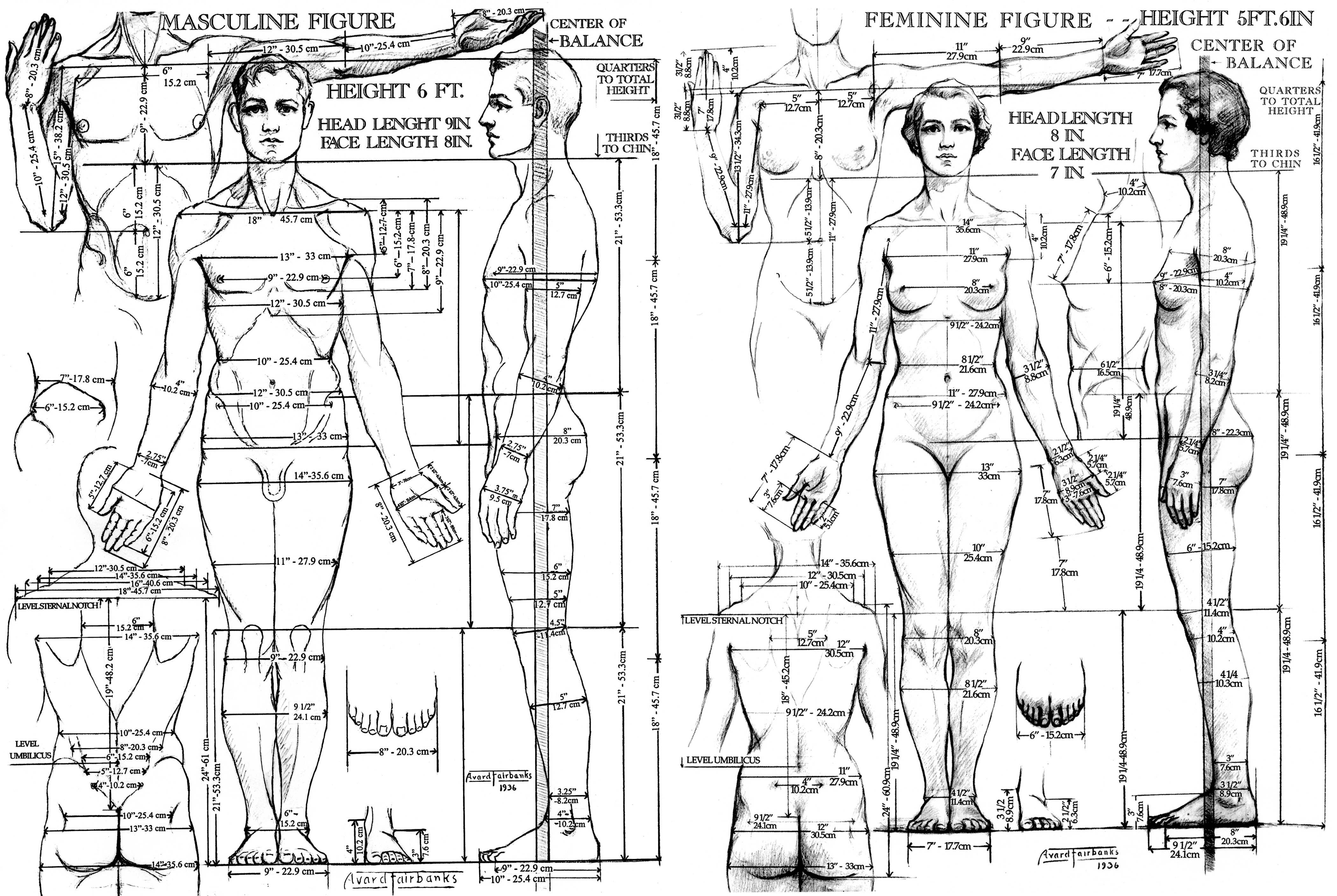
This classic proportion diagram shows the 8-head canon for male and female figures—use it as a quick reference guide.
2. The Skeleton: Your Internal Framework
The skeleton gives structure and determines where joints bend. Key artist-relevant parts:
- Skull — Cranium + jaw; affects head shape.
- Spine — Curves (cervical, thoracic, lumbar) create posture and allow twisting.
- Rib cage — Egg-shaped barrel protecting organs; wider at bottom.
- Pelvis — Bowl-shaped; tilts to shift weight (critical for contrapposto).
- Major joints — Shoulders (ball-and-socket, high mobility), elbows (hinge), wrists, hips (ball-and-socket), knees (hinge), ankles.
Landmarks you can see/feel: collarbones, shoulder blades, hip bones (ASIS), kneecaps, elbows.

Front-view female skeleton highlighting major bones and landmarks artists use for structure.
3. Major Muscle Groups & Surface Forms
Muscles create the visible contours and bulk. Focus on big groups first:
- Torso — Pectorals (chest), latissimus dorsi (back “wings”), abdominals (six-pack area), obliques (sides).
- Arms — Deltoids (shoulder caps), biceps/triceps, forearms (complex but wedge-shaped).
- Legs — Quadriceps (front thigh bulk), hamstrings (back), calves (diamond shape), gluteals (butt).
- Neck — Sternocleidomastoid (V-shaped from ear to collarbone).
Muscles bulge on the outside of bends and stretch on the inside. Fat and skin soften edges.
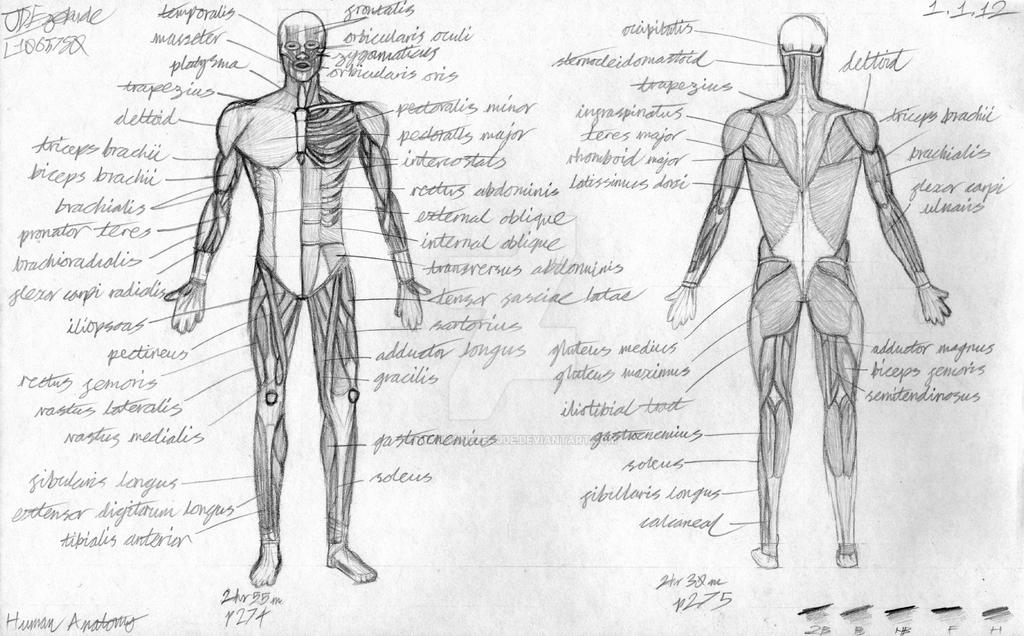
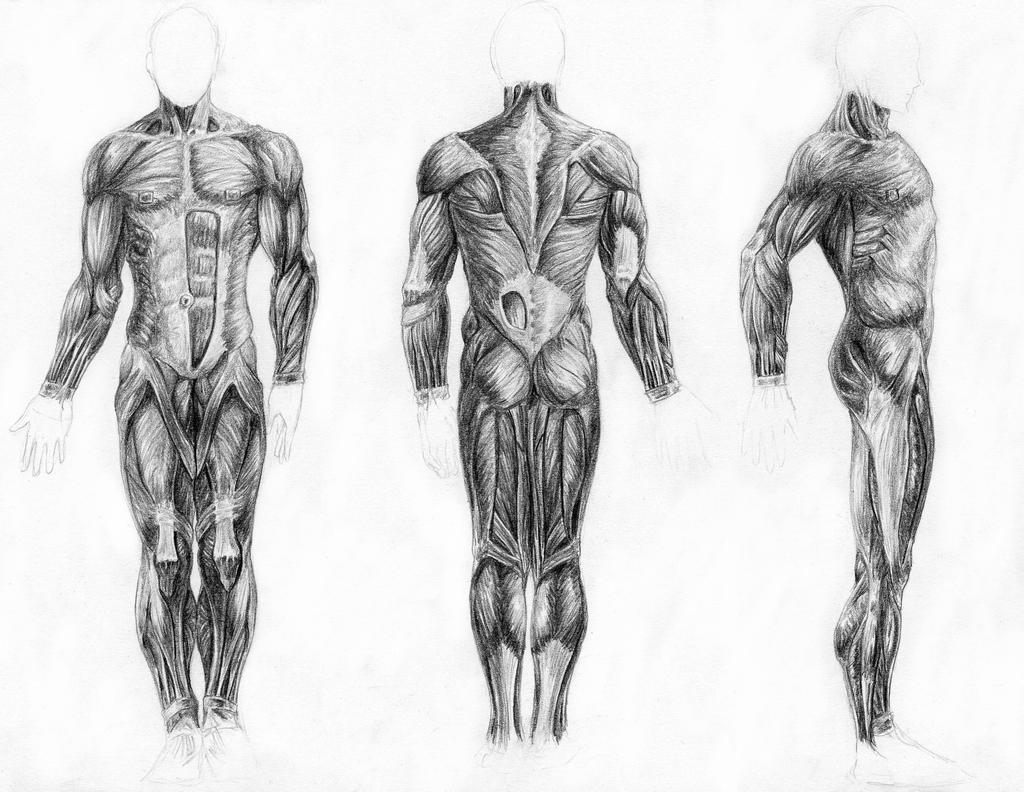
Labeled muscle sketches (front and back views) showing key groups artists simplify and exaggerate.
4. Gesture, Balance & Contrapposto
Anatomy isn’t static—bodies move and balance dynamically.
- Line of action — The main curve of energy through the pose.
- Weight distribution — Standing figures usually rest weight on one leg, tilting the pelvis.
- Contrapposto — Classic pose where shoulders and hips tilt oppositely for natural, relaxed stance.
- Opposing angles (shoulders vs. hips, head tilt) add life and avoid stiffness.
Gesture captures this rhythm before anatomy details.
Contrapposto pose example showing weight shift, opposing angles, and natural balance.
5. Simplifying with Mannequin & Basic Shapes
Break the body into 3D primitives for any pose:
- Head: Sphere/oval
- Rib cage: Egg or barrel
- Pelvis: Bowl or block
- Spine: Flexible curve connecting them
- Limbs: Cylinders/tapered tubes
- Hands/feet: Wedge + cylinders
This “mannequin” method lets you invent poses without copying photos.
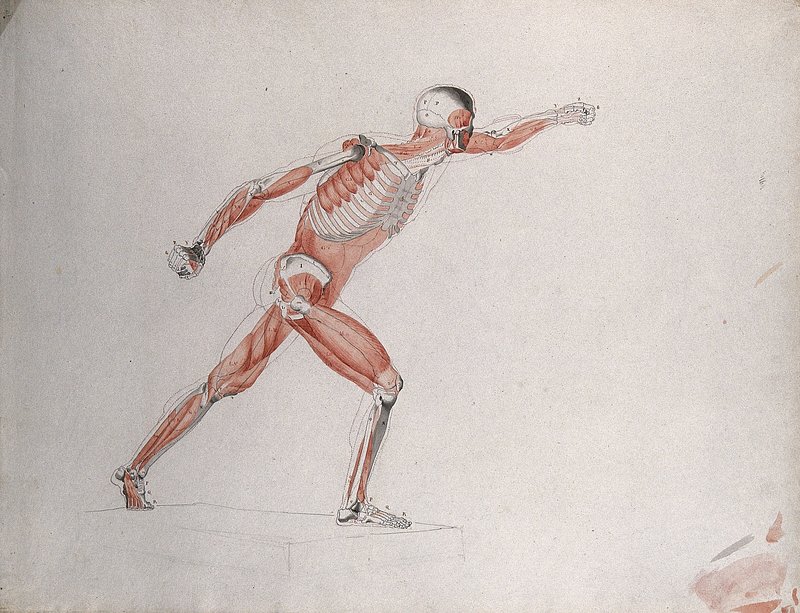
Gesture drawing overlaid with simplified skeleton and muscle forms—perfect for understanding structure in motion.
Quick Reference Tips for Artists
- Start every figure with gesture → construction (shapes) → anatomy refinement.
- Use landmarks to measure: nipple line ≈ bottom of rib cage, navel ≈ top of pelvis.
- Gender differences: Males — broader shoulders, narrower hips; Females — wider hips, narrower shoulders, more curve.
- Age variations: Babies (big head), children (shorter limbs), elderly (stooped posture).
- Avoid over-detailing muscles early—focus on big forms and flow.
Recommended Resources
- Books — “Figure Drawing: Design and Invention” by Michael Hampton (practical construction), “Constructive Anatomy” by George Bridgman.
- Videos — “FULL BODY ANATOMY CRASH COURSE (for artists)” on YouTube — Comprehensive overview of key muscles/bones.
- “HOW TO DRAW ANATOMY (drawing the body for beginners)” — Shape-based approach without memorization.
- Sites — Love Life Drawing, Proko.com, New Masters Academy (beginner anatomy courses).
Master these basics through daily practice: gesture warm-ups + simple mannequin figures + anatomy studies from life/photos. Over time, anatomy becomes intuitive, letting you focus on expression, style, and storytelling. Keep building that visual library—your figures will gain confidence and believability fast! 🦴✏️