Mastering Perspective in Staircase Drawing: Freehand Sketches from Multiple Angles for Dynamic Architectural Illustrations

Description:
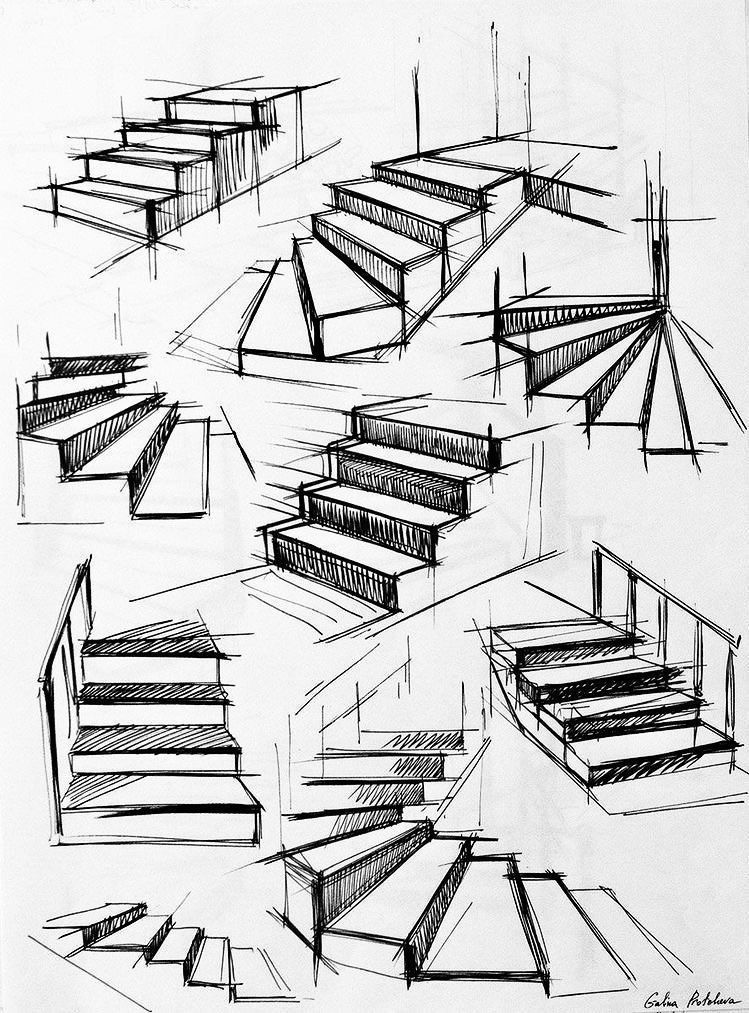
Drawing stairs convincingly is a key skill in architectural sketching, concept art, urban illustration, and technical drawing. This collection of expressive freehand ink sketches (signed “Galina Potapova”) showcases a variety of staircase designs rendered from diverse viewpoints, emphasizing the power of linear perspective to create depth, movement, and realism. From straight flights in one- and two-point perspective to challenging bird’s-eye, worm’s-eye, and spiral forms, these studies demonstrate how to handle risers, treads, railings, and foreshortening with confident line work. Perfect for intermediate artists looking to loosen up their technical drawings or beginners building confidence in 3D representation, this tutorial analyzes each sketch, explains the perspective principles at play, and provides step-by-step guidance to recreate similar effects.


Why Mastering Stairs Improves Your Overall Drawing Skills
Stairs combine horizontal treads, vertical risers, and often angled railings—testing your understanding of perspective, proportion, and volume. Loose, energetic line work (as seen here with hatching for shadow and bold outlines) adds life, preventing rigid, mechanical results. These sketches progress from simple to complex, encouraging iterative practice.
Key Perspective Types Demonstrated
- Straight Stairs in Two-Point Perspective (Most Common Views)
- Several sketches show classic angled flights where verticals remain parallel, while treads and risers converge to two vanishing points on the horizon line.
- Example: Bottom-center wide flight—strong diagonal emphasis creates upward momentum.
- Tips: Start with the nearest riser as a vertical line, project treads to left/right VPs, ensure equal spacing diminishes toward the horizon.

- Bird’s-Eye View (Looking Down)
- Top row features overhead angles with treads visible as overlapping planes, risers foreshortened.
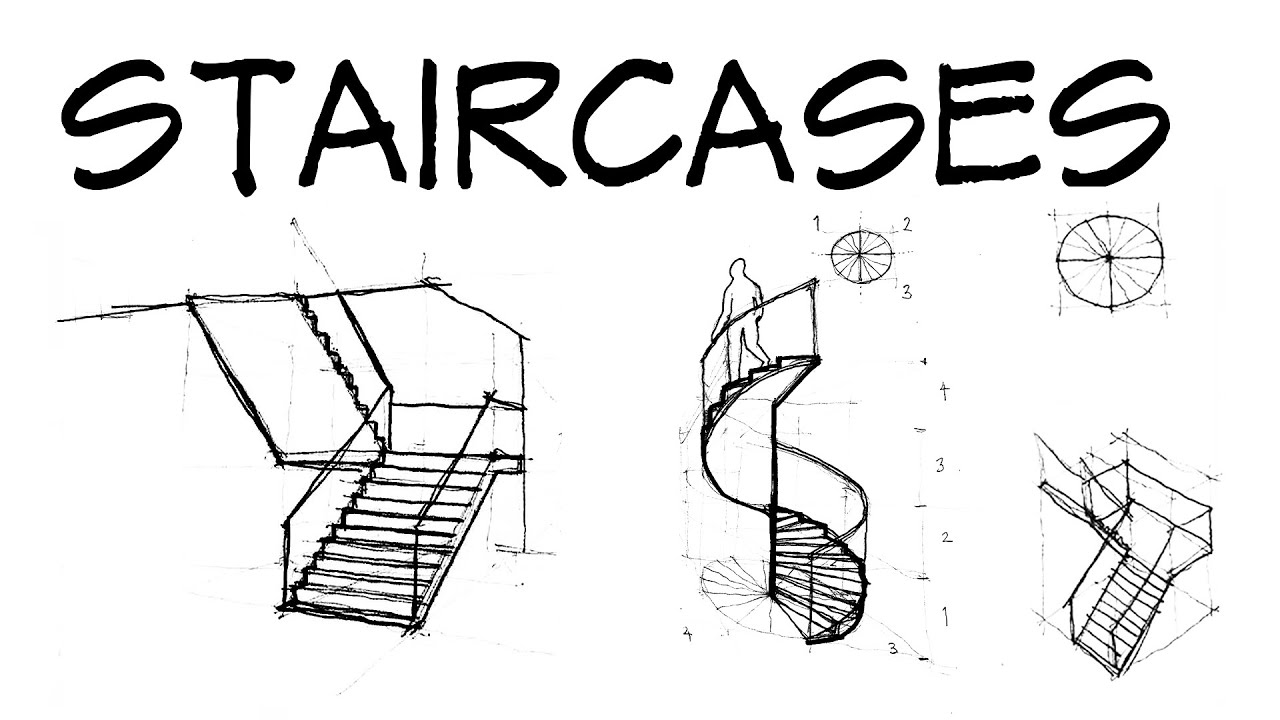
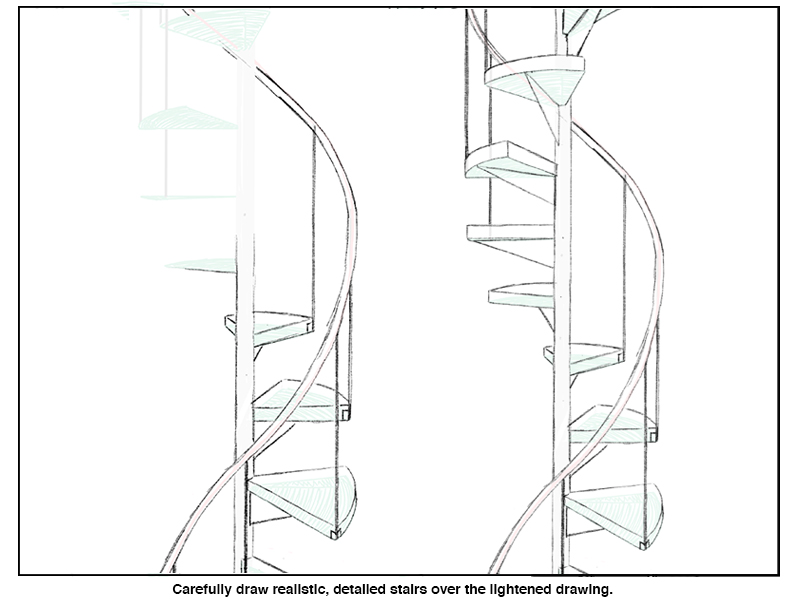
- Spiral and curved stairs appear frequently—converging inward for a vortex effect.
- Tips: Use a high horizon line or third VP above; ellipse guides for spiral treads help maintain consistency.
- Worm’s-Eye View (Looking Up)
- Lower sketches show dramatic upward angles—treads recede sharply, undersides visible, creating towering scale.
- Example: Middle-right with radiating lines for intense depth.
- Tips: Place third VP below the page; exaggerate convergence for drama.
- One-Point and Frontal Views
- Simpler straight-on flights with parallel risers and converging depths.
- Great for beginners to establish proportions before rotating.

Step-by-Step Approach to Sketching Stairs Like These
- Establish Perspective Framework — Lightly draw horizon line and vanishing points (off-page for subtlety).
- Block Basic Volumes — Use boxes for each step; stack and connect.
- Refine Treads and Risers — Add thickness; hatch undersides for shadow.
- Add Railings and Details — Thin lines converging to same VPs; suggest posts or balusters.
- Vary Line Weight — Thicker foreground, thinner background for depth.
- Loosen Up — Multiple quick overlays (as in these sketches) build confidence and energy.
Pro Tip: Practice 10-15 minute gestures—rotate the staircase mentally and sketch from imagination after referencing these.
Applications
| Field | Why These Sketches Help |
|---|---|
| Architecture | Quick concept visualization for interiors/exteriors |
| Urban Sketching | On-location capture of public stairs |
| Concept Art/Comics | Dramatic angles for storytelling |
| Illustration | Adding depth to environments |
Practice Recommendations
- Thumbnail 20 small stairs in different perspectives daily.
- Combine types: L-shaped, U-shaped, or with landings.
- Experiment with media: Ink for bold lines, pencil for soft shading.
These expressive studies by Galina Potapova remind us that perfect measurement isn’t always needed—understanding perspective and confident mark-making create convincing illusions.
Resources:
- “Architectural Graphics” by Francis D.K. Ching
- YouTube channels: TheModmin, Circle Line Art School
- Proko perspective courses
Share your stair sketches below! Use #PerspectiveStairsChallenge to join the community.
Architectural Sketching Academy ©