Head Perspective & Angle Mastery: 9 Standard Views of Planarized Plaster Cast – Step-by-Step Tutorial

Tutorial Overview
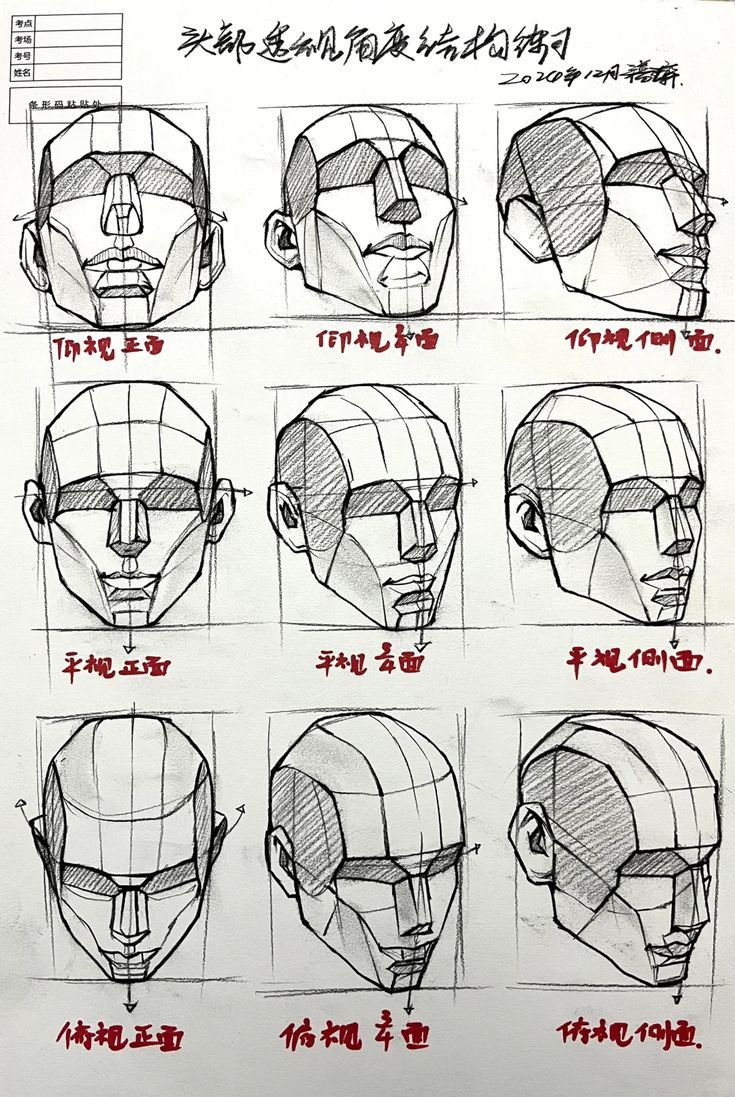
This classic China Academy of Art sketch teaching plan (December 2020 draft) is the gold standard template for head structure and perspective training. It simplifies the complex human head into a planarized plaster cast, systematically presenting 9 standard views (front, three-quarter, profile, low angle, high angle, etc.) to demonstrate:
- Precise changes in outer contours and internal structure lines
- Perspective scaling laws (near larger, far smaller)
- Simplification and summarization of light-shadow planes
- Dynamic shifting of the crosshair centerline
This tutorial transforms the teaching plan into a reproducible, practice-oriented, and assessable professional training system, suitable for:
- Art academy prep / college entrance exam students
- Illustrators / game concept artists
- Digital sculptors (ZBrush / Blender)
- Self-taught sketch enthusiasts
Core Teaching Philosophy
“Planarize first, volumize later; structure before detail.”
- Planarization: Treat the head as a geometric solid assembled from flat planes, ignoring rounded transitions.
- Crosshair Centerline: Every view uses a red-black cross to mark the brow-to-nose-base midline and ear-tragus-to-chin midline, helping judge viewpoint deviation.
- Nine-Square Perspective Frame: Each head is embedded in a uniformly proportioned rectangular grid, making it easy for students to align, measure, and copy.
Full Breakdown of 9 Views
| No. | View Name | Key Features | Training Focus |
|---|---|---|---|
| 1 | Low-Angle Front | Chin protrudes, nostrils visible, forehead compressed | Practice chin protrusion and nostril perspective |
| 2 | Low-Angle Right 3/4 | Right chin more prominent, left ear shrinks | Master asymmetric compression |
| 3 | Low-Angle Profile | Only one side visible, nose tip upturned | Reinforce profile silhouette memory |
| 4 | Eye-Level Front | Perfectly symmetrical, crosshair centered | Golden standard for calibrating proportions |
| 5 | Eye-Level Right 3/4 | Right side occupies 2/3, left ear shrinks | Most common portrait angle |
| 6 | Eye-Level Profile | Ear centered, forehead-nose-chin in three equal parts | Practice three courts, five eyes in profile |
| 7 | High-Angle Front | Forehead expands, nostrils hidden, chin compressed | Practice forehead expansion and chin compression |
| 8 | High-Angle Right 3/4 | Right forehead larger, right ear shifts down | Master dual perspective compression |
| 9 | High-Angle Profile | Top of head elliptical, ear shifts down, neck elongated | Reinforce top-down perspective and neck extension |
Universal Construction Line Template
Every head sketch follows these 7 core structure lines (marked in red):
- Brow-to-nose-base midline (vertical, judges left-right shift)
- Ear-tragus connecting line (horizontal, judges up-down tilt)
- Hairline` (forehead top boundary)
- Zygomatic arch high-point line
- Ala of nose outer line
- Mouth slit line (corner-to-corner)
- Chin lowest point
Mnemonic: “Brow-nose-ear-zygoma-wing-mouth-chin — seven lines rule all.”
Step-by-Step Training Method
Phase 1: Copy Single View (30 min per view)
Goal: Master replication of planarized structure
Tools: HB pencil, red pen, ruler
Steps:
- Trace frame: Use ruler to copy the rectangular nine-square grid
- Draw crosshair: Mark brow-to-nose-base & ear-tragus lines in red
- Sketch structure: Connect in order 1–7 with light lines
- Fill planes: Use diagonal hatching to indicate light-shadow facets
- Verify proportions: Measure with pencil (“eye width = nose-base width = ear height”)
Phase 2: Rotational Memory (No Reference)
Goal: Internalize structural change patterns across 9 views
Exercise:
- Randomly select 1 copied view
- Close reference, draw adjacent view from memory (e.g., eye-level front → low-angle front)
- Self-check crosshair shift with red pen
Phase 3: Live Sketching (Plaster Cast)
Goal: Transition from planar to volumetric
- Position a Roman Youth plaster cast
- Project red laser crosshair onto the cast
- Sketch each view following the teaching plan
- Erase red lines at the end, retain volume
Digital Art Extension
| Software | Application Tips |
|---|---|
| Clip Studio Paint | Import nine-square template → lock layer → red structure layer |
| Blender | Use Head Plane reference model → 9 preset camera angles |
| Procreate | Create “Head 9 Views” canvas template (4000×4000px) |
Common Mistakes & Fixes
| Mistake | Cause | Fix |
|---|---|---|
| Forehead too small in low angle | Ignoring near-larger-far-smaller | Enlarge forehead to 1.5× eye-level size |
| Ear too far forward in profile | Misaligned ear-tragus-to-chin line | Ear tragus should be 1/3 behind facial midline |
| Chin disappears in high angle | Over-compression | Retain chin tip, compress height only |
| Crosshair crooked | Random midline | Must be defined by two points (brow + nose base) |
30-Day Training Plan
| Week | Goal | Daily Task |
|---|---|---|
| Week 1 | Master eye-level 3 views | Copy 1 view daily (front, 3/4, profile) |
| Week 2 | Conquer low-angle 3 views | 1 view daily, focus on nostril perspective |
| Week 3 | Conquer high-angle 3 views | 1 view daily, practice forehead expansion |
| Week 4 | Integrated sketching | Random view daily, sketch plaster cast |
Assessment Standard: Crosshair error < 2mm across all 9 views, complete structure lines, clear light-shadow planes.
Downloadable Resources
- 【PDF】9-View Structure Template (Printable)
- 【PSD】Layered Red-Line Template (Clip Studio / Photoshop)
- 【BLEND】3D Planarized Head Reference Model
- 【Video】30-Minute Follow-Along Tutorial (No Speed-Up)
Conclusion
This 9-view planarized plaster cast teaching plan is the complete bridge from structure to perspective, from copying to live sketching. Master it, and you will have:
- Confidence to draw heads from any angle
- A structural skeleton for character design
- The scoring key for college entrance sketch exams
Start your first copy now! Share your work with #Head9ViewsTraining — we’ll feature the best in our community.
Original: China Academy of Art Affiliated High School 2020 Sketch Curriculum | Tutorial by [Your Art Institution] – Professional Sketch Training Since 2025