Decoding the Stygimoloch Skull: A Step-by-Step Tutorial on Anatomy, Discovery, and Paleoenvironmental Context

Introduction to Stygimoloch
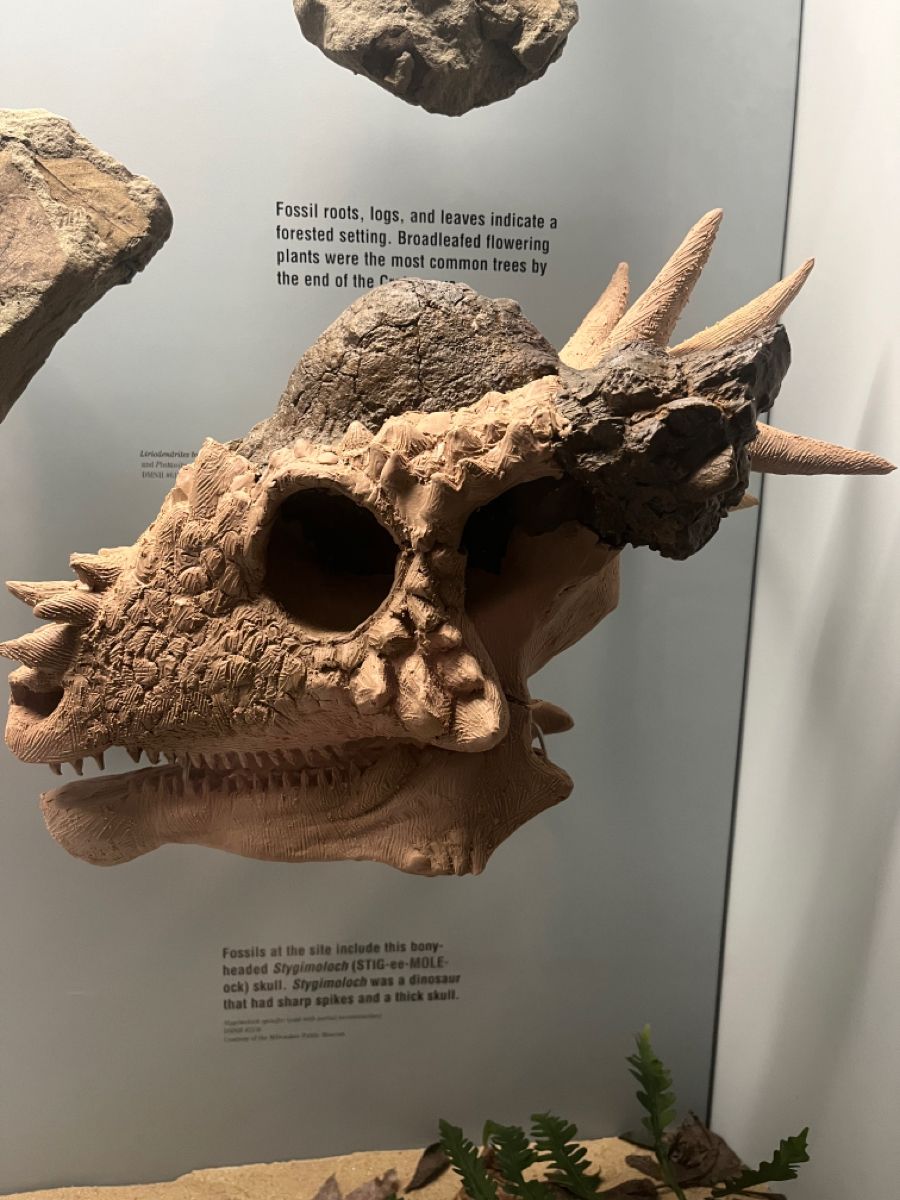
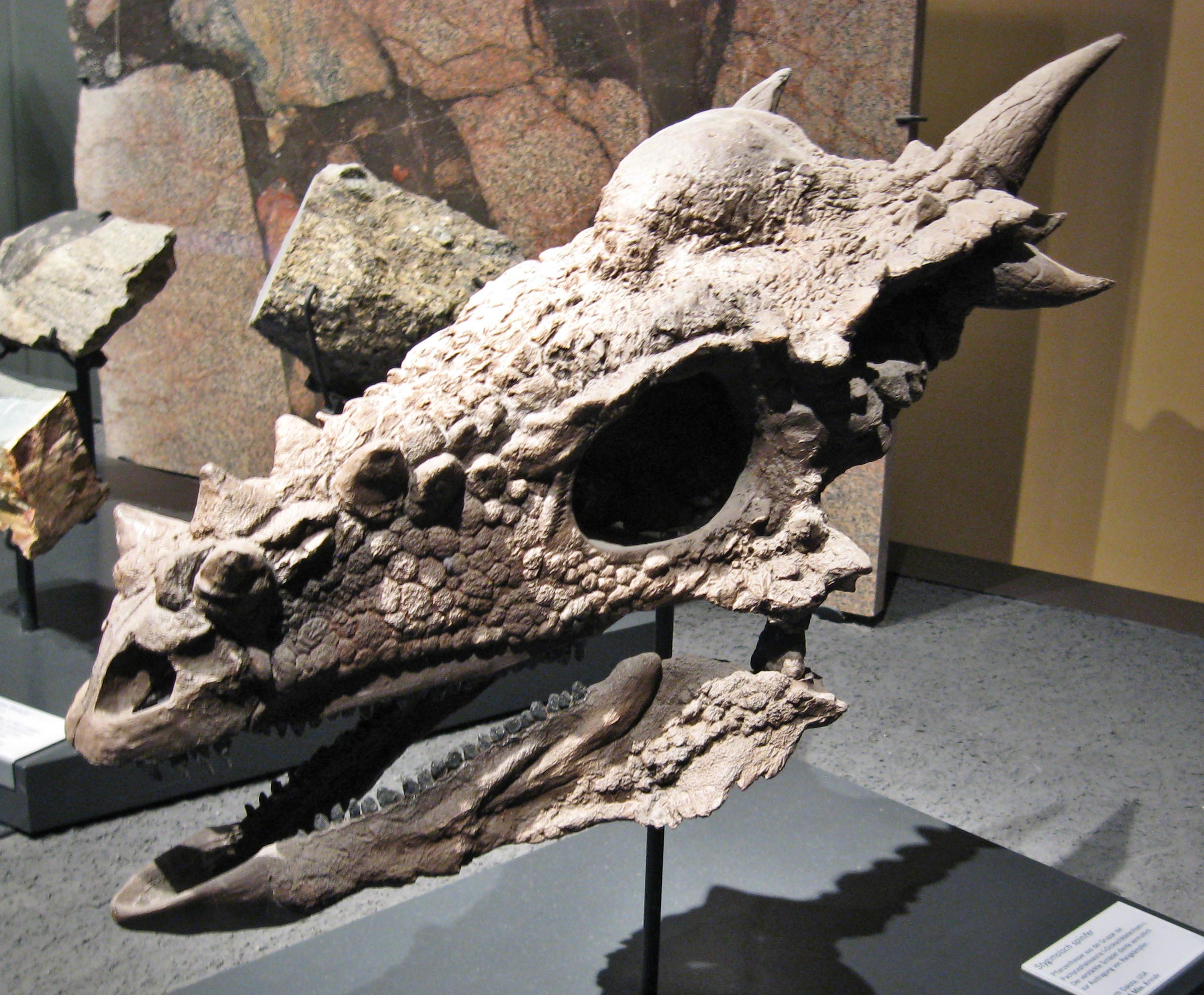
The image depicts a museum exhibit featuring the fossilized skull of Stygimoloch spinifer, a Late Cretaceous pachycephalosaurid dinosaur renowned for its ornate, spike-adorned dome. Suspended alongside fossilized plant elements like roots and leaves, the display includes interpretive labels describing a forested habitat dominated by broadleaved flowering plants and highlighting the skull’s distinctive features: sharp spikes, bony knobs, and a thickened cranium. Stygimoloch, whose name means “river demon from the Styx” in Greek, lived approximately 68-66 million years ago in what is now North America. This tutorial-style guide breaks down the exhibit comprehensively, from visual analysis to anatomical details, historical context, behavioral insights, and ongoing debates in paleontology. Perfect for students, educators, or dinosaur enthusiasts, it equips you with the knowledge to interpret similar displays, whether visiting museums like the Denver Museum of Nature & Science or studying remotely.
Commence your examination by assessing the exhibit’s composition: The skull is positioned centrally, with a dome-shaped cranium encircled by clusters of nodes and long, backward-curving horns up to 10-15 cm (4-6 inches) long, evoking a demonic appearance that inspired its name. Surrounding plant fossils underscore the Hell Creek Formation’s environment, a lush floodplain with angiosperms as the primary vegetation by the Cretaceous end. Note the label’s emphasis on the site’s fossils, indicating this specimen hails from formations like Hell Creek or Lance in Montana or Wyoming. Stygimoloch measured about 3 meters (10 feet) long, weighed 77-170 kg (170-375 lbs), and was a bipedal herbivore adapted for quick movements in wooded areas.
Step 1: Visual Identification and Cranial Features – Spotting Diagnostic Traits
Initiate like a paleontological identification tutorial: Distinguish Stygimoloch by its skull morphology. The dome, formed by thickened frontal and parietal bones up to 10 cm (4 inches) thick, is smaller and more spiked than in relatives like Pachycephalosaurus. In the image, observe the squamosal horns—three to four pairs of elongated spikes radiating from the skull’s rear, measuring 5-10 cm each—and smaller nasal hornlets, which may have served in display or defense. The orbital region shows large eye sockets for keen vision, while the beak-like jaws with leaf-shaped teeth indicate a diet of foliage, fruits, and seeds.
For exhibit analysis, compare textures: The fossil’s rough, pitted surface results from vascular grooves, suggesting a covering of keratin in life, enhancing the spikes’ length and sharpness. Debate persists on its validity—some paleontologists view Stygimoloch as a juvenile Pachycephalosaurus wyomingensis, with spikes resorbing into a larger dome during growth, while recent studies, including 2025 findings from Wyoming’s Ferris Formation, support it as a distinct taxon based on southernmost records and morphological differences.

Step 2: Anatomical Dissection – Understanding Skeletal Adaptations
Proceed as in an anatomy tutorial: The skull’s dome likely facilitated head-butting behaviors for dominance or mating, with internal microstructures absorbing impacts like a shock absorber. Short forelimbs and strong hind legs (inferred from complete skeletons) enabled bipedal locomotion at speeds up to 20-30 km/h (12-19 mph) for evading predators like Tyrannosaurus. The neck vertebrae, robust yet flexible, supported the heavy head during charges.
In fossil preparation, skulls like this are extracted using air scribes and acid baths to remove matrix, then stabilized with adhesives for display. Size variations suggest sexual dimorphism, with males possessing more elaborate ornamentation. For comparative study, contrast with Dracorex (flat-headed juvenile?) or mature Pachycephalosaurus, noting ontogenetic changes if synonymous.
Step 3: Historical Discovery and Fossil Record – Tracing Paleontological Roots
Trace origins historically: Stygimoloch spinifer was described in 1983 by Peter Galton and Hans-Dieter Sues from partial skulls found in Montana’s Hell Creek Formation. Key specimens include the holotype (MPM 8111) from South Dakota and recent 2025 discoveries in Wyoming’s Ferris Formation, extending its range southward and supporting its validity. Fossils are rare, primarily skulls due to their durability, unearthed via surface prospecting and screen-washing in badlands.
Museums like the Museum of the Rockies or Berlin’s Museum für Naturkunde house replicas or originals, often displayed with contextual flora to evoke the Laramidia ecosystem.
Step 4: Behavioral and Ecological Insights – Reconstructing Daily Life
Reconstruct ecology: Inhabiting forested floodplains, Stygimoloch browsed low vegetation in small herds, using spikes for visual signaling or flank-butting rather than direct head rams to minimize injury. Coexisting with Triceratops and Edmontosaurus, it faced predation from tyrannosaurids, relying on agility and camouflage.
Recent research debates head-butting efficacy, with CT scans revealing trabecular bone for shock absorption. Extinction tied to the Chicxulub impact 66 million years ago.
Step 5: Modern Significance and Exhibit Interpretation – Applying Knowledge Today
Exhibits like this, possibly from institutions featuring Hell Creek fauna, educate on biodiversity and evolution, with interactive elements like 3D models enhancing engagement. For visitors, scrutinize labels for ontogeny debates; use apps for augmented reconstructions.
In paleontology, Stygimoloch fuels discussions on synonymy, with 2025 studies affirming its status amid new fossils. This guide empowers deeper appreciation of prehistoric life.