Light and Shadow: How to Paint Light and Shadow Realistically
Painting realistic light and shadow is one of the most powerful ways to create depth, form, and mood in your artwork. Whether you’re working in oils, acrylics, watercolors, or digitally, the principles remain the same: observe how light behaves on surfaces, simplify values into light/mid/dark, and build form gradually. Light reveals form; shadow defines it.
Mastering this turns flat shapes into convincing 3D objects. Let’s break it down step by step.

Key Concepts: Types of Light and Shadow
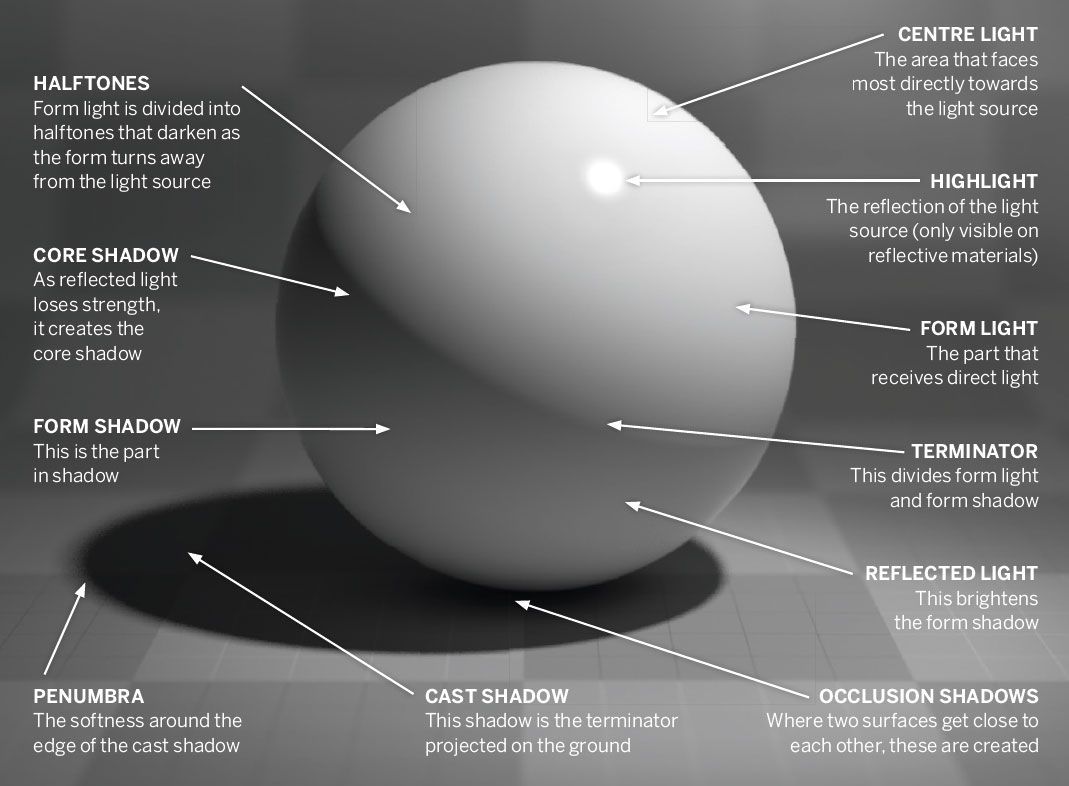
- Light Side — Areas directly hit by the light source (highlight + mid-tones).
- Form Shadow — The shadow on the object itself where light doesn’t reach directly.
- Core Shadow — The darkest part of the form shadow (often along the “turn” from light to dark).
- Cast Shadow — The shadow the object projects onto a surface (usually darker and cooler than form shadow).
- Reflected Light — Bounced light from surroundings that illuminates shadows slightly (often cooler or warmer depending on environment).
- Highlight — Brightest specular reflection where light bounces directly off the surface.
Shadows are never pure black—mix complements or add reflected color. Highlights aren’t always pure white—adjust for material.
This classic sphere demonstrates light side, form shadow, core shadow, reflected light, and cast shadow.
A clear value scale on a sphere showing smooth transitions from light to dark.

Step-by-Step: Painting Realistic Light and Shadow
- Set Up Your Subject & Light Use a single, strong light source (e.g., lamp or window) for clear shadows. Avoid multiple lights at first—they complicate things. Squint at your subject/reference to simplify into big light and shadow shapes. Ignore details initially.
- Establish Values First (Grayscale Block-In) Paint or draw a value map: lightest lights to darkest darks. Use 5–7 values max. Start with mid-tone base, block in shadows darkly, then add lights. This ensures correct contrast.
- Paint Shadows First (or Lights—Your Choice) Many artists block darks early (easiest in opaque media like oils/acrylics). Mix shadows with complements (e.g., blue + orange for neutral gray-brown) instead of black. Add reflected color (cool blue in cool light, warm in warm). Soften edges where shadow meets light (sfumato-like blending) for realism.
- Add Form & Transitions Blend mid-tones smoothly between light and shadow for roundness. Use glazing (thin transparent layers) in acrylics/oils for subtle shifts. Keep cast shadows cooler/darker near the object, warmer/softer farther away.
- Highlights & Reflected Light Place highlights last—small, bright, and sharp for glossy surfaces; softer for matte. Add subtle reflected light into shadows (never as bright as direct light). Adjust edges: hard for cast shadows on flat surfaces, soft for form shadows.
- Refine & Check Step back, squint, flip horizontally (mirror/digital) to spot errors. Ensure lightest light and darkest dark create strong contrast.
This chiaroscuro still life uses dramatic light and deep shadows for strong 3D illusion.
Dramatic chiaroscuro painting with intense light source creating deep, realistic shadows.

Medium-Specific Tips
- Oils — Blend wet-into-wet for soft transitions; use glazing for depth.
- Acrylics — Work fast or use retarder; glaze thin layers for realistic buildup.
- Watercolor — Preserve lights (paint around them); layer shadows transparently.
- Digital — Use layers for shadows/highlights; adjust opacity and blend modes.
Common Mistakes to Avoid
- Using pure black for shadows → Kills vibrancy (use dark complements instead).
- Over-blending → Loses form; keep some hard edges for contrast.
- Ignoring reflected light → Makes shadows look flat and floating.
- Inconsistent light direction → Confuses viewer.
Video Tutorials for Hands-On Learning
- “Beginner’s Guide to Light and Shadow for Artists” (Draw Paint Academy) — Egg demo showing core concepts.
- Will Kemp’s “How to Paint Light & Shade in Acrylics” series — Practical apple painting steps.
- “Easy tips to paint light and shadow” (Clip Studio Paint/Art Rocket) — Beginner-friendly grayscale to color approach.
Practice with simple forms (sphere, egg, apple) under controlled light. Squint often, simplify values, and build slowly. Once you “see” light and shadow like this, your paintings gain incredible realism and depth—keep observing the real world!
Your next still life will look more three-dimensional than ever. Grab your brushes and start chasing that light! 🌟🖌️