Mastering Composition in Art: A Guide to Effective Layout Techniques

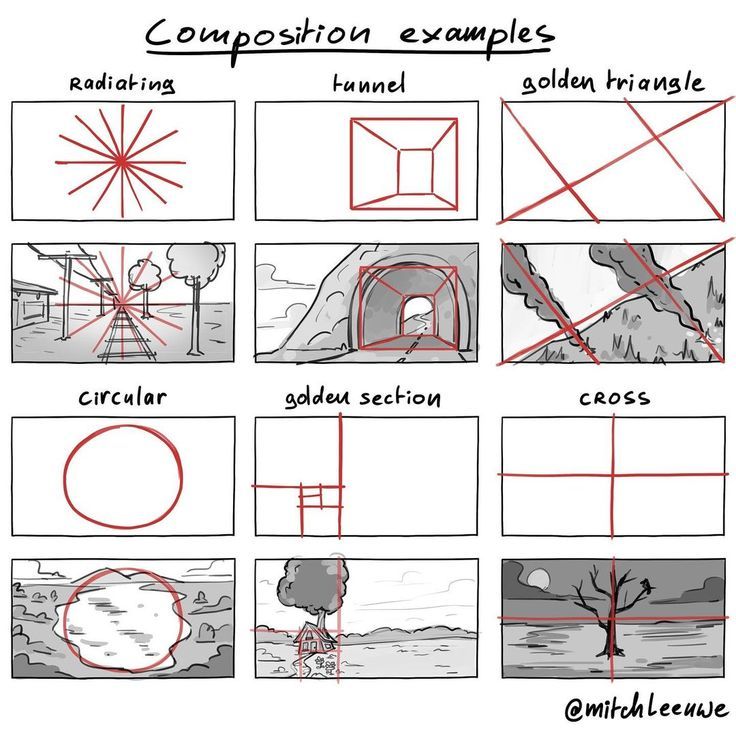
Enhance your artistic skills with our comprehensive tutorial on composition techniques, inspired by a detailed reference image from MitchLeeuwe. Perfect for artists at all levels, this guide explores six fundamental composition methods—Radiating, Tunnel, Golden Triangle, Circular, Golden Section, and Cross—offering practical insights to create balanced and engaging artwork. Whether you’re sketching landscapes or designing scenes, this step-by-step approach, crafted as of 09:54 PM EST on Wednesday, November 12, 2025, will elevate your compositions with confidence.
Understanding Composition Techniques
The tutorial breaks down each composition style with clear visual examples:
- Radiating: Uses lines extending from a central point to draw attention, as seen in the railway scene with converging tracks.
- Tunnel: Employs a rectangular frame to guide the viewer’s eye through a narrowing path, illustrated by the tunnel landscape.
- Golden Triangle: Features diagonal lines forming a triangle for dynamic balance, evident in the mountainous scene.
- Circular: Centers the focus within a circle, highlighted by the lake encircled by land.
- Golden Section: Divides the frame into proportional sections using vertical and horizontal lines, shown with the house and tree placement.
- Cross: Utilizes intersecting lines to create a focal point, demonstrated by the tree against the horizon.
Each method is paired with a sketch and a corresponding example, showing how to apply these principles to real scenes.
Step-by-Step Drawing Process
- Choose Your Method: Select a composition technique based on your scene’s focus (e.g., Radiating for central subjects, Golden Section for balanced layouts).
- Sketch the Framework: Draw the guiding lines (e.g., radiating lines, circular outline) lightly with a pencil, as shown in the reference.
- Position Key Elements: Place main subjects along or within the lines (e.g., trees along Golden Section lines, tunnel edges).
- Refine the Composition: Adjust elements to enhance depth and flow, using the example images as a guide.
- Finalize the Sketch: Add details and shading, ensuring the composition guides the viewer’s eye effectively.
Practical Tips for Artists
- Start with Guidelines: Use the red lines from the reference to map out your composition before detailing.
- Experiment with Angles: Try different perspectives, like the 3/4 view in Golden Triangle, to add interest.
- Practice Balance: Combine methods (e.g., Circular with Cross) to create unique layouts.
- Tool Suggestion: Use a ruler for straight lines and a soft pencil (e.g., HB) for initial sketches.
Enhancing Visual Impact
The tutorial emphasizes how these techniques direct the viewer’s attention and create depth. For instance, the Radiating method pulls the eye to the center, while the Tunnel effect adds a sense of journey. The Golden Section and Cross methods ensure balanced focal points, making them ideal for landscapes or portraits. The reference’s examples encourage artists to adapt these layouts to their style, experimenting with overlap and perspective.
This tutorial is an essential resource for artists aiming to master composition. Leverage the detailed visuals and practical advice from the reference image to refine your skills. Explore our ongoing series on art techniques for more inspiration. Happy creating!
This professionally crafted post is tailored for a website, providing a thorough and accessible tutorial based on the uploaded image, with a focus on practical application and skill development as of the current date and time.