Top 10 Fighter Aircraft in the World: A Visual Ranking and In-Depth Tutorial on Modern Air Combat Powerhouses (2026 Edition)

Description: Explore the World’s Leading Fighter Jets – From Stealth Dominance to Raw Speed and Versatility
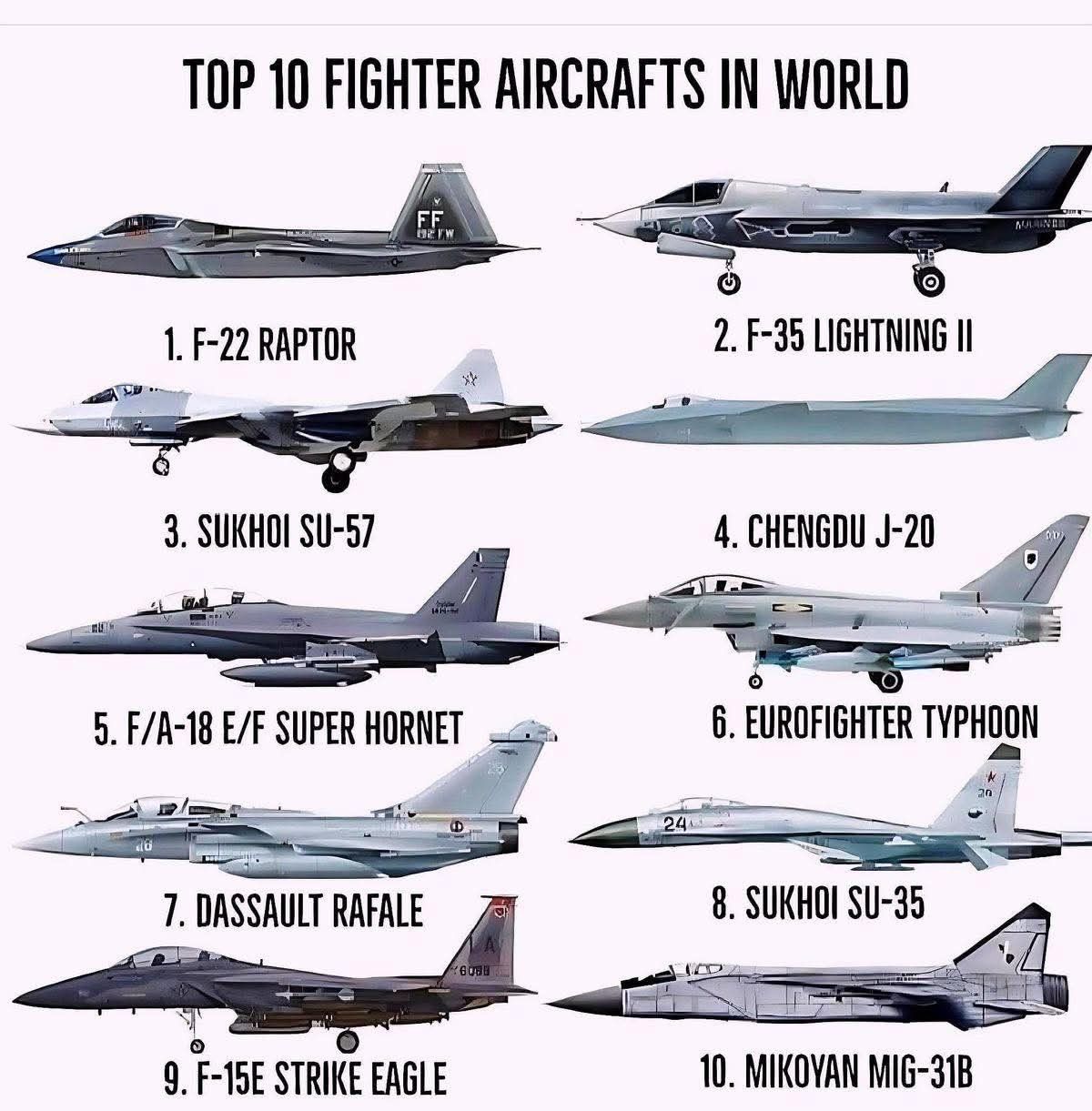
This eye-catching infographic-style image ranks the Top 10 Fighter Aircraft in the World, showcasing high-resolution side-profile views of each jet with clear numbering and national markings. The composite highlights a mix of fifth-generation stealth platforms and advanced fourth-generation (or 4.5-gen) multirole fighters, reflecting ongoing debates in military aviation circles about what truly defines “best” in 2026—stealth, sensor fusion, maneuverability, speed, weapons load, or operational maturity.
The ranking in the image places heavy emphasis on air superiority and emerging stealth technologies:
- F-22 Raptor (USA) – Often hailed as the ultimate air dominance fighter.
- F-35 Lightning II (USA) – The most widely deployed fifth-gen multirole jet.
- Sukhoi Su-57 (Russia) – Russia’s flagship stealth fighter with exceptional agility.
- Chengdu J-20 (China) – China’s large-scale fifth-gen interceptor.
- F/A-18E/F Super Hornet (USA) – Proven carrier-based multirole workhorse.
- Eurofighter Typhoon (Europe) – Agile European consortium design.
- Dassault Rafale (France) – Versatile omnirole fighter with combat-proven record.
- Sukhoi Su-35 (Russia) – Super-maneuverable Flanker evolution.
- F-15E Strike Eagle (USA) – Heavy-hitting multirole strike platform.
- Mikoyan MiG-31BM (Russia) – Ultra-fast interceptor for long-range defense.
This post serves as a comprehensive tutorial-style guide to understanding this ranking. We’ll break down the visual elements, analyze each aircraft’s key strengths, compare critical specifications in a structured table, discuss ranking criteria, and explore real-world implications as of 2026. Whether you’re studying aerospace engineering, following geopolitical airpower trends, or simply passionate about military aviation, this detailed walkthrough will equip you with the knowledge to evaluate modern fighters critically.
Step 1: Decoding the Image – Visual Analysis and Layout
The graphic uses a clean, vertical layout with large, detailed silhouettes arranged in pairs or staggered for readability. Each jet is shown from a similar angle (mostly left-side profiles with landing gear down), allowing direct shape and size comparisons. Stealthy designs (F-22, F-35, Su-57, J-20) feature smoother contours and angled surfaces, while fourth-gen jets display more traditional intakes and tails.
- Stealth Emphasis: The top four are all fifth-generation platforms with reduced radar cross-sections (RCS), internal weapons bays, and advanced coatings—visually evident in their faceted or blended shapes.
- Diversity: The list balances U.S. dominance (four entries), Russian designs (three), Chinese (one), European (two), highlighting global competition.
- Artistic Style: High-contrast, realistic renders make it ideal for social media or educational use; zoom in to spot details like thrust-vectoring nozzles (Su-57, Su-35) or canards (Rafale, Typhoon).
Pro tip: To replicate similar comparisons, use flight simulation tools (e.g., DCS World) or official manufacturer 3-views for accurate scaling.
Step 2: Ranking Criteria – What Makes a “Top” Fighter in 2026?
Rankings like this are subjective and vary by source (e.g., AeroTime places Su-57 first for agility; others prioritize F-35’s sensor fusion or F-22’s stealth). Common factors include:
- Stealth (RCS reduction)
- Sensors & Avionics (AESA radar, sensor fusion, data links)
- Speed & Maneuverability (supercruise, thrust vectoring)
- Weapons & Range
- Operational Maturity & Numbers
- Combat Provenness
The image’s order leans toward air superiority + stealth, with U.S. platforms at the top due to superior low-observability and integration.
Step 3: Side-by-Side Technical Comparison Table
Here’s a curated overview of key specs (approximate public figures as of 2026; classified details vary):
| Rank | Aircraft | Country | Generation | Max Speed (Mach) | Stealth Level | Key Strengths | Approx. Units in Service | Primary Role |
|---|---|---|---|---|---|---|---|---|
| 1 | F-22 Raptor | USA | 5th | 2.25 | Very High | Supercruise, unmatched agility, stealth | ~180 | Air superiority |
| 2 | F-35 Lightning II | USA | 5th | 1.6 | High | Sensor fusion, multirole, global ops | 1,000+ | Multirole stealth |
| 3 | Sukhoi Su-57 | Russia | 5th | 2.0 | Medium-High | 3D thrust vectoring, supermaneuverability | ~70-100 | Multirole stealth |
| 4 | Chengdu J-20 | China | 5th | 2.0 | Medium-High | Long range, large fleet growth | 250-300 | Air superiority/interception |
| 5 | F/A-18E/F Super Hornet | USA | 4.5 | 1.8 | Low-Medium | Carrier ops, proven reliability | 600+ | Multirole carrier |
| 6 | Eurofighter Typhoon | Europe | 4.5 | 2.0+ | Low-Medium | Agility, high thrust-to-weight | 600+ | Air superiority/multirole |
| 7 | Dassault Rafale | France | 4.5 | 1.8+ | Low-Medium | Omnirole, combat-proven (Libya, Mali) | 250+ | Multirole omnirole |
| 8 | Sukhoi Su-35 | Russia | 4.5 | 2.25 | Low | Extreme maneuverability, long-range | 150+ | Air superiority/multirole |
| 9 | F-15E Strike Eagle | USA | 4+ | 2.5 | Low | Heavy payload, strike capability | 200+ (E/EX variants) | Strike/multirole |
| 10 | MiG-31BM | Russia | 4+ | 2.83 | Low | World’s fastest, long-range intercept | 100+ | High-speed interception |
Tutorial note: Stealth rankings are estimates—F-22’s RCS is often cited as ~0.0001 m², far below others.
Step 4: In-Depth Breakdown of the Top Contenders
- F-22 Raptor (#1): Pinnacle of air dominance; supercruise (Mach 1.8+ without afterburners), thrust vectoring, and unbeatable BVR (beyond-visual-range) engagement. Limited production and high maintenance cost cap its numbers.
- F-35 Lightning II (#2): The “quarterback” of modern air forces—helmet-mounted display, networked warfare, three variants (A/B/C). Its real strength lies in information dominance rather than dogfighting.
- Su-57 (#3): Russia’s answer to fifth-gen threats; excels in close-range maneuvers with 3D nozzles. Production ramps up, but stealth maturity trails U.S. designs.
- J-20 (#4): Focuses on long-range Pacific operations; rapid fleet expansion makes it a strategic game-changer for China.
- Lower ranks highlight proven 4.5-gen platforms: Rafale and Typhoon shine in export success and multirole flexibility; Su-35 offers raw performance; MiG-31BM remains unmatched for speed in intercept roles.
Step 5: Broader Context and Future Outlook (2026)
As of early 2026, fifth-gen fighters dominate discussions, but upgrades to fourth-gen jets (e.g., F-15EX, Super Hornet Block III) keep them relevant. Emerging programs like NGAD (U.S.), Tempest/FCAS (Europe), and China’s next steps will reshape lists soon. Rankings evolve with real-world performance—pilot skill, tactics, and electronic warfare often decide outcomes over raw specs.
Use this guide to dive deeper: Compare in simulators, read manufacturer whitepapers, or follow defense analyses. Which jet do you think deserves a higher spot, and why? Share in the comments!