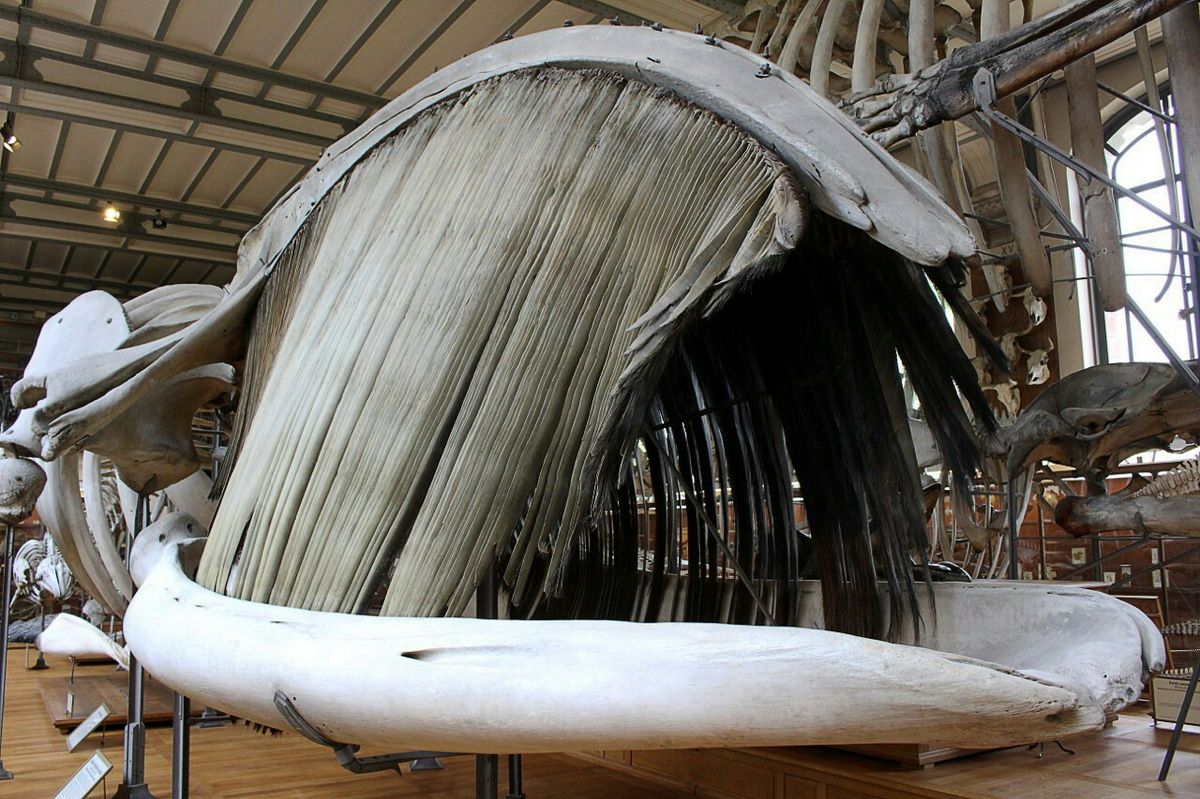
The Majestic Baleen of the Blue Whale: A Close-Up View of Nature’s Greatest Filter-Feeding Mechanism in a Museum Display
 This striking photograph captures a rare and impressive museum exhibit featuring the enormous lower jaw and baleen apparatus of a blue whale (Balaenoptera musculus), the largest animal ever to have lived on Earth. Mounted in a grand natural history hall—likely within a historic European institution such as the Natural History Museum in London or a comparable collection—the massive, curved mandibular arch dominates the frame. From the upper jaw (not fully visible but implied by the hanging structure), hundreds of long, parallel baleen plates descend like a dense, fringed curtain, creating a dramatic, cathedral-like cavity that once filtered vast quantities of krill from the ocean.
The baleen appears in its preserved, keratinous form: pale beige to grayish plates, each up to 1 meter long in life, with finely frayed inner edges forming the “fringe” that traps prey while allowing seawater to escape. The lower jaw, a single massive, boat-shaped bone (often exceeding 7 meters in arc length in adult blue whales), is bleached bone-white with subtle weathering cracks and mounting hardware visible, supported by sturdy metal brackets and stands. Surrounding elements include other cetacean skeletons—smaller whale skulls, ribs, and vertebrae—hanging or displayed on the walls and floor, set against the elegant architecture of arched ceilings, wooden floors, and large windows that bathe the scene in natural light. Informational labels and spotlights add a scholarly atmosphere, emphasizing the exhibit’s role in public education and scientific wonder.
Here are several high-quality images showcasing similar blue whale baleen displays, jaw mounts, and close-up views of baleen plates in museum settings to highlight the scale and intricate detail:
Anatomical and Functional Breakdown: Understanding Baleen in Mysticete Whales
Blue whales belong to the mysticete (baleen whale) suborder, which evolved from toothed ancestors around 30–35 million years ago. Unlike odontocetes (toothed whales such as dolphins), mysticetes lack teeth entirely in adulthood. Instead, they possess baleen plates—specialized keratin structures (the same protein as human hair and nails) that grow downward from the upper jaw in parallel rows (typically 200–400 plates per side in blue whales).
Key features visible in this exhibit:
- Plate Structure — Each plate is triangular, broad at the base (attached to the palate), tapering inward. The outer smooth side faces the mouth cavity; the inner side frays into long, hair-like filaments (the “baleen fringe”) that form an effective sieve.
- Feeding Mechanism — During lunge feeding, the whale engulfs up to 100 tons of water and krill in a single gulp (throat pleats expand dramatically). The tongue then pushes water outward through the baleen, trapping 4–8 tons of krill per day—equivalent to millions of tiny crustaceans.
- Size & Scale — In adults, baleen can reach 90–100 cm in length with fringes up to 50 cm; the entire mouth cavity spans over 5–6 meters wide when open.
- Preservation — Museum specimens often retain original baleen (as here) or use replicas due to keratin’s fragility. Historic whaling provided many such mounts; modern displays emphasize conservation.
Tutorial: How to Study and Appreciate Baleen Whale Exhibits Like This One
- Observe Scale in Person — Stand beneath or beside the jaw to grasp proportions—blue whales reach 30 meters long and 200 tons. Compare to human height for context.
- Examine Baleen Texture — Note the gradient from rigid base to flexible fringe; touch (if permitted) reveals keratin’s toughness yet elasticity.
- Understand Evolutionary Context — Mysticetes diverged from archaeocetes; baleen enabled filter-feeding on abundant plankton in nutrient-rich oceans.
- Link to Ecology — Blue whales consume 1–2% of their body weight daily in krill—critical to carbon cycling in oceans. Declines from whaling (pre-1960s) reduced populations by 99%; recovery highlights conservation success.
- Photography & Documentation Tips — Use wide-angle lenses for full jaw views; low-angle shots emphasize grandeur. Respect museum rules—no flash on delicate keratin.
- Further Exploration — Visit iconic displays like “Hope” at London’s Natural History Museum (suspended in lunge pose) or the AMNH’s blue whale model with interpretive baleen details.
This exhibit transforms abstract anatomy into visceral awe, reminding visitors of the blue whale’s role as the ocean’s gentle giant and the fragility of marine ecosystems. It serves as both a testament to 19th–20th-century whaling history and a powerful call for ongoing protection of the planet’s largest inhabitants.
Perfect for inspiring visits to natural history museums worldwide or deepening appreciation for cetacean biology. Have you stood beneath a blue whale skeleton or marveled at baleen up close? Share your experiences in the comments below!