Towering Pentaceratops Skeleton: A Tutorial-Style Guide to This Record-Breaking Ceratopsian Skull and Museum Masterpiece

Experience the sheer scale and majesty of one of the most impressive dinosaur displays in the world: this towering mounted skeleton of Pentaceratops sternbergii, a Late Cretaceous horned herbivore whose skull holds (or has held) records as one of the largest land vertebrate skulls ever discovered. Captured in a dramatic museum gallery with strategic low-angle lighting, the exhibit emphasizes the enormous, upward-sweeping frill and robust body, creating an unforgettable visual impact. This in-depth, professional tutorial explores the anatomy, paleontological significance, exhibit features, and scientific context of this spectacular specimen—ideal for dinosaur enthusiasts, educators, students, and museum visitors seeking a deeper understanding of ceratopsian diversity.
Step 1: Visual Examination and Key Identification Features
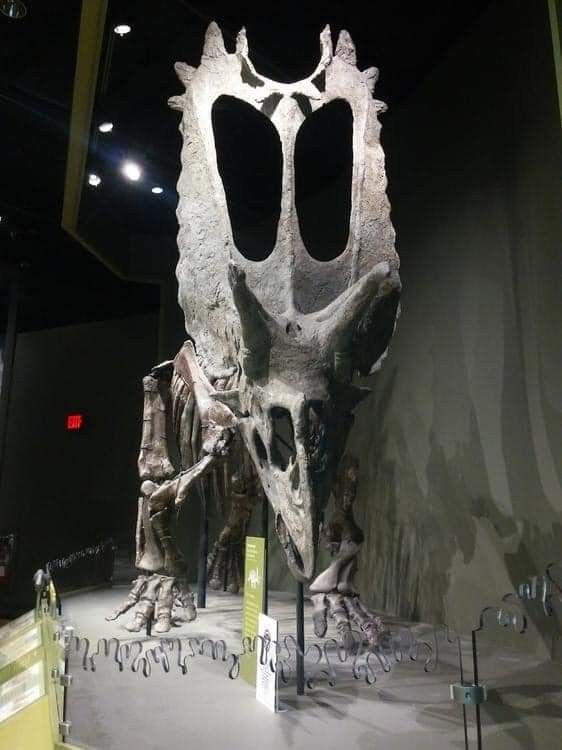
The photograph showcases a full-body skeletal mount rising dramatically toward the ceiling of a darkened gallery, with spotlights highlighting bone textures and shadows for maximum drama. The skeleton stands on a gray platform surrounded by protective barriers and interpretive signage.
Prominent Anatomical Highlights:
- Massive Skull and Frill: The head dominates the upper portion, with a towering, elongated parietal-squamosal frill featuring large, oval fenestrae (openings) that reduce weight while maintaining strength. The frill extends far upward and backward, giving the skull an extraordinary vertical height—estimated at over 3 meters (10+ feet) in life for the largest specimens.
- Horn Arrangement: Characteristic of Pentaceratops (“five-horned face”), visible horns include a prominent nasal horn, supraorbital (brow) horns above each eye, and smaller jugal (cheek) horns—creating a formidable defensive or display structure.
- Body Proportions: The quadrupedal stance shows powerful forelimbs, a barrel-shaped ribcage for a large gut (adapted for fermenting tough plant material), and sturdy hind limbs. The neck is short and muscular, supporting the heavy skull.
- Preservation and Mounting: Bones exhibit natural fossil coloration (brownish-gray) with matrix remnants, mounted on a custom armature for stability. The dramatic upward pose accentuates the frill’s height, making the specimen appear even more imposing.
Identification Tip: Compare to close relatives like Triceratops (shorter, more rounded frill without large fenestrae) or Torosaurus (longer but lower frill with similar openings). Pentaceratops is distinguished by its exceptionally tall, fan-like frill and five-horn configuration. This mount closely matches famous specimens like OMNH 10165 at the Sam Noble Oklahoma Museum of Natural History.
Here are comparable museum-mounted Pentaceratops and related giant ceratopsian skeletons for visual reference:


Step 2: Geological and Historical Context
Pentaceratops lived during the Campanian stage of the Late Cretaceous (~76–73 million years ago) in what is now the southwestern United States, particularly New Mexico (Fruitland and Kirtland Formations). These dinosaurs inhabited lush, subtropical floodplains near the Western Interior Seaway, browsing on ferns, cycads, and low vegetation.
First described in 1923 by Henry Fairfield Osborn from fossils collected by Charles H. Sternberg, Pentaceratops remains relatively rare compared to Triceratops. Major specimens, including record-holding skulls, were excavated in the 1940s–1990s and prepared for museum display. This mount likely represents a composite or high-fidelity cast/reconstruction based on key finds, as complete originals are fragile and irreplaceable.
Practical Note for Collectors/Researchers: Always verify provenance—authentic fossils show characteristic bone histology and matrix from specific formations.
Step 3: Anatomical Insights and Paleobiological Significance
Pentaceratops was a large chasmosaurine ceratopsian, reaching 6–8 meters (20–26 feet) long and weighing 4–6+ tons. Its enormous skull (up to ~3 meters tall in exceptional cases) served multiple functions:
- Display and Intraspecific Competition: The tall frill and horns likely functioned in visual displays for mating, species recognition, or dominance battles—similar to modern ungulates.
- Defense: Horns and frill provided protection against predators like tyrannosaurids.
- Thermoregulation and Muscle Attachment: Large fenestrae reduced weight; extensive blood vessel grooves suggest possible heat dissipation or vascular supply to keratin sheaths.
- Diet and Ecology: Beak-like mouth and shearing teeth indicate a selective browser, with a large gut for processing fibrous plants.
Research Insight: Studies of growth series show frills enlarged dramatically with maturity, supporting display hypotheses over pure defense.
Tutorial Exercise: Sketch the skull silhouette and label parts (rostral, nasal horn, jugal horn, parietal fenestrae, squamosal). Compare proportions to Triceratops using online 3D models.
Step 4: Exhibit Design, Preparation, and Visitor Tips
Museum mounts like this require expert engineering:
- Preparation: Bones cleaned with pneumatic tools, consolidated with resins, and gaps filled based on related specimens.
- Mounting: Steel framework supports the heavy skull; angled pose enhances drama and educational impact.
- Lighting and Presentation: Spotlights create shadows that accentuate textures; barriers protect while allowing close viewing.
Visitor Recommendations:
- View from multiple angles—low for jaw details, high for frill scale.
- Use the gallery’s interpretive panels for context.
- Photograph with people for scale (the frill often towers over adults).
- Maintain respectful distance to preserve the specimen.
Step 5: Broader Significance and Further Exploration
This Pentaceratops mount exemplifies the incredible diversity of ceratopsians and the evolutionary creativity of their headgear. It highlights how provincialism in Late Cretaceous North America produced unique giants, and serves as a gateway to discussions on extinction, biomechanics, and fossil preparation.
Recommended Resources:
- Museums: Sam Noble Oklahoma Museum of Natural History (home to iconic Pentaceratops mounts); New Mexico Museum of Natural History.
- Books: “Horned Dinosaurs” by Peter Dodson.
- Online: Explore skeletal reconstructions on Paleobiology Database or 3D models via Sketchfab.
This awe-inspiring display brings the Late Cretaceous to life—capturing the wonder of prehistoric giants. If you’ve visited similar exhibits or have questions about ceratopsians, share in the comments—we’d love to continue the conversation! 🦕