Facial Features Masterclass: Eye, Ear, Mouth & Nose – Anatomical Construction & Proportional Blueprint

Introduction: The Four Pillars of Portrait Precision
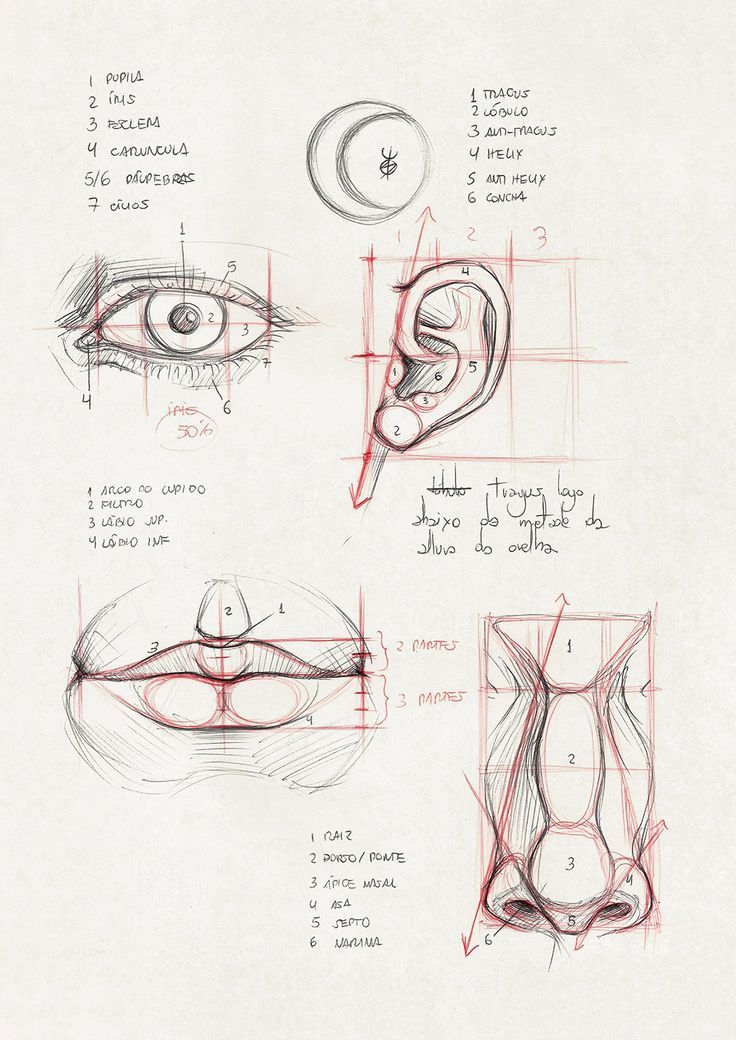
A compelling portrait lives or dies in the eyes, ears, mouth, and nose. This meticulously labeled anatomical worksheet—drawn in the classical atelier tradition—distills each feature into numbered construction zones, proportional grids, and landmark relationships. Using nothing but pencil, red guideline overlays, and concise annotations, the artist reveals a universal drafting system that works in realism, illustration, or stylized character design.
This tutorial transforms the raw study sheet into a professional, curriculum-ready masterclass. Whether you’re:
- A beginner learning accurate placement
- An intermediate artist refining proportions
- A digital painter building custom brushes
- An instructor designing a facial features module
…you will finish with a repeatable, measurable method for drawing all four features in perfect relational harmony.
The Universal Grid System
Every feature uses the same red construction framework:
| Element | Meaning |
|---|---|
| Red Horizontal Lines | Eye-level, mouth-line, nose-base |
| Red Vertical Lines | Centerline, feature width divisions |
| Numbers 1–6 | Sequential construction order |
| Circles & Ovals | 3D form placeholders |
FEATURE 1: THE EYE – 7-Layer Anatomical Stack
Top Left – Labeled 1 to 7
Construction Order (Follow Numbers)
- Pupila – Central black dot
- Iris – Circle (11.5–12mm real size)
- Esclera – White of eye (visible 1/2 iris width on each side)
- Córnea – Corneal bulge (iris sits forward) 5/6. Pálpebras – Upper & lower eyelids (thick planes wrapping sphere)
- Cílios – Eyelashes (grouped, curved, upper thicker)
Key Proportions
- Iris width = 1 unit
- Total eye width = 2 units (1 iris + 1/2 sclera left + 1/2 right)
- Upper lid crease = 1/3 iris height above iris
- Lower lid = 1/3 below
Pro Tip: Draw the sphere first, then wrap eyelids like a visor.
FEATURE 2: THE EAR – 6-Part Spiral Architecture
Top Right – Labeled 1 to 6
Construction Order
- Tragus – Small flap in front of canal
- Lóbulo – Earlobe (soft, hangs below attachment)
- Anti-tragus – Bump opposite tragus
- Hélix – Outer rim spiral
- Anti-hélix – Inner Y-shaped ridge
- Concha – Bowl leading to canal
Grid Logic
- Ear height = nose length (top of brow to base of nose)
- Ear tilt = parallel to nose bridge
- Setback = 1 eye-width behind eye corner
Anatomy Note: The ear is a modified helix spiral—think seashell, not random squiggle.
FEATURE 3: THE MOUTH – 4-Zone Form & Volume
Bottom Left – Labeled 1 to 4
Construction Order
- Arco do Cupido – Cupid’s bow peaks
- Filtro – Philtrum (vertical groove)
- Lábio Sup. – Upper lip (thinner, darker)
- Lábio Inf. – Lower lip (fuller, lighter)
Proportional Rules
- Mouth width = distance between iris centers
- Upper lip height = 1/3 total mouth height
- Lower lip height = 2/3
- Corners align with mid-pupil vertically
Volume Hack: Draw lips as two stacked cylinders—upper thinner, lower fatter.
FEATURE 4: THE NOSE – 6-Landmark Skeleton
Bottom Right – Labeled 1 to 6
Construction Order
- Raiz – Root (between eyes)
- Dorso/Ponte – Bridge
- Ápice Nasal – Tip
- Asa – Nostril wings
- Septo – Central divider
- Nariz – Overall form
Grid Blueprint
- Nose length = ear height
- Nose width at base = 1 eye width
- Nostrils = tilted ovals, never circles
- Bridge width = 1/2 nostril width
Side View Secret: The nose projects forward like a wedge—tip furthest, wings recede.
MASTER INTEGRATION: The Four Features in Harmony
The “One Eye” Spacing Rule
- Eye to ear: 1 eye width
- Eye to nose base: 1 eye width down
- Nose base to chin: 1 eye width
- Mouth width: 2 eye widths (iris to iris)
The Red Centerline
- Runs through:
- Mid-pupils
- Philtrum center
- Nose septum
- Chin cleft
Step-by-Step Tutorial: Draw All Four Features in 45 Minutes
Materials
- Smooth drawing paper
- HB & 2B pencils
- Red pen (for guidelines)
- Ruler & compass
Phase 1: Universal Grid (5 min)
- Draw vertical centerline.
- Mark eye line (mid-face).
- Add nose base and chin at 1-eye intervals.
Phase 2: Eye (10 min)
- Draw iris circle on eye line.
- Add sclera halves.
- Wrap upper/lower lids.
- Add lashes in groups of 3.
Phase 3: Ear (8 min)
- Behind eye, draw helix spiral.
- Add Y-shaped anti-helix.
- Drop lobule below attachment.
Phase 4: Mouth (7 min)
- Below nose, draw Cupid’s bow.
- Add full lower lip cylinder.
- Shade upper lip darker.
Phase 5: Nose (8 min)
- From eye line, drop bridge.
- Add ball tip.
- Draw tilted nostril ovals.
Phase 6: Final Refinement (7 min)
- Erase red lines.
- Add subtle shadows under nose, lips, ear.
- Deepen iris texture, nostril darkness.
Advanced Stylization Matrix
| Style | Eye | Ear | Mouth | Nose |
|---|---|---|---|---|
| Realism | Full sclera, radial iris | Detailed concha | Subtle philtrum | Visible ala crease |
| Anime | 70% iris, no sclera | Simplified helix | Small, upturned | Dot or line |
| Caricature | Tiny or huge | Exaggerate lobule | Overbite/underbite | Hook or button |
| Digital | Glow highlight | Rim light | Gloss on lower lip | Subsurface red |
Common Errors & Instant Fixes
| Error | Fix |
|---|---|
| Eye too high/low | Lock to mid-face grid |
| Ear too forward | Set back 1 eye width |
| Mouth too wide | Measure iris-to-iris |
| Nose flat | Add ball + wings volume |
Why This System Works
- Numbers eliminate guesswork
- Red grids ensure alignment
- Anatomical labels build muscle memory
- One-eye rule unifies the face
Master these four features, and you’ve built the structural core of any portrait.
Your 30-Day Challenge
| Week | Goal |
|---|---|
| 1 | Draw 10 eyes using 7-step method |
| 2 | Draw 10 ears in 3 angles |
| 3 | Draw 10 mouths with 3 expressions |
| 4 | Combine all four in full face |
Share progress: #FacialBlueprint
Downloadable Resources
- Printable Red Grid Template (PDF)
- 4K Reference Pack: 100 Feature Angles
- Procreate Brush: Anatomical Red Liner
- Next Lesson: Full Head Proportions & Tilt
Classical Anatomical Studies in the Tradition of Bridgman, Loomis & Bargue | Tutorial by [Portrait Precision Academy] – Accurate Drawing Since 2025