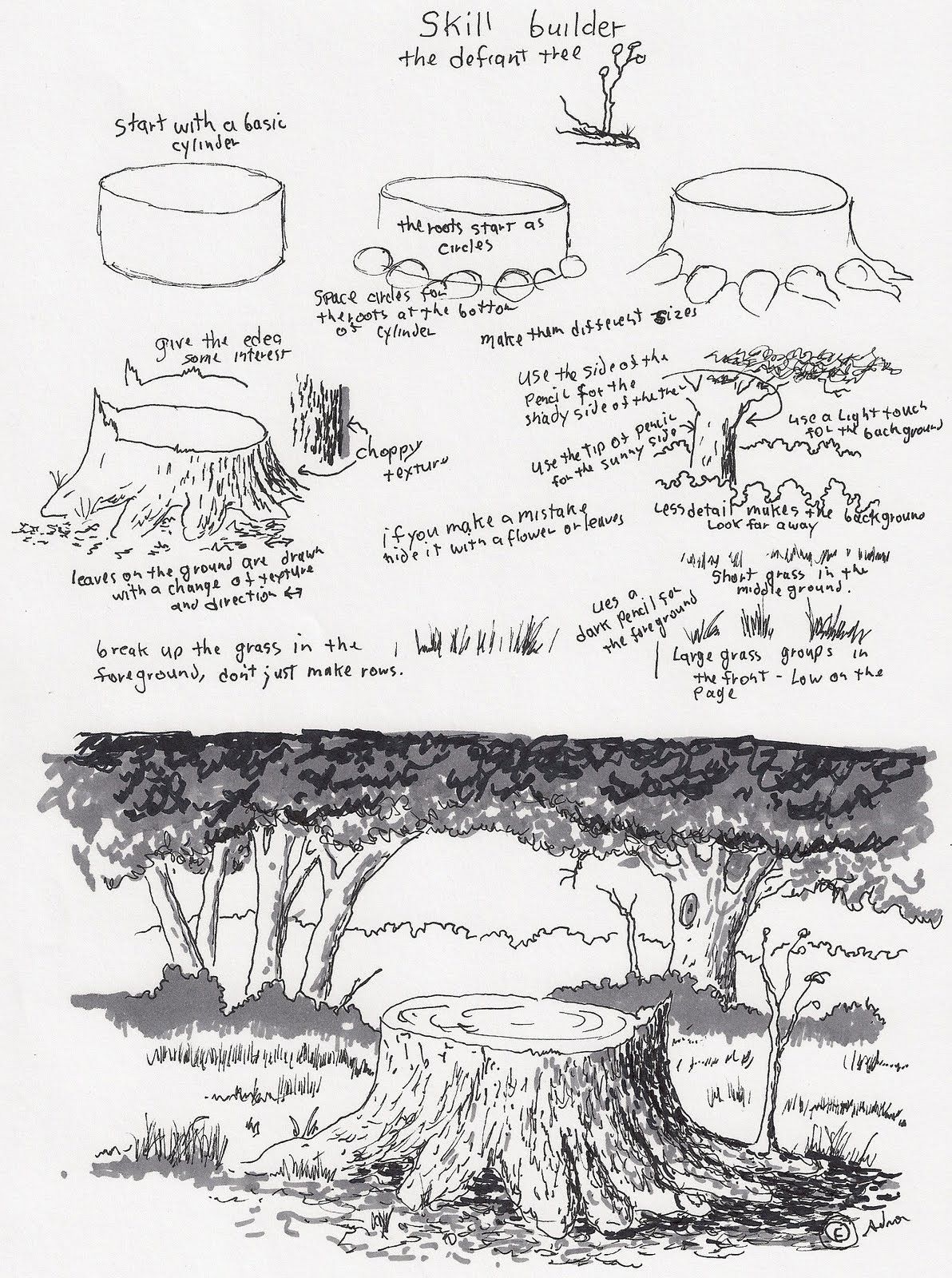
Skill-Builder: The Defiant Tree – A Complete Step-by-Step Tutorial on Drawing Character-Rich Trees with Organic Roots, Dynamic Foliage, and Natural Ground Integration

Introduction: Why “Defiant”?
Every landscape tells a story. In this masterfully annotated worksheet by artist C. Adron, one tree stands alone—gnarled, wind-bent, rooted in rocky soil, crowned with wild, asymmetrical foliage. It is not just a tree. It is the Defiant Tree—a symbol of resilience, age, and personality.
This tutorial transforms Adron’s hand-drawn skill-builder into a professional, structured lesson suitable for beginners, intermediate artists, and instructors. We’ll walk through every annotation, diagram, and technique to help you draw trees that feel alive, not just copied. By the end, you’ll be able to:
- Construct a realistic trunk from a simple cylinder
- Draw expressive, wind-shaped roots
- Build organic, light-responsive foliage
- Integrate trees into textured, believable ground
- Avoid common “flat” or “symmetrical” tree pitfalls
Let’s begin.
Worksheet Overview
The page is divided into four learning zones:
- Top Row: Trunk & root construction (cylinder → roots → branching)
- Middle Row: Foliage techniques, light logic, and detail hierarchy
- Bottom Row: Ground texture and foreground integration
- Full Scene (Bottom): Complete defiant tree in context
We’ll analyze each zone in sequence.
Zone 1: Building the Trunk & Roots (Top Diagrams)
Step 1 – Start with a Basic Cylinder
Annotation: “Start with a basic cylinder”
- Why a cylinder? Tree trunks are 3D forms, not flat shapes. A cylinder gives you volume, taper, and twist from the start.
- How to Draw:
- Draw a vertical oval (top of cylinder).
- Connect with two slightly curving parallel lines downward.
- Close with a wider oval at the base (roots will emerge here).
- Pro Tip: Tilt the cylinder slightly for contrapposto—even trees lean!
Step 2 – Roots Begin as Circles
Annotation: “The roots start as circles… Space circles for the roots at the bottom of cylinder”
- Key Insight: Roots are modified branches growing downward. Treat them like tubes emerging from the trunk base.
- Construction:
- Draw 3–5 overlapping ovals around the base.
- Vary sizes: larger near trunk, smaller as they spread.
- Connect ovals to trunk with smooth, flowing lines.
- Realism Hack: Roots follow terrain—let some dip below ground level and re-emerge.
Step 3 – Add Edge Interest
Annotation: “Give the edges some interest”
- Technique: Break the smooth cylinder with notches, scars, and bark ridges.
- Tools:
- Short, jagged lines for old wounds
- Wavy lines for bark texture
- Knot holes (small dark circles)
- Goal: Avoid a “pole” look. Even smooth bark has subtle variation.
Zone 2: Foliage, Light, and Personality (Middle Row)
Step 4 – Choppy, Wind-Shaped Foliage
Annotation: “Choppy turns” | “Leaves on the ground are drawn with a choppy direction & texture”
- Core Principle: Foliage is not a cloud. It has direction, density, and edge.
- Wind Logic:
- Prevailing wind bends branches → foliage clusters downwind.
- Upper canopy: tighter, rounder clumps
- Lower branches: longer, drooping strands
- Drawing Method:
- Use scribbled ovals in clusters.
- Vary pressure: dark where leaves overlap, light at edges.
- Leave sky holes—negative space is your friend.
Step 5 – Light & Shadow Hierarchy
Annotations:
- “Use the side of the pencil for the shady side of the tree”
- “Use the tip of pencil for the sunny side”
- “Use a light-touch for far background”
| Element | Tool | Pressure | Purpose |
|---|---|---|---|
| Sunny side | Sharp pencil tip | Light, crisp | Highlight edges |
| Shady side | Side of pencil lead | Medium, broad | Mass shadow |
| Distant trees | Light touch | Very light | Atmospheric perspective |
- Bonus: Add rim lighting—a thin bright line where sun hits the edge of foliage.
Step 6 – Detail Fall-Off
Annotation: “Less detail in the far background… Look far away”
- Rule of Thumb:
- Near: Full texture (bark ridges, leaf clumps)
- Mid: Simplified shapes
- Far: Suggest with tone, not line
- Exercise: Squint at your reference. What disappears first?
Step 7 – Ground Cover Integration
Annotation: “Break up the grass in the foreground, don’t just make rows.”
- Avoid: Even, parallel grass strokes → looks like a lawn.
- Do:
- Vary height: Tall clumps in front, shorter behind.
- Overlap: Let grass blades cross roots and trunk base.
- Add debris: Fallen leaves, twigs, small rocks.
- Texture Palette:
- |||| → tall blades
- ~ → low moss
- *** → leaf litter
Zone 3: Foreground Texture & Scale (Bottom Row)
Annotation: “Large grass groups in the front – Low at the page”
- Depth Cue: Larger, darker, more detailed elements = closer.
- Layering Strategy:
- Foreground: Bold, high-contrast grass clumps
- Midground: Tree base, roots, shadow
- Background: Faint distant treeline
Full Scene: The Defiant Tree in Context
The bottom illustration ties everything together:
- Tree: Leaning left, defying gravity
- Roots: Gripping rocky soil, some exposed
- Foliage: Wind-swept to the right, sparse on the upwind side
- Ground: Uneven, with tall grass framing the base
- Background: Washed-out forest, implying depth
Step-by-Step Tutorial: Draw Your Own Defiant Tree
Materials
- Drawing paper (smooth or medium texture)
- HB & 2B pencils
- Kneaded eraser
- Blending stump (optional)
Phase 1: Structure (5 minutes)
- Draw a tilted cylinder (2/3 page height).
- Add 5 root circles at base, varying sizes.
- Connect roots with flowing lines—some dip below ground.
- Add bark texture: notches, knots, vertical ridges.
Phase 2: Branch Framework (3 minutes)
- From top of trunk, draw 3–5 major branches arching outward.
- Add secondary twigs with quick, light lines.
- Ensure asymmetry—no mirror images.
Phase 3: Foliage Masses (7 minutes)
- Use side of pencil to block in shadow side of canopy.
- Use tip for sunlit edges.
- Scribble leaf clumps in wind direction.
- Carve out sky holes with eraser.
Phase 4: Ground & Integration (5 minutes)
- Draw tall, bold grass in foreground.
- Let blades overlap roots.
- Add fallen leaves and small rocks.
- Fade detail as you move back.
Phase 5: Final Polish (3 minutes)
- Deepen shadows under roots and on trunk’s shady side.
- Add rim light on sunlit foliage edges.
- Smudge distant background for haze.
Advanced Variations
| Style | Modification |
|---|---|
| Ancient Oak | Exaggerate root spread, add hollow in trunk |
| Storm Survivor | Split trunk, broken branches, leaning 45° |
| Digital Version | Use Procreate “Narinder Pencil” + custom grass brush |
| Ink & Wash | Outline with dip pen, wash shadows with diluted ink |
Common Mistakes & Fixes
| Mistake | Fix |
|---|---|
| Symmetrical foliage | Force one side to be 30% smaller |
| Flat ground | Add 3 height levels of grass |
| Over-detailed background | Blur or lighten far trees |
| Trunk too smooth | Add at least 5 bark imperfections |
Why This Exercise Builds Skill
The Defiant Tree trains:
- Form construction (cylinder → volume)
- Organic asymmetry (no two sides alike)
- Light logic (sunny vs. shady application)
- Depth integration (foreground/mid/background)
- Narrative drawing (a tree with character)
Master this, and you can draw any tree in any environment—from lonely sentinels to dense forests.
Your Challenge
- Draw the Defiant Tree following this tutorial.
- Then reinvent it: make it younger, taller, dead, or in snow.
- Share your version with #DefiantTreeChallenge
Downloadable Resources
- Printable Cylinder & Root Template (PDF)
- Timed Drawing Video: 20-Min Defiant Tree
- Next Lesson: Drawing Wind-Swept Pines on Cliffs
Original Art & Notes © C. Adron | Tutorial by [Your Art Academy] – Empowering Observational Drawing Since 2025