How to Accurately Divide Surfaces and Volumes in Perspective – The Professional Architect’s Method (Halves, Thirds, Quarters & Fifths)

Master one of the most valuable (yet rarely explained) skills in architectural sketching, illustration, and concept art: dividing any face, façade, or 3D volume into precise, equal proportions while in perfect perspective. Whether you’re designing windows on a skyscraper, placing columns on a temple, or subdividing a sci-fi panel, this technique will make your drawings look confident, measured, and truly professional.
What You’ll Learn in This Tutorial
- The classic diagonal/crossing method used by architects for over 400 years
- How to divide any rectangular plane into exact halves, thirds, quarters, fifths (and beyond) without guessing
- Why this works equally well in one-point, two-point, and three-point perspective
- Clean, repeatable steps that work on paper or digitally
- How to instantly elevate your sketches from “student” to “portfolio-ready”
Step-by-Step Breakdown (The Universal Method)
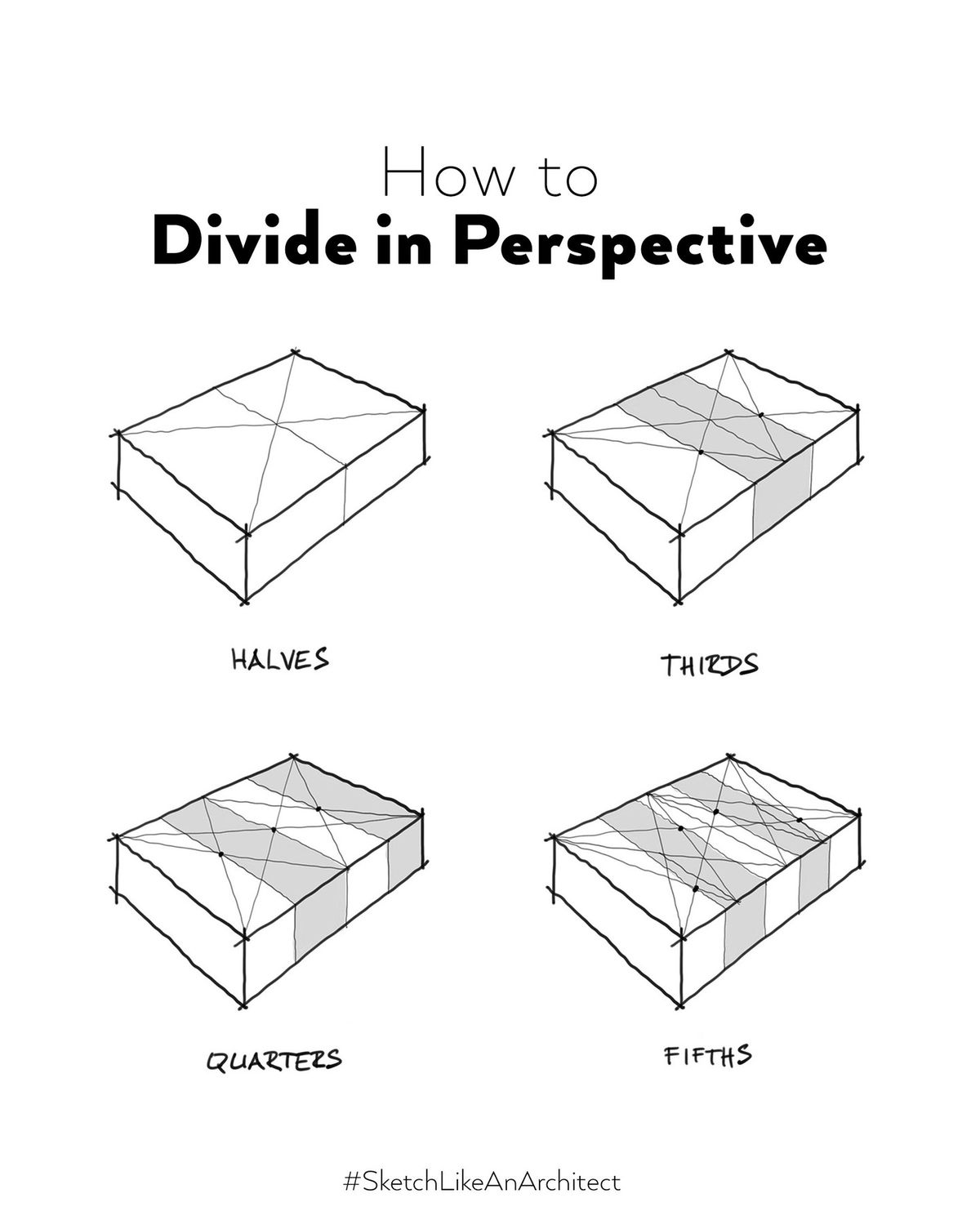
- Draw your rectangle (or any parallelogram) in perspective It can be a floor, wall, roof, or floating panel — the shape must simply have four sides and obey your vanishing points.
- To divide into HALVES Draw one diagonal from corner to corner. From the midpoint of any side, draw a line parallel to the opposite side through the intersection point of the diagonal. Done — perfect center lines in perspective.
- To divide into THIRDS From one corner, mark two arbitrary (but equal) points along one edge. Connect both points to the opposite corner. From the remaining corner, draw lines that cross these two lines and continue until they hit the opposite side. The three intersection points give you exact thirds.
- To divide into QUARTERS First find the center using the “halves” method, then apply the same diagonal technique to each half — or simply combine the halves and thirds methods.
- To divide into FIFTHS (and higher) Choose one edge and mark four equal arbitrary segments (use a ruler or just eyeball consistent ticks). Draw lines from those four points to the opposite corner. From the adjacent corner, draw a single line that crosses all four — the intersection points divide the surface into five perfectly proportional bands in perspective.
Why This Method Is Better Than Measuring or Eyeballing
- 100 % accurate every time, regardless of how extreme the perspective
- Works even when the surface is heavily foreshortened or almost edge-on
- No need for rulers, calculators, or complex math on set
- Scales infinitely — sixths, sevenths, tenths, etc., using the same principle
- Looks effortlessly professional (clients and art directors notice the precision)
Practical Applications
- Spacing windows and mullions on building elevations
- Creating evenly spaced roof tiles, bricks, or sci-fi panel lines
- Laying out columns, arches, or balcony railings
- Designing repeating patterns on floors, ceilings, or curved surfaces
- Subdividing any prop, vehicle, or environment asset in concept art
Pro Tips
- Lightly sketch construction lines in blue or non-photo blue so they disappear under ink or digital paint.
- In digital software (Procreate, Photoshop, Clip Studio), put all construction lines on a separate layer set to 10–20 % opacity.
- Once you internalize the method, you can do it almost freehand — architects often sketch entire façades in under a minute using only these divisions.
This single technique is taught on day one in most top architecture schools and is used daily by the world’s best environment artists and illustrators.
Add it to your skillset today and watch every perspective drawing you make instantly gain authority, rhythm, and precision.