Mastering Camera Lens Choice for Storyboards & Cinematography – Part 2: When and Why to Use Wide-Angle Lenses

Description (Ideal for an art-direction, storyboarding, or filmmaking tutorial website)
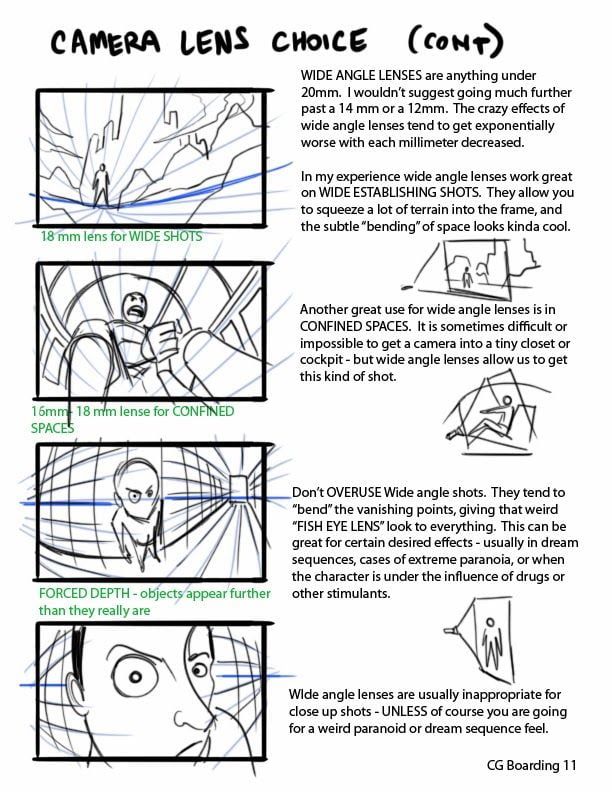
Understanding how lens choice affects mood, spatial perception, and storytelling is one of the most powerful tools a storyboard artist, director, or cinematographer can have. In this in-depth continuation page (CG Boarding – Page 11), we dive deep into the practical and creative uses of wide-angle lenses (typically 20 mm and shorter on full-frame 35 mm sensors) and show exactly when they shine — and when they can destroy your scene.
What You’ll Learn in This Tutorial
- The real-world differences between moderate wide (18–24 mm) and extreme wide/fisheye lenses
- How wide-angle lenses exaggerate depth and create “forced depth”
- Perfect scenarios for using wide lenses in confined spaces
- When wide lenses enhance drama and when they accidentally create comedy or paranoia
- Clear visual examples with side-by-side storyboard frames
Detailed Breakdown from the Board
1. Wide-Angle Definition Anything 20 mm and shorter is considered truly wide. The shorter the focal length (18 mm → 16 mm → 14 mm → 12 mm), the more pronounced the perspective distortion becomes. Vertical and horizontal lines bend dramatically, and objects near the edges stretch — this is the signature “wide-angle look.”
2. Establishing Shots & Epic Scale An 18 mm lens is perfect for sweeping cityscapes, vast interiors, or any moment you want the audience to feel the grandeur of the environment. The subtle bending of space feels dynamic and cinematic rather than cartoonish.
3. Confined / Cramped Spaces One of the best-kept secrets: wide-angle lenses are your best friend when storyboarding tiny cockpits, claustrophobic bathrooms, car interiors, or prison cells. A normal or telephoto lens simply can’t fit both the actor and the environment in frame — a 16–18 mm lens lets you get right up in the actor’s face while still showing the oppressive walls closing in around them.
4. Forced Depth – Making Objects Look Farther Apart Wide lenses push the background dramatically away from the foreground. Use this intentionally when you want a hallway to feel endless, a character to appear isolated in a huge room, or a hero to look small against an overwhelming landscape.
5. The Danger Zone: Overusing Extreme Wide Lenses Beware of “fish-eye paranoia.” Lenses shorter than ~15 mm start creating the classic “bent-world” look. Unless you’re deliberately going for dream sequences, drug-trip visuals, extreme horror, or first-person GoPro-style action, this much distortion will make your audience laugh or feel nauseated instead of immersed.
6. When NOT to Use Wide Lenses Close-up emotional dialogue scenes, romantic moments, or any time you want the audience to feel intimate and connected with a character. Wide lenses push faces to the edges where distortion is strongest and make noses and foreheads bulge unnaturally — the exact opposite of flattering or empathetic.
Quick Reference Cheat Sheet
✓ Use 14–18 mm when:
- Shooting in extremely tight locations
- You need heroic establishing shots
- You want exaggerated depth and dynamic lines
- Directing action scenes with lots of movement through environment
✗ Avoid extreme wide when:
- Filming two-shots or over-the-shoulder dialogue
- You want beauty or neutrality
- The scene is already emotionally fragile
Master these principles and your storyboards will instantly communicate the exact emotional tone the director wants — before a single frame is shot.
Perfect for storyboard artists, directors, cinematographers, concept artists, and anyone preparing camera plans for film, animation, or games.