Mastering Three-Point Perspective: The Ultimate Step-by-Step Tutorial for Drawing Dramatic Cityscapes and Towering Architecture

Three-point perspective is the most powerful and dynamic system for depicting tall buildings, skyscrapers, aerial city views, dramatic architectural scenes, and any subject viewed from extreme high or low angles. Unlike one- or two-point perspective, three-point perspective introduces a third vanishing point (usually placed far above or below the horizon), allowing vertical lines to converge dramatically—creating that iconic “looking straight up at skyscrapers” or “bird’s-eye city grid” effect.
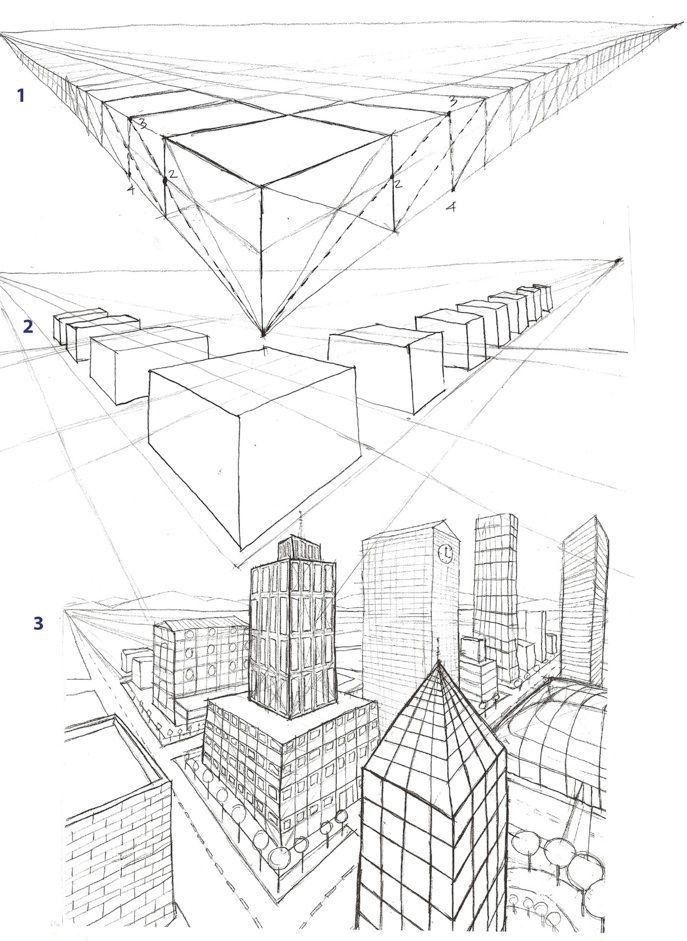
This comprehensive tutorial breaks down the exact construction method shown in the masterful schematic drawing above. Follow these steps to build convincing, accurate scenes of towering urban environments with perfect scale, proportion, and depth.
Materials Recommended
- Large drawing paper (A3 or bigger recommended)
- Pencils (HB for construction, 2B–6B for final lines)
- Long straightedge or ruler
- Eraser (kneaded for clean corrections)
- Optional: T-square, drafting triangle, or perspective grid overlay (digital or printed)
Core Principles of Three-Point Perspective
- Horizon Line — Your eye level (can be very low or very high).
- Two Horizontal Vanishing Points (VP1 & VP2) — On the horizon line; control left/right convergence of parallel lines.
- Third Vanishing Point (VP3) — Usually placed high above (for looking up) or far below (for looking down); controls vertical convergence.
- All vertical lines in reality converge toward VP3 in this system.
Step-by-Step Construction (Following the Diagram)
Step 1: Establish the Three Vanishing Points & Basic Grid
- Draw a large triangle with three points far apart: VP1 (left), VP2 (right), and VP3 (top center, high above the page).
- Connect each point to the others with long converging lines → this creates the foundational perspective grid.
- Place a central cube or rectangular prism near the bottom of the page.
- Draw lines from every corner of this central form to all three vanishing points. Result: A perfectly foreshortened cube floating in three-point space (as shown in diagram 1). Tip: The closer the central form is to VP3, the more extreme the upward distortion.
Step 2: Build a Row of Diminishing Cubes (Scale & Depth)
- From the front edge of your central cube, draw a ground line receding toward the horizon.
- Mark equal intervals along this ground line (or use a measuring system).
- From each division point, draw vertical lines upward.
- Project the top and side edges of each new cube back to VP1, VP2, and VP3. Result: A perfect row of identical cubes that appear to get smaller and closer together as they recede—classic one-point depth illusion enhanced by three-point vertical convergence (see diagram 2). Pro Tip: Keep intervals slightly closer together as they recede to enhance natural foreshortening.
Step 3: Transform Cubes into Buildings – Add Architectural Details Now turn simple boxes into believable skyscrapers and city blocks:
- Extrude upward: Extend vertical edges toward VP3 to create tall towers.
- Add roofs & setbacks: Use VP1 and VP2 to draw horizontal roof lines and ledges that converge correctly.
- Windows & grid patterns: Draw horizontal bands parallel to the horizon, then divide them with verticals converging to VP3.
- Street level & foreground: Add lower buildings, domes, curved roofs, and domes using the same three vanishing points.
- Ground plane & trees: Draw circular tree canopies on the ground plane (they become ellipses in perspective). Result: A dramatic, immersive cityscape with towering verticals, believable scale, and powerful sense of height (diagram 3).
Advanced Techniques & Pro Tips
- Extreme angles: Place VP3 very close to the top of the page for intense upward views; place it far off-page for subtler convergence.
- Bird’s-eye (downward) view: Flip the system—put VP3 far below the horizon.
- Curved forms: Use the perspective grid as a guide—plot key points on the grid, then draw smooth curves between them (domes, arches, rounded towers).
- Atmospheric perspective: Fade distant buildings lighter and cooler (blues/grays) to enhance depth.
- Avoid common mistakes:
- Never draw verticals parallel to the page edge (they must converge to VP3).
- Don’t place important subjects too close to VP3 (extreme distortion).
- Keep measuring consistent—use the grid, not guesswork.
Practice Challenges
- Replicate the exact sequence in the diagram (cube → row → cityscape).
- Draw a single skyscraper from a dramatic low angle.
- Create a full city block viewed from street level looking up.
- Try a bird’s-eye city grid with streets receding in all directions.
- Add people and vehicles—use the same three vanishing points to keep them in scale.
Three-point perspective unlocks the ability to draw architecture with cinematic drama and true three-dimensional conviction. Once you internalize the system, you’ll never struggle with “how tall should this building be?” or “why do my verticals look wrong?”
Practice this method regularly—it’s the gold standard for concept artists, illustrators, architects, and anyone who wants to depict the modern urban world with power and accuracy.
Ready to conquer towering perspectives? Start with Step 1 today and build your own dramatic city skyline!
Happy drawing! 🏙️✏️