The Iconic Brachiosaurus Cast at the Field Museum: A Sauropod Sentinel Over Chicago – A Detailed Paleontological Tutorial
Description:
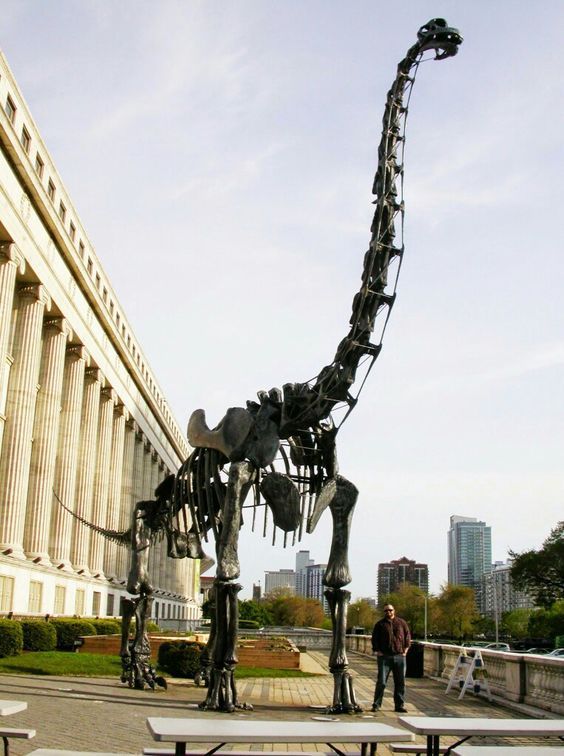
The striking image captures a towering fiberglass cast skeleton of Brachiosaurus altithorax (with elements based on the closely related Giraffatitan brancai) standing proudly on the northwest terrace outside the Field Museum of Natural History in Chicago. Posed with its long neck arched skyward, the mount gazes toward the city skyline, framed by the museum’s neoclassical columns and a person for scale—emphasizing its immense proportions. This professional tutorial-style guide explores the specimen step-by-step, perfect for educators, students, researchers, and visitors. We’ll cover the dinosaur’s anatomy, historical significance, the story of the Field Museum’s replicas, mount construction, and its cultural legacy, providing an in-depth resource for understanding one of the most recognizable sauropods in paleontology.
Step 1: Identifying the Specimen in the Image – The Outdoor Brachiosaurus Cast
The skeleton is a life-sized, all-weather fiberglass replica installed on the Field Museum’s northwest terrace in 1999. Standing approximately 72 feet (22 meters) long and 40 feet (12 meters) tall at the head, it represents Brachiosaurus altithorax, the holotype discovered by the museum’s own paleontologist Elmer S. Riggs in 1900 near Fruita, Colorado. However, since the original fossil comprises only about 20–25% of the skeleton (primarily limbs, vertebrae, and pelvis), missing parts—including much of the neck, tail, and skull—were sculpted based on the more complete African relative Giraffatitan brancai (formerly classified as Brachiosaurus brancai) from Tendaguru, Tanzania.
This composite approach creates a classic “Brachiosaurus” silhouette: longer forelimbs than hindlimbs (hence “arm lizard”), a steeply sloping back, and an elongated neck for high browsing. The dark bronze-like finish and dynamic pose make it an iconic landmark, visible from Lake Shore Drive.
A similar view of the Brachiosaurus cast on the Field Museum terrace:


Step 2: Anatomy of Brachiosaurus – Iconic Sauropod Adaptations
Break down the skeleton as if examining a fossil quarry:
- Skull and Neck: Small head with nostrils on top (possibly for snorkeling in older theories, now debated), pencil-like teeth for stripping leaves, and 13–15 elongated cervical vertebrae forming a giraffe-like neck up to 30 feet (9 meters) long.
- Limbs and Torso: Uniquely long forelimbs (humerus longer than femur) elevated the shoulders, creating a sloping posture. Massive pillar-like legs supported weights of 30–50 tons (estimates vary with modern revisions downward).
- Tail and Body: Whiplash tail for balance/counterweight; deep chest (altithorax means “deep chest”) housed a large heart for pumping blood to the elevated head—possibly requiring 1.5–2 tons of pressure.
Modern studies suggest Brachiosaurus was a high browser, feeding on conifers and cycads unavailable to shorter sauropods. Air sacs (like birds) lightened the skeleton while aiding respiration.
Tutorial tip: Compare to Giraffatitan—the Berlin mount (tallest dinosaur skeleton at 43 feet/13 meters) heavily influenced this replica’s proportions.
Diagram and details of the composite Brachiosaurus reconstruction:

Step 3: Discovery and Historical Context – The Field Museum’s Flagship Dinosaur
Brachiosaurus altithorax was named in 1903 by Elmer Riggs from bones excavated in 1900— the museum’s first major dinosaur find. Initially overshadowed by “Brontosaurus,” it gained fame in the 1990s with Jurassic Park‘s depictions (though film versions mix traits).
In 1993, coinciding with the movie’s release, the Field Museum unveiled an indoor fiberglass cast (“Ernestine”) in Stanley Field Hall. Relocated outdoors in 1999 (replaced by SUE the T. rex in 2000), this terrace version became a Chicago icon, often dressed in sports jerseys for local teams.
The indoor cast moved to O’Hare International Airport in 1999, greeting travelers in Terminal 1.
Another perspective of the outdoor mount with human scale:


Step 4: Mount Construction and Legacy – From Quarry to Landmark
The replicas were crafted by Research Casting International/Paleo Art Studios & Technologies (PAST), using molds of the holotype and measurements from Berlin’s Giraffatitan. Fiberglass over a steel armature ensured durability—though the outdoor version endured 23 Chicago winters before retirement in 2022 due to rust and cracking.
Its cultural impact: Featured in media, dressed for championships (Blackhawks, Bears), and symbolizing the museum’s dinosaur legacy until replaced by indoor titanosaur “Máximo” in 2018.
Step 5: Modern Interpretations and Visiting Tips
Recent research revises Brachiosaurus as rarer and possibly lighter (28–47 tons), with Giraffatitan distinct. No complete skeleton exists, making composites educational tools.
If visiting the Field Museum today, explore indoor exhibits like SUE, Máximo the Patagotitan, and Griffin Halls of Evolving Planet. The terrace spot now hosts temporary displays, but the airport version endures.
In summary, this image immortalizes a beloved chapter in paleontology—a composite giant bridging North American and African sauropods, welcoming generations to the wonders of deep time outside one of the world’s great natural history museums.