My Cozy Morning Routine

My Cozy Morning Routine Starting your day on a positive note can make all the difference in your productivity and overall well-being. Embracing a consistent cozy morning routine can boost your energy levels and improve your mental clarity. Morning Routine Aesthetic A well-crafted morning routine aesthetic sets the tone for a successful day, allowing you to prioritize morning self-care and establish a sense of calm before the day gets busy. Key Takeaways Establish a consistent wake-up time to regulate your body’s internal clock. Incorporate activities that promote relaxation and calmness. Prioritize self-care to boost energy levels and mental clarity. Create a cozy atmosphere that fosters a positive morning experience. Be flexible and adapt your routine as needed to suit your lifestyle. The Power of How You Start Your Day How you begin your day can significantly influence your mental and physical health. Establishing a morning routine can have a profound impact on your daily life, setting the stage for improved morning productivity and a positive mindset. A well-crafted morning routine is more than just a series of tasks; it’s a foundation for achieving a balanced lifestyle. By incorporating mindfulness practices, you can enhance your mental clarity and prepare yourself for the challenges ahead. Why Morning Routines Matter Morning routines matter because they provide a sense of structure and control. By starting your day with a clear plan, you can better manage your time and prioritize tasks effectively. This, in turn, can lead to increased productivity and reduced stress levels. Benefits Description Increased Productivity Prioritizing tasks and managing time effectively Reduced Stress Having a clear plan for the day Improved Mental Clarity Incorporating mindfulness practices The Science Behind Successful Mornings Research has shown that the way we start our day can significantly impact our circadian rhythms and overall well-being. By exposing ourselves to natural light and engaging in gentle physical activity, we can regulate our internal clocks and boost our energy levels. “The morning is an important time of day, as it sets the tone for the rest of the day.” Dr. Andrew Weil Setting Intentions vs. Going with the Flow …

My Cozy Morning Routine Read More


How Fossils Are Formed: From Living Organisms to Stone

How Fossils Are Formed: From Living Organisms to Stone The process of fossilization is a complex and fascinating one, transforming living organisms into stone over thousands or even millions of years. It begins with the death of an organism, which then gets buried under layers of sediment, protecting it from scavengers and oxygen. fossil formation As more sediment layers accumulate, the pressure increases, and the organism’s remains undergo significant changes. Over time, the original organic material is replaced with minerals, creating a stone replica of the organism. This intricate process is a key area of study in paleontology, helping us understand the history of life on Earth. Key Takeaways The fossilization process involves the transformation of living organisms into stone. Organisms must be quickly buried to protect them from scavengers and oxygen. Mineral replacement is crucial for creating a lasting fossil. Paleontology relies heavily on the study of fossils to understand Earth’s history. Fossil discovery provides valuable insights into the evolution of life. What Are Fossils? Fossils are remnants of ancient life forms that have been preserved over time. These remnants can include bones, leaves, or even tracks left behind by organisms that lived in the distant past. The study of fossils, known as paleontology, is a crucial aspect of understanding Earth’s history. Definition and Basic Concepts Fossils are the preserved remains or traces of animals, plants, and other organisms from the remote past. They are typically found in sedimentary rocks and can provide significant information about the history of life on Earth. The process of fossilization is complex and involves several stages, including burial, mineralization, and replacement. Fossils can range from tiny microorganisms to massive dinosaur bones, offering a glimpse into the diversity of life on our planet. The Importance of Fossils in Understanding Earth’s History Fossils play a vital role in understanding Earth’s history, providing evidence of past life forms and ecosystems. By studying fossils, scientists can reconstruct ancient environments and understand how life has evolved over time. The fossil record is a chronological record of the history of life on Earth, with fossils serving as a key indicator of the planet’s past climates, geological events, and the evolution of different species. This information is crucial for the field of paleontology, helping scientists to better understand the Earth’s history and the processes that have shaped our planet. The Rare Conditions Required for Fossilization For fossils to form, certain rare conditions must be satisfied, making the process of fossilization exceptionally uncommon. The journey from a living organism to a fossil involves several critical steps, each dependent on specific environmental circumstances. Quick Burial: The First Critical Step One of the primary conditions for fossilization is quick burial. When an organism dies, it must be rapidly buried by sediment to protect it from scavengers, oxygen, and other factors that contribute to decay. This swift burial helps preserve the organism’s remains, increasing the chances of fossilization. Quick burial is crucial because it shields the organism from the elements and scavengers that would otherwise consume or destroy the remains. Environments such as river deltas, where sediment is frequently deposited, are conducive to this process. Environmental Factors That Promote Preservation Besides quick burial, various environmental factors play a significant role in promoting preservation. Low oxygen levels, for instance, significantly reduce the rate of decay, while the presence of minerals can aid in the replacement of original organic material, creating a more durable fossil. A notable example of favorable environmental conditions is seen in amber preservation, where resin encases organisms, protecting them from external factors and allowing for exceptional preservation of even the most delicate structures. Environmental Factor Role in Preservation Low Oxygen Levels Reduces decay rate Presence of Minerals …

How Fossils Are Formed: From Living Organisms to Stone Read More

How to Break Any Drawing Into Simple Shapes

How to Break Any Drawing Into Simple Shapes Learning to break down complex subjects into simple shapes is a fundamental skill for artists. This technique simplifies the process of creating detailed and accurate representations of the world around us. By understanding that any subject can be reduced to basic forms, artists can more easily capture proportions and perspectives. This skill is especially beneficial for beginners, as it provides a clear and manageable approach to art basics. Drawing Basics Mastering the art of simplifying complex forms into basic shapes enhances an artist’s ability to observe and render the world with precision. It’s a crucial step in developing drawing basics skills. Key Takeaways Breaking down complex subjects into simple shapes simplifies the drawing process. This technique is fundamental for artists, especially beginners. Understanding basic forms helps in capturing accurate proportions and perspectives. Simplifying complex forms enhances an artist’s observational skills. Mastering simple shapes is a crucial step in developing drawing skills. The Power of Shape Recognition in Art The ability to break down complex subjects into simple shapes is a fundamental skill in art. This skill allows artists to accurately depict their subjects by understanding the underlying structure. By simplifying complex forms, artists can focus on proportions, perspective, and other essential elements of drawing. shape recognition in art Why Master Artists Use Simple Shapes Master artists often use simple shapes as the foundation for their work. This approach enables them to capture the essence of their subject quickly and accurately. By using basic forms, artists can ensure that their drawings are proportional and well-structured. The use of simple shapes also allows artists to simplify complex subjects, making it easier to draw from observation or memory. This technique is particularly useful when drawing complex scenes or figures, as it helps artists to break down the subject into manageable parts. How Your Brain Already Recognizes Basic Forms Our brains are wired to recognize basic forms and shapes. This innate ability is the foundation upon which more complex visual processing is built. By leveraging this natural ability, artists can improve their drawing skills and enhance their artistic abilities. Shape Artistic Application Example Circles and Ovals Organic forms, facial features Drawing portraits Squares and Rectangles …

How to Break Any Drawing Into Simple Shapes Read More

From Rough Sketch to Final Artwork: Full Process

From Rough Sketch to Final Artwork: Full Process Embarking on an artistic journey can be both thrilling and intimidating. The process of transforming a rough sketch into a final artwork involves several stages, each requiring patience, dedication, and creativity. The creative process is a personal and iterative journey, where artists refine their ideas, experiment with different techniques, and bring their vision to life. As artists navigate through the various stages, they witness significant art progress, shaping their initial sketches into captivating artworks. Art Progress Understanding the full process can help artists and enthusiasts alike appreciate the effort and skill that goes into creating a masterpiece. By breaking down the journey into manageable stages, artists can focus on refining their craft and achieving their creative goals. Key Takeaways The artistic journey involves multiple stages, from rough sketches to final artwork. The creative process is iterative and personal, requiring patience and dedication. Understanding the full process can help artists appreciate the effort involved in creating a masterpiece. Breaking down the journey into manageable stages can help artists refine their craft. The transformation from a rough sketch to final artwork is a significant achievement in an artist’s journey. The Creative Spark: Beginning Your Artistic Journey Embarking on an artistic journey begins with a spark of inspiration. As artist and educator, Brent Cotton, once said, “The most important thing is to create a body of work that is true to yourself.” Finding inspiration is the first step in this creative process. Finding Inspiration in Everyday Life Inspiration can be found in the mundane and the extraordinary alike. It might be a beautiful sunset, a conversation with a stranger, or the intricate patterns of nature. The key is to remain open and observant. Keeping an open mind allows artists to discover new sources of inspiration. As “The world is full of hidden treasures, and the artist’s task is to uncover them.” This mindset encourages exploration and creativity. Developing Your Unique Artistic Vision Developing a unique artistic vision involves more than just finding inspiration; it’s about translating that inspiration into a personal style. Keeping an Inspiration Journal One effective method for capturing inspiration is by keeping an inspiration journal. This can be a physical notebook or a digital collection where you store ideas, sketches, and references. Reference Collection Methods Building a reference collection is crucial for artistic development. This can include photographs, sketches, and other materials that inspire and inform your work. By systematically collecting and organizing these references, artists can develop a rich resource that fuels their creativity and informs their artistic vision. Essential Tools and Materials for the Complete Process Whether you’re a traditional, digital, or hybrid artist, having the essential tools and materials is vital for the creative process. The right art supplies can significantly impact the quality and expressiveness of your artwork. Traditional Art Supplies Worth Investing In For those who prefer traditional media, investing in high-quality pencils, paints, and canvases is crucial. Graphite pencils (HB, 2B, 4B, 6B) are versatile for sketching, while high-quality paints like Winsor & Newton or Grumbacher offer rich colors. Canvas or watercolor paper from brands like Canson or Fabriano can enhance the texture and durability of your work. …

From Rough Sketch to Final Artwork: Full Process Read More

10-Minute Daily Sketch Prompts to Improve Fast

10-Minute Daily Sketch Prompts to Improve Fast Are you looking to improve your drawing skills quickly and effectively? Incorporating daily sketching into your routine can be a game-changer. By dedicating just a few minutes each day to sketching, you can significantly enhance your artistic abilities. ketch Prompts Using sketch prompts can help guide your daily practice, ensuring you stay focused and motivated. These prompts can be as simple as drawing an object or as complex as creating a detailed scene. The key is to keep your practice sessions short and enjoyable, allowing you to improve your drawing skills without feeling overwhelmed. Key Takeaways Daily sketching can significantly improve your drawing skills. Using sketch prompts helps keep your practice sessions focused. Short practice sessions can be more effective than long, infrequent ones. Consistency is key to improving your artistic abilities. Daily sketching can be a fun and creative way to express yourself. The Power of Daily Sketching Practice The journey to artistic mastery begins with a simple, daily commitment to sketching. By incorporating sketching into your daily routine, you can significantly enhance your artistic skills and foster artistic growth. Daily sketching practice is not just about creating art; it’s about developing a habit that cultivates your ability to observe, interpret, and render the world around you. Why Consistency Matters More Than Talent Consistency is the backbone of skill development in sketching. While natural talent can provide a good foundation, it’s the regular practice that hones your skills and transforms you into a proficient artist. The importance of consistency can be seen in several areas: Develops muscle memory, making drawing more intuitive Enhances observational skills, allowing for more accurate representations Builds confidence, encouraging experimentation and risk-taking The Science Behind Skill Development Through Regular Practice Research in neuroscience and psychology supports the idea that regular practice is crucial for skill development. The process of learning and mastering a skill, such as sketching, involves creating new neural pathways in the brain. Regular, consistent practice strengthens these pathways, making the skill more automatic over time. As Malcolm Gladwell famously noted in his book “Outliers,” “Practice isn’t the thing you do once you’re good. It’s the thing you do that makes you good.” “The only way to do great work is to love what you do.” – Steve Jobs By understanding the science behind skill development, artists can better appreciate the value of their daily sketching practice, staying motivated to continue improving their craft. How 10-Minute Exercises Accelerate Your Progress Incorporating short, focused sketch exercises into your daily routine can significantly enhance your artistic progress. By dedicating a brief period each day to sketching, you can develop a consistent practice habit that fosters improvement and creativity. The Psychology of Time Constraints Time constraints can have a profound effect on the creative process. Parkinson’s Law states that “work expands to fill the time available for its completion.” By limiting the time available for a sketch, you can actually boost your productivity and focus. This phenomenon is known as the Zeigarnik effect, where unfinished tasks remain in your mind until completed. “The most important thing is to create, not to compete. The moment you start comparing yourself to others, you’re no longer creating.” Ray Bradbury Building Focus Through Brief, Intentional Practice Brief, intentional practice sessions can significantly improve your focus. By concentrating on a single task for a short duration, you can enhance your ability to concentrate and reduce distractions. This focused approach to practice allows you to make the most of your time and energy. …

10-Minute Daily Sketch Prompts to Improve Fast Read More

What Are Fossils? Understanding the Basics of Ancient Life

What Are Fossils? Understanding the Basics of Ancient Life Fossils are the remains or imprints of plants, animals, and other organisms from the past. They provide a window into the history of life on Earth, allowing us to study the evolution of species and ecosystems. what are fossils The study of fossils is known as paleontology, a field that has greatly contributed to our understanding of ancient life. By analyzing fossils, scientists can reconstruct the environments and conditions of the past, shedding light on the Earth’s history. Key Takeaways Fossils are the remains or imprints of ancient organisms. Paleontology is the study of fossils and their significance. Fossils provide insights into the evolution of species and ecosystems. The study of fossils helps us understand the Earth’s history. Fossils are a crucial tool for reconstructing ancient environments. What Are Fossils: The Preserved Remnants of Ancient Life To understand what fossils are, we must first consider the definition and criteria used by scientists to classify them. Fossils are not just any remains of ancient life; they must meet specific criteria to be considered as such. Scientific Definition and Criteria A fossil is defined as the preserved remains or trace of an ancient organism. The scientific community relies on specific criteria to determine whether a specimen is a fossil. These criteria include the object’s age, its origin, and whether it provides evidence of past life. The Minimum Age Requirement One of the key criteria for a specimen to be considered a fossil is its age. Generally, to be classified as a fossil, a specimen must be at least 10,000 years old. This age threshold distinguishes fossils from more recent remains. Distinguishing Fossils from Other Natural Objects Fossils are often confused with other natural objects, such as rocks or mineral deposits. However, fossils provide direct evidence of past life, whereas other objects do not. The process of fossilization involves the replacement of original organic material with minerals, preserving the structure of the organism. Understanding the definition and criteria for fossils is crucial in the field of paleontology. By applying these criteria, scientists can accurately identify and study fossils, gaining insights into the history of life on Earth. The Remarkable Process of Fossilization Fossilization is an intricate process that transforms organic remains into lasting relics of the past. This complex phenomenon has captivated scientists and the general public alike, offering a window into the history of life on Earth. Requirements for Successful Preservation For fossilization to occur, specific conditions must be met. Two crucial factors are: Rapid burial, which protects the remains from scavengers and oxygen The presence of hard parts, such as bones or shells, which are more likely to be preserved Rapid Burial and Oxygen-Free Environments Rapid burial is essential as it shields the organic matter from oxygen, reducing the likelihood of decay. Environments with low oxygen levels, such as deep-sea sediments or swamps, are ideal for this process. Presence of Hard Parts …

What Are Fossils? Understanding the Basics of Ancient Life Read More

The Intricate Process of Fossilization: A Comprehensive Step-by-Step Tutorial on How Organisms Become Fossils

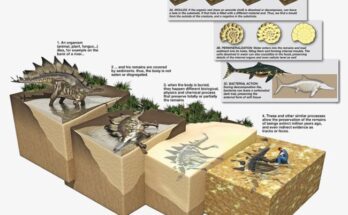
The Intricate Process of Fossilization: A Comprehensive Step-by-Step Tutorial on How Organisms Become Fossils Description: Understanding Fossilization Through Illustrated Stages Fossilization is a remarkable geological and biological phenomenon that transforms …

The Intricate Process of Fossilization: A Comprehensive Step-by-Step Tutorial on How Organisms Become Fossils Read More