Pachycephalosaurus: Unveiling the Dome-Headed Dinosaur

Introduction to Pachycephalosaurus
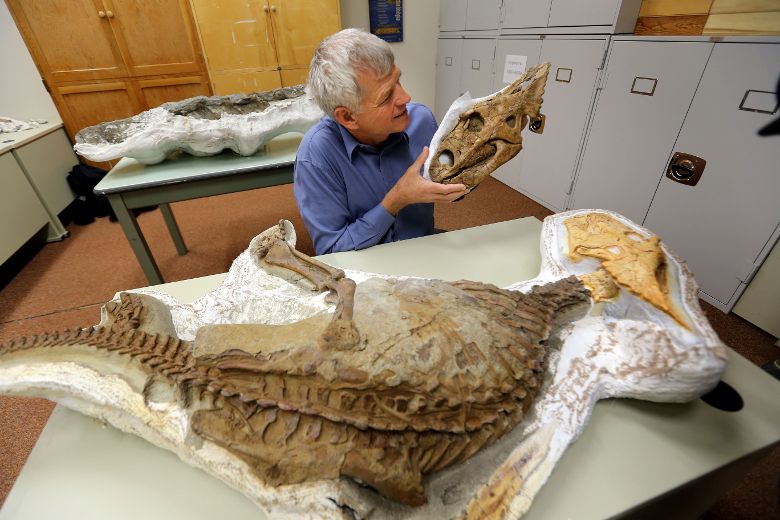
The image depicts a fascinating fossil specimen of Pachycephalosaurus, a distinctive dinosaur from the Late Cretaceous period, approximately 70–66 million years ago. Displayed in what appears to be a research or museum preparation room, the fossil includes a well-preserved skeleton with a prominent skull held by an individual, likely a paleontologist. The thick, domed cranium and associated skeletal elements provide a rare glimpse into this herbivorous theropod’s anatomy. This detailed guide, crafted as a professional paleontological tutorial, explores the taxonomy, anatomy, and ecological significance of Pachycephalosaurus, using the image as a foundation for educating enthusiasts and researchers about this unique dinosaur.
The careful handling of the skull and the detailed preservation of the skeleton highlight its scientific importance, offering insights into the life of a mature individual from the final stages of the Cretaceous.
Taxonomy and Evolutionary Context
Pachycephalosaurus is classified within the following taxonomic framework:
- Kingdom: Animalia
- Phylum: Chordata
- Class: Reptilia
- Clade: Dinosauria
- Order: †Ornithischia
- Suborder: †Pachycephalosauria
- Family: †Pachycephalosauridae
- Genus: †Pachycephalosaurus (Brown & Schlaikjer, 1943)
- Species: †P. wyomingensis (Brown & Schlaikjer, 1943)
First described from fossils found in the Hell Creek Formation of Montana and South Dakota, Pachycephalosaurus is the largest known member of the pachycephalosaurid family, known for their thick-skulled heads. This species lived during the Maastrichtian stage of the Late Cretaceous, coexisting with other iconic dinosaurs like Tyrannosaurus and Triceratops before the mass extinction event.
Physical Description and Anatomy
The fossil in the image reveals several defining characteristics:
- Skull and Dome: The most striking feature is the thick, rounded skull roof, up to 25 cm (10 inches) thick in adults, composed of solid bone. The individual holding the skull demonstrates its robust structure, likely used for head-butting or display.
- Dentition: The jaws contain small, leaf-shaped teeth suited for a herbivorous diet, indicating it fed on tough vegetation like ferns and cycads.
- Skeletal Structure: The partially exposed skeleton shows a bipedal posture with a long tail for balance, short forelimbs, and a relatively lightweight body, estimated at 4–5 meters (13–16 feet) in length.
- Preservation: The articulated vertebral column and limb bones suggest careful excavation and preparation, with the fossil embedded in a matrix that preserves fine details.
The research setting, with cabinets and additional fossils, indicates ongoing study or cataloging.
Habitat, Diet, and Paleobiology
Pachycephalosaurus inhabited the forested floodplains and coastal plains of western North America, part of the Late Cretaceous Laramidia landmass. Its diet likely consisted of low-lying plants, processed by its dental batteries and strong jaw muscles. The thick skull has sparked debate about its use—possibly for intraspecific combat (head-butting rivals) or as a species-specific display structure.
As a bipedal dinosaur, it may have been agile, using its tail for stability. Evidence from bone histology suggests it reached maturity around 10–12 years, with the specimen possibly representing an adult based on skull development.
Discovery and Preservation
Fossils of Pachycephalosaurus were first identified in the early 20th century, with significant finds in the Hell Creek and Lance Formations. The specimen in the image, likely an original fossil or high-quality cast, was preserved in fine-grained sediments, indicating rapid burial in a fluvial environment. Preparation involves mechanical cleaning and stabilization, as seen in the intact skeletal elements.
Scientific and Educational Significance
Pachycephalosaurus provides critical insights into pachycephalosaur behavior and ornithischian evolution. Studies using CT scans and biomechanical modeling explore the skull’s structural integrity, supporting theories of head-butting or display functions. The fossil’s presence in a research setting underscores its value for academic study, while its unique dome makes it a popular educational tool in museums.
Conclusion: A Window into Cretaceous Dynamics
The Pachycephalosaurus fossil offers a detailed look at a distinctive Late Cretaceous dinosaur, with its thick skull and robust skeleton revealing adaptations for survival. The research environment suggests active investigation, connecting modern science to ancient life. For enthusiasts, visiting institutions like the Museum of the Rockies or participating in dinosaur research can deepen understanding. This guide serves as a foundation for exploring Pachycephalosaurus, encouraging further study of its ecological role.
Pro Tip for Aspiring Paleontologists: When analyzing pachycephalosaur fossils, measure skull dome thickness and curvature to infer behavioral adaptations and species variation.