Exploring the Arthropod Fossils of the Paleozoic Era

Introduction to Paleozoic Arthropod Fossils
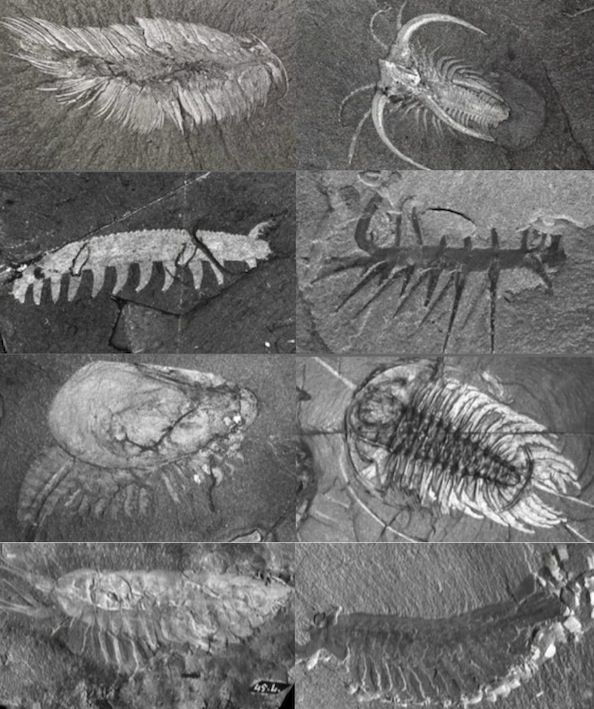
The image presents a compelling collection of fossilized arthropods from the Paleozoic era, spanning approximately 541 to 252 million years ago. This gallery features eight distinct specimens, each showcasing the diverse morphology of ancient arthropods preserved in fine sedimentary rock. These fossils, likely from formations such as the Burgess Shale or similar Lagerstätten, offer a window into the early evolution of life during the Cambrian explosion and beyond. This detailed guide, structured as a professional paleontological tutorial, examines the anatomy, taxonomy, and ecological significance of these specimens, using the image as a foundation for educating enthusiasts and researchers about the rich arthropod history of the Paleozoic.
The high level of detail in the preservation, with visible appendages and body segments, underscores the scientific value of these fossils in understanding early complex life forms.
Taxonomy and Evolutionary Context
The fossils depicted belong to various arthropod groups within the following broad taxonomic framework:
- Kingdom: Animalia
- Phylum: Arthropoda
- Subphyla: Includes Trilobitomorpha (trilobites), Chelicerata (e.g., eurypterids), and possibly Crustaceomorpha or Mandibulata (e.g., marrellomorphs)
These specimens represent key evolutionary stages during the Paleozoic, particularly the Cambrian (541–485 million years ago), Ordovician (485–443 million years ago), and Devonian (419–359 million years ago). Arthropods, characterized by segmented bodies, jointed appendages, and exoskeletons, were among the most successful early animals, diversifying into numerous ecological niches.
Specimen Analysis: A Detailed Overview
1. Top Left: Marrellomorph (e.g., Marrella)
- Description: Features feathery appendages and a segmented body, approximately 2–3 cm long.
- Significance: A hallmark of the Burgess Shale, indicating a soft-bodied, possibly planktonic lifestyle.
2. Top Right: Trilobite with Horns (e.g., Walliserops)
- Description: Displays prominent cephalic horns and a segmented exoskeleton, around 5–7 cm.
- Significance: Suggests sexual dimorphism or defensive adaptations, common in Devonian trilobites.
3. Second Row Left: Anomalocaridid (e.g., Anomalocaris)
- Description: Elongated body with grasping appendages and a circular mouth, up to 10 cm.
- Significance: An apex predator of the Cambrian, representing early arthropod complexity.
4. Second Row Right: Eurypterid (Sea Scorpion)
- Description: Scorpion-like with a broad tail and chelicerae, approximately 15–20 cm.
- Significance: Indicates a predatory marine lifestyle, with fossils from the Silurian and Devonian.
5. Third Row Left: Trilobite (e.g., Olenellus)
- Description: Rounded cephalon, thorax, and pygidium, around 4–6 cm.
- Significance: A common Cambrian form, reflecting widespread trilobite diversity.
6. Third Row Right: Trilobite (e.g., Phacops)
- Description: Well-preserved compound eyes and segmented body, about 5 cm.
- Significance: Devonian species with advanced vision, adapted to varied environments.
7. Bottom Left: Marrellomorph or Related Form
- Description: Large, fan-like appendages and a soft body, up to 8 cm.
- Significance: Suggests a filter-feeding or swimming lifestyle, common in Cambrian seas.
8. Bottom Right: Eurypterid or Large Arthropod
- Description: Long, segmented body with robust appendages, possibly 20–30 cm.
- Significance: Indicates a top predator or scavenger, with fossils from Silurian deposits.
Habitat, Diet, and Paleobiology
These arthropods inhabited marine environments ranging from shallow coastal waters to deep ocean floors. The marrellomorphs and anomalocaridids likely fed on plankton or small prey, using their appendages for filter feeding or grasping. Trilobites exhibited varied diets, from detritivory to predation, depending on species, with compound eyes suggesting keen environmental awareness. Eurypterids, as carnivores or scavengers, occupied higher trophic levels, preying on trilobites and other soft-bodied organisms.
Their exoskeletons provided protection and support, with molting evidence seen in some fossils. The exceptional preservation in anoxic sediments allowed for the retention of delicate structures, offering insights into their locomotion and sensory capabilities.
Discovery and Preservation
These fossils likely originate from Lagerstätten like the Burgess Shale (Canada), Chengjiang Biota (China), or Silurian deposits (e.g., New York). Rapid burial in fine mud under low-oxygen conditions prevented decay, preserving soft tissues alongside hard exoskeletons. Preparation involves careful mechanical cleaning and, in some cases, chemical treatment to enhance visibility.
Scientific and Educational Significance
These Paleozoic arthropods are crucial for studying the Cambrian explosion, the rapid diversification of life forms. Trilobites, with their extensive fossil record, serve as index fossils for dating rocks, while eurypterids and anomalocaridids illuminate early predator-prey dynamics. The image’s educational value lies in its comparative display, ideal for museum exhibits and academic research into arthropod evolution.
Conclusion: A Legacy of Ancient Diversity
This collection of Paleozoic arthropod fossils showcases the incredible variety and adaptability of early life forms. Their preservation offers a detailed record of the Cambrian explosion and subsequent evolutionary developments, making them a treasure for paleontology. For enthusiasts, visiting sites like the Royal Ontario Museum or engaging in fossil documentation projects can deepen appreciation. This guide provides a foundation for exploring these ancient arthropods, encouraging further study of their ecological roles.
Pro Tip for Aspiring Paleontologists: When analyzing arthropod fossils, measure segment ratios and appendage structure to infer locomotion and feeding strategies.