Dunkleosteus: The Armored Predator of the Devonian Seas

Introduction to Dunkleosteus
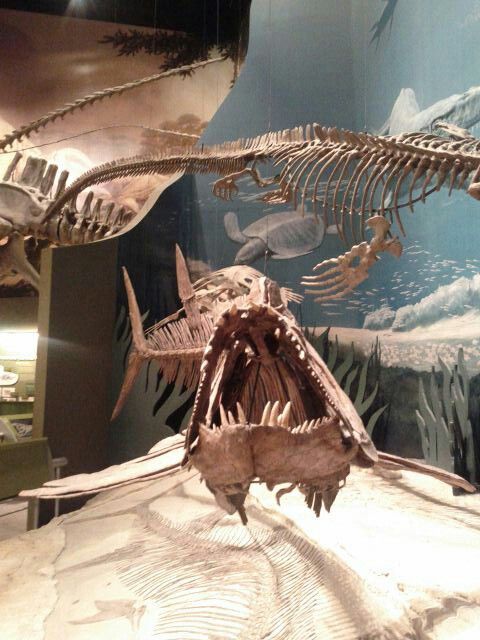
The image showcases a striking exhibit featuring the fossilized remains of Dunkleosteus, a formidable placoderm fish that dominated the oceans during the Late Devonian period, approximately 358–382 million years ago. Displayed prominently in a museum setting, the skeleton reveals a massive skull with a gaping jaw lined with sharp, bony plates, alongside the elongated vertebral column and fins of this prehistoric predator. Surrounded by other marine fossils and a backdrop depicting an ancient underwater scene, this specimen offers a vivid window into the Devonian ecosystem. This detailed guide, crafted as a professional paleontological tutorial, explores the anatomy, taxonomy, and ecological role of Dunkleosteus, utilizing the image as a foundation for educating enthusiasts and researchers about one of the earliest jawed vertebrates.
The exhibit’s dramatic presentation, with the fish’s head angled upward and its armored body partially embedded in a sedimentary matrix, highlights its role as an apex predator and provides a tangible connection to Earth’s distant past.
Taxonomy and Evolutionary Context
Dunkleosteus is classified within the following taxonomic framework:
- Kingdom: Animalia
- Phylum: Chordata
- Class: †Placodermi
- Order: †Arthrodira
- Family: †Dinichthyidae
- Genus: †Dunkleosteus (named by David Dunkle and Jay Terrell, 1934)
- Species: Multiple, with D. terrelli as the type species
Placoderms, an extinct class of armored fish, were among the first vertebrates to develop jaws, marking a significant evolutionary milestone. Dunkleosteus thrived in the Devonian “Age of Fishes,” with fossils primarily found in North America, Europe, and Morocco, within formations like the Cleveland Shale. Its lineage represents a key transition toward modern jawed vertebrates, including sharks and bony fish.
Physical Description and Anatomy
The fossil specimen in the image reveals several defining characteristics:
- Skull and Jaws: The most striking feature is the massive, armored head, measuring up to 1 meter (3.3 feet) in length in larger individuals. The jaw consists of sharp, self-sharpening bony plates rather than teeth, capable of exerting a bite force estimated at 6,000 Newtons (1,350 lbs)—comparable to a modern lion. The image shows the wide gape, indicative of its ability to consume large prey.
- Armor: The anterior portion of the body is encased in thick, bony plates, providing protection against rivals and prey. The posterior body, visible in the elongated vertebral column, was likely covered in scales or soft tissue, as seen in related arthrodires.
- Fins and Tail: The paired pectoral and pelvic fins, along with a heterocercal tail (unequal lobes), suggest powerful swimming capabilities. The fins’ skeletal structure indicates maneuverability suited for an ambush predator.
- Size: Estimates suggest Dunkleosteus grew to 6–10 meters (20–33 feet) in length, with the specimen in the image likely representing a mid-to-large individual based on the skull size relative to the display.
The surrounding marine fossils, including a long-necked plesiosaur-like creature, contextualize Dunkleosteus within a diverse Devonian seascape.
Habitat, Diet, and Paleobiology
Dunkleosteus inhabited warm, shallow seas and continental shelves, thriving in environments rich with marine life such as ammonites, trilobites, and early fish. As an apex predator, it preyed on other armored fish, sharks, and possibly smaller placoderms, using its powerful jaws to crush through bone and shell. Evidence of coprolites (fossil feces) containing fish bones supports its carnivorous diet.
Its bite mechanism, involving rapid jaw closure and a unique hinge-like articulation, allowed it to dismember prey efficiently. The armored plating suggests it faced competition or predation, possibly from other Dunkleosteus individuals, as inferred from healed bite marks on some fossils.
Discovery and Preservation
Fossils of Dunkleosteus were first described in the 19th century, with significant finds in the Ohio and Cleveland Shale formations. The specimen in the image, mounted in a museum, likely underwent meticulous preparation to preserve the delicate skull plates and vertebral column. The sedimentary matrix and articulated skeleton indicate rapid burial in an anoxic marine environment, preventing decay and scavenging.
Scientific and Educational Significance
Dunkleosteus provides critical insights into the evolution of jawed vertebrates and the diversification of marine ecosystems during the Devonian. Its biomechanical adaptations are studied using finite element analysis to model bite forces, while its armored structure informs research on early vertebrate defense mechanisms. The museum display, with its educational backdrop, serves as a resource for paleontology students and the public, illustrating the complexity of ancient marine food webs.
Conclusion: A Legacy of the Devonian
The Dunkleosteus fossil exhibit is a testament to the evolutionary innovation of the Devonian period, showcasing the rise of jawed predators that shaped marine life. Its imposing presence in the museum setting invites further exploration into paleontology, encouraging visits to institutions like the Cleveland Museum of Natural History or participation in fossil documentation projects. This guide offers a foundation for understanding Dunkleosteus, inspiring deeper investigation into the “Age of Fishes.”
Pro Tip for Aspiring Paleontologists: When studying placoderm fossils, focus on the articulation of jaw plates and the thickness of dermal armor to infer feeding strategies and predator-prey interactions.