The Last Supper: A 50-Million-Year-Old Eternal Grudge
The Discovery
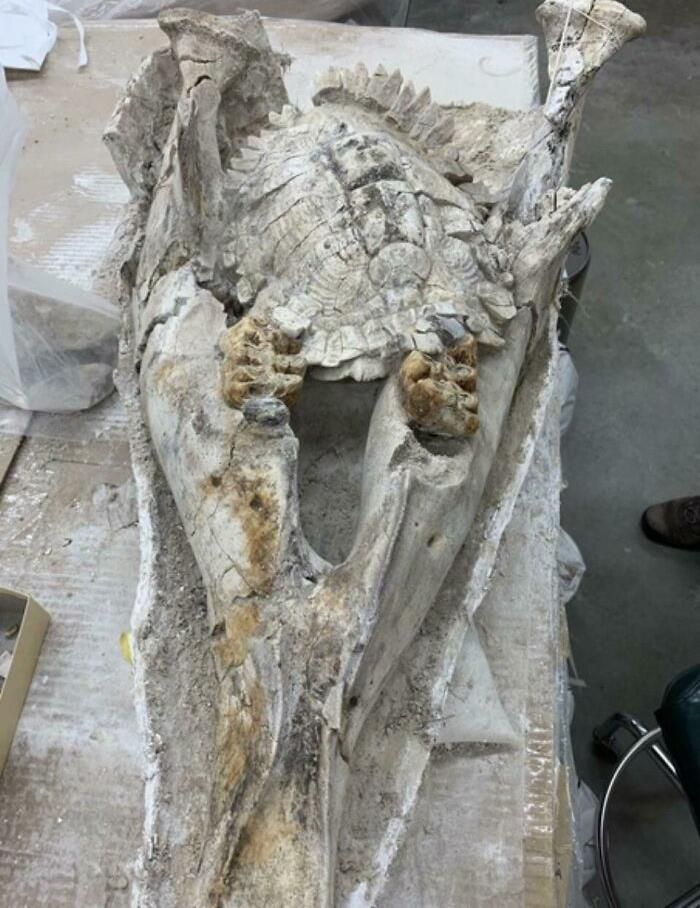
What you are looking at is a rare instance of “frozen behavior.” While paleontologists often find bones, it is much rarer to find direct evidence of a specific interaction between species. In this fossil, a turtle is lodged within the jaws of a large prehistoric crocodile (likely a species of Borealosuchus or similar Eocene-era predator).

The Anatomy of a Fossil
-
The Predator: The elongated, heavy skull surrounding the turtle belongs to an ancient crocodilian. You can clearly see the thick, reinforced bone of the snout and the sockets where massive teeth once sat.
-
The Prey: Nestled right where the throat would begin is the unmistakable scute pattern of a turtle shell. The shell appears remarkably intact, suggesting the turtle may have been the predator’s final meal before a sudden event—such as a mudslide or rapid sedimentation—buried them both.
-
The Irony: Some researchers speculate that the turtle might actually be what killed the crocodile. If the turtle was too large or its shell too hard, it could have become lodged in the predator’s throat, causing it to choke or preventing it from eating further.
Scientific Significance
Fossils like this are vital for reconstructing ancient ecosystems. They provide definitive proof of predator-prey relationships that would otherwise be based on guesswork. It tells us exactly what these giants were eating and how they hunted in the lush, swampy environments of the Paleogene period.