Airborne Early Warning & Control (AEW&C) Aircraft Comparison: Tu-126 Moss (Russia), E-767 (Japan), KJ-2000 (China), and E-2D Advanced Hawkeye (USA) – A Detailed Visual and Technical Tutorial (2026 Edition)

Description: Comprehensive Guide to Key Global AEW&C Platforms – Design Evolution, Radar Capabilities, Performance Specs, Operational Roles, and Strategic Significance
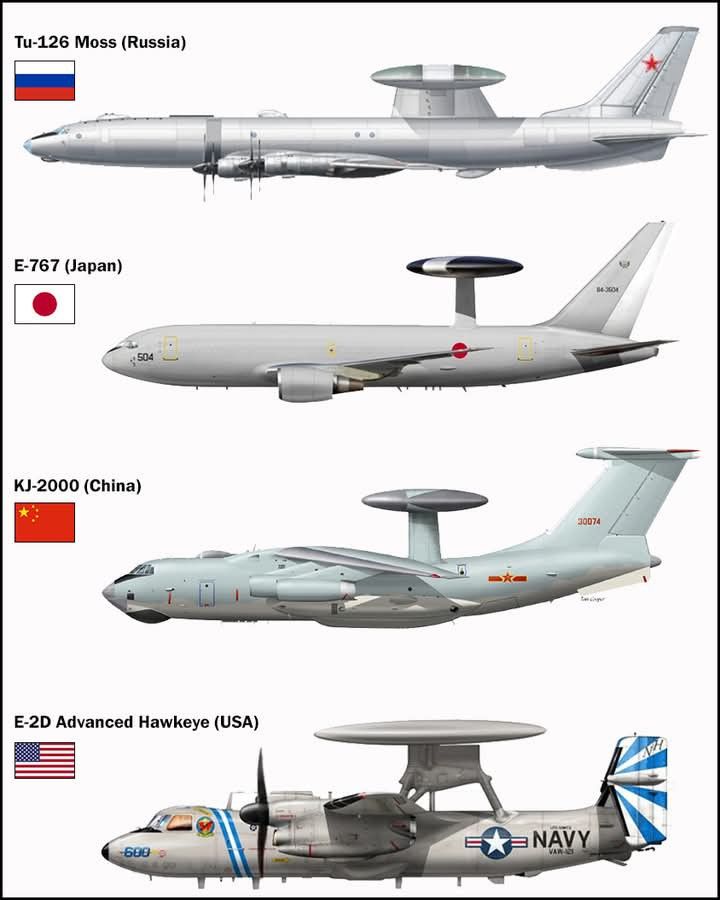
This striking side-by-side profile comparison showcases four distinctive Airborne Early Warning and Control (AEW&C) aircraft from major powers: Russia’s historic Tu-126 Moss, Japan’s Boeing E-767, China’s KJ-2000 (Mainring), and the U.S. Navy’s E-2D Advanced Hawkeye. The image uses clean technical illustrations with national flags, tail markings, and consistent angles to highlight radome designs, airframe sizes, propulsion types, and overall configurations—from massive turboprop giants to compact carrier-based rotodomes.
The layout emphasizes contrasts in philosophy:
- Tu-126 Moss (top) – Soviet-era behemoth based on the Tu-114 airliner, with a large rotating rotodome and four powerful turboprops.
- E-767 (second) – Boeing 767-based wide-body with a traditional rotating rotodome, in Japan Air Self-Defense Force markings.
- KJ-2000 (third) – Il-76-derived platform with a fixed triangular phased-array radome (non-rotating), in PLAAF gray camouflage.
- E-2D Advanced Hawkeye (bottom) – Twin-turboprop carrier aircraft with an 8-bladed propeller and oversized rotodome, in U.S. Navy high-visibility scheme.
This post functions as a professional tutorial, walking through the image step by step, providing updated 2026 specifications in a comparison table, explaining radar technologies, mission capabilities, and modern relevance for aviation enthusiasts, defense analysts, or students of military aviation.
Step 1: Visual Breakdown – Interpreting the Profiles
The composite uses realistic 3-view renders scaled for comparison:
- Radome Placement & Type: Rotating rotodomes (Tu-126, E-767, E-2D) vs. fixed triangular array (KJ-2000) – fixed designs eliminate mechanical rotation for reliability but may have coverage trade-offs.
- Airframe Scale: Tu-126 and KJ-2000 are largest (strategic endurance); E-767 is wide-body jet; E-2D is compact turboprop for carrier ops.
- Propulsion & Tail: Contra-rotating props (Tu-126), jet engines (E-767, KJ-2000), high-mounted wings and folding props (E-2D).
Pro tip: Radome size/shape directly impacts radar performance—larger domes generally support bigger antennas for longer range and better resolution.
Step 2: Historical & Design Context
- Tu-126 Moss (NATO: Moss; operational ~1970s–1980s, retired): Soviet first-generation AEW&C on Tu-114/Tu-142 airframe; Liana/Flat Jack radar for fleet defense.
- E-767 (Japan, 1998–present): Boeing 767-200ER with E-3 Sentry mission systems; four aircraft for JASDF maritime/air defense.
- KJ-2000 (China, ~2005–present): Il-76 airframe with indigenous phased-array radar; bridges capability gap toward indigenous designs like KJ-500/KJ-3000.
- E-2D Advanced Hawkeye (USA, 2010s–present): Evolution of 1960s E-2 family; carrier-based tactical AEW&C with modern AN/APY-9 radar and aerial refueling.
Step 3: Specifications Comparison Table (2026 Figures)
Approximate values from public sources (Wikipedia, manufacturer data, defense analyses); radar ranges vary by target RCS/altitude.
| Aircraft | Country | Entry/IOC | Crew (Mission + Flight) | Max Speed | Range/Endurance | Service Ceiling | Radar Type & Est. Range | Key Strengths | Status (2026) |
|---|---|---|---|---|---|---|---|---|---|
| Tu-126 Moss | Russia | 1971 | ~12 (plus spares) | ~790 km/h (Mach 0.74) | ~7,000 km / 7–10 hrs on station | ~10,000–13,000 m | Rotating L-band (Flat Jack); ~200–300 km vs bombers | Massive endurance, early Soviet AEW pioneer | Retired (replaced by A-50/A-100) |
| E-767 | Japan | 1998 | ~2 flight + 17–19 mission | Mach 0.86 (~900 km/h) | ~10,370 km / 9–13 hrs on station | ~12,200 m | Rotating AN/APY-2 (S-band); >320–400 km | High altitude, excellent over-water performance, no refueling needed | Active (4 aircraft, JASDF) |
| KJ-2000 (Mainring) | China | ~2005 | ~10–15 mission | ~850–900 km/h | ~5,500 km / 7–8 hrs endurance | ~12,000 m | Fixed 3-face AESA (L-band); ~470 km vs fighters, up to 1,200 km vs ballistic | Non-rotating array, large coverage volume | Active (~4–5 aircraft, expanding fleet) |
| E-2D Advanced Hawkeye | USA | 2014+ | 2 pilots + 3 mission | ~648 km/h (350 kts) | ~2,778 km ferry; 6–8+ hrs endurance (AR extends) | ~11,300 m (37,000 ft) | Rotating AN/APY-9 (UHF); >550 km volume, tracks 3,000+ targets | Carrier ops, all-weather, missile defense integration | Active (growing fleet, Navy primary) |
Notes: Radar ranges are estimates vs fighter-sized targets at altitude; actual performance classified. E-2D excels in tactical/carrier environments; larger platforms in strategic coverage.
Step 4: Radar & Mission Capabilities – Tutorial Insights
- Radar Tech:
- Rotating rotodomes (Tu-126, E-767, E-2D): Mechanical scan + electronic; full 360° with mechanical reliability trade-offs.
- Fixed phased-array (KJ-2000): Electronic steering, no moving parts → higher reliability, simultaneous multi-beam, but potential blind sectors.
- Roles:
- Strategic: Tu-126/KJ-2000/E-767 for wide-area surveillance, fighter direction, maritime patrol.
- Tactical/Carrier: E-2D for fleet defense, missile cueing, close integration with strike groups.
- Survivability & Integration: Modern platforms (E-2D, E-767) feature advanced data links, jamming resistance; older Tu-126 limited by 1970s tech.
Step 5: Modern Context & Future Outlook (2026)
As of early 2026:
- Tu-126: Historical artifact; lessons fed into A-50/A-100.
- E-767: Reliable JASDF backbone; potential upgrades.
- KJ-2000: Bridge to indigenous KJ-500/KJ-3000 (fixed arrays on Y-9/Y-20).
- E-2D: U.S. Navy fleet multiplier with aerial refueling doubling on-station time.
AEW&C evolves toward networked, distributed sensing (e.g., E-7 Wedgetail influence). This image captures generational shifts from Cold War giants to agile, high-tech platforms.
Dive deeper with simulators (DCS World E-2D/A-50 modules), official fact sheets, or defense journals. Which AEW&C design intrigues you most—strategic endurance or carrier versatility? Comment below!