The Enigmatic Deinotherium: A Tutorial-Style Guide to This “Terrible Beast” Proboscidean and Its Iconic Downward-Curving Tusks in Museum Display

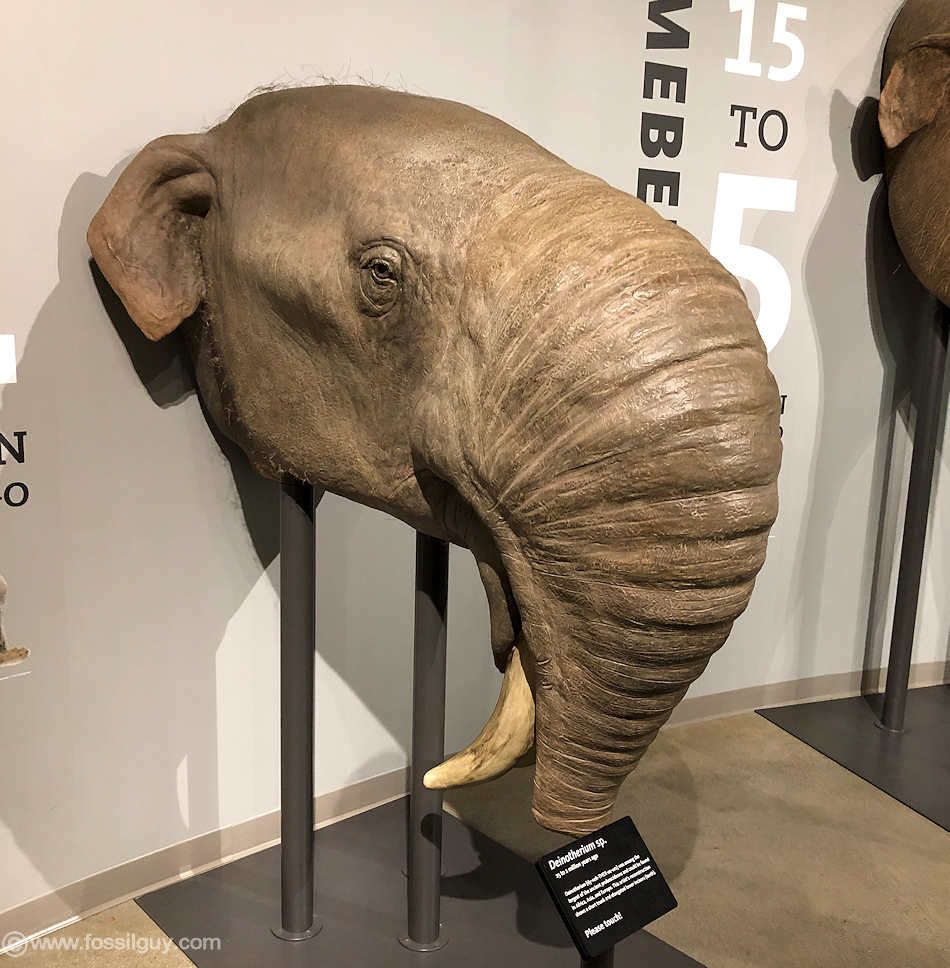
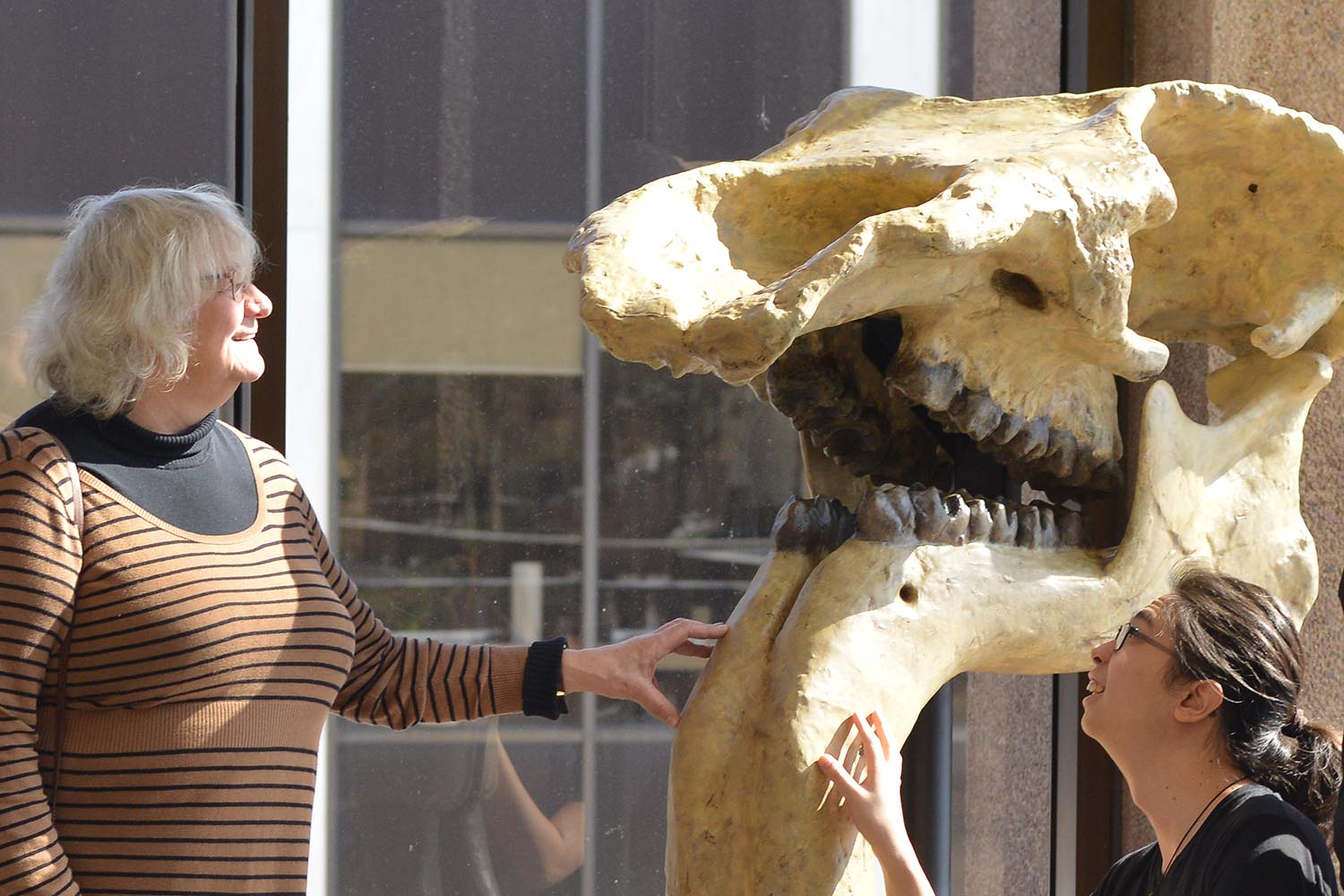
Discover one of paleontology’s most intriguing prehistoric mammals in this striking close-up of a Deinotherium sp. life-size reconstruction head, mounted in a modern museum exhibit. With its dramatically downturned lower tusks, robust wrinkled trunk, and massive proportions, this specimen exemplifies the unique adaptations of deinotheres—ancient relatives of modern elephants that roamed Eurasia and Africa from the Middle Miocene to the Early Pleistocene (~15–1 million years ago). This professional, step-by-step tutorial provides an in-depth analysis of the anatomy, paleobiology, historical context, and exhibit features—perfect for fossil enthusiasts, educators, students, and visitors exploring Cenozoic megafauna.
Step 1: Visual Examination and Distinctive Features
The photograph captures a detailed, realistic life-size model of the Deinotherium head in profile, mounted on tall metal supports for dramatic elevation. The head is angled downward, emphasizing the most iconic trait: a pair of short, thick, ivory-colored tusks emerging from the lower jaw (mandible) and curving sharply backward and downward in a hook-like arc.
Key Visible Elements:
- Downward-Curving Tusks: These lower incisors, up to 1–1.4 meters long in life, project prominently and recurve toward the ground—completely unlike the upward-curving upper tusks of modern elephants.
- Trunk (Proboscis): The elongated, muscular trunk hangs downward with deep wrinkles and folds, ending near the tusks. Scientific reconstructions suggest a shorter, more robust trunk than modern elephants, suited for grasping and manipulating vegetation.
- Skin Texture and Features: The surface shows lifelike grayish-brown wrinkled skin, a large ear, and a flat, sloping forehead—hallmarks of deinothere cranial morphology.
- Exhibit Details: Positioned against a light wall with partial signage (“MEMBE… TO 5” likely part of a timeline or label), the mount includes a plaque reading “Deinotherium sp. up to 4m at shoulder” (partially visible) and credits (@www.fossigilguy), highlighting its educational role.
Quick Identification Tip: The lower-jaw tusks are the definitive feature—no other proboscidean has this arrangement. Compare to gomphotheres (shovel-tusks) or mammoths (upper tusks only).
Here are comparable museum-mounted Deinotherium heads and full reconstructions showcasing the distinctive downward tusks:

Step 2: Geological and Evolutionary Context
Deinotherium (meaning “terrible beast”) evolved from earlier deinotheres like Prodeinotherium and thrived in forested to woodland environments across Europe, Asia, and Africa during a period of climatic cooling and habitat change. Fossils date primarily from the Late Miocene to Pliocene, with the youngest African remains (~1 million years old) overlapping early hominid evolution.
First described in 1829 by Johann Jakob von Kaup from German fossils, early paleontologists struggled with the tusk orientation—initially reconstructing them upward. Modern consensus views Deinotherium as a specialized browser, with its unique anatomy reflecting adaptations to increasingly open landscapes.
Practical Note: Authentic fossils show wear patterns on the tusks’ inner and rear surfaces, indicating repeated use in stripping bark or pulling branches.
Step 3: Anatomical Insights and Paleobiological Significance
Deinotherium was among the largest land mammals ever, with shoulder heights of 3.5–4+ meters (up to 13+ feet) and weights of 8–12+ tons—surpassing most modern African elephants.
- Tusk Function: Wear marks suggest use for stripping leaves, bark, or branches from trees—hooked downward to pull vegetation toward the mouth, assisted by the trunk.
- Trunk and Feeding: The enlarged nasal opening indicates a strong proboscis, likely shorter and more muscular than modern elephants’, for precise grasping. A flexible neck allowed head movement to position tusks effectively.
- Diet and Ecology: As a high browser in woodlands, it consumed leaves, twigs, and soft vegetation—its tapir-like molars suited for shearing rather than grinding tough grasses.
- Evolutionary Role: Deinotheres represent a basal proboscidean lineage, diverging early from the line leading to modern elephants.
Research Insight: Studies (e.g., Markov et al., 2001–2002) propose a robust, non-elephantine trunk and lower lip positioned behind the tusks for functional feeding.
Tutorial Exercise: Compare tusk orientation—sketch the head in side view, labeling mandible, lower incisors, nasal aperture, and trunk. Use online 3D models to visualize feeding posture.
Here are life-size reconstructions and size comparisons illustrating Deinotherium’s massive scale relative to humans and modern elephants:
Step 4: Exhibit Preparation, Reconstruction, and Display Tips
This museum piece is a high-fidelity life-size model (likely fiberglass/resin over a steel frame), based on fossil skulls and recent soft-tissue studies. Preparation involves:
- Scanning real fossils for accuracy.
- Sculpting skin texture, wrinkles, and hair tufts (some reconstructions add sparse hair).
- Mounting on elevated stands to convey imposing height and allow eye-level viewing.
Visitor Tips:
- View from below to appreciate tusk curvature and trunk reach.
- Read accompanying labels for timeline context (e.g., Miocene–Pliocene).
- Photograph with people for scale—the head alone rivals human height.
Step 5: Broader Significance and Further Exploration
Deinotherium captivates as a “what-if” of proboscidean evolution—its bizarre tusks highlight diverse adaptations before the dominance of modern elephants. It also connects to early human history, with African species coexisting with early hominids.
Recommended Resources:
- Books: “The First Fossil Hunters” by Adrienne Mayor (links fossils to ancient myths).
- Museums: Natural History Museum (London), La Brea Tar Pits (Los Angeles head model), or European collections.
- Online: Wikipedia’s Deinotherium page or fossilguy.com for detailed galleries.
This extraordinary Deinotherium display bridges deep time and modern wonder—inviting us to marvel at nature’s creativity. Share your thoughts or museum photos in the comments—we’d love to discuss more prehistoric giants! 🐘