Majungasaurus crenatissimus and Carnotaurus sastrei: A Stunning Side-by-Side Comparison of Abelisaurid Predators in Museum Exhibit

Introduction to the Exhibit – Two Iconic Abelisaurids Face to Face
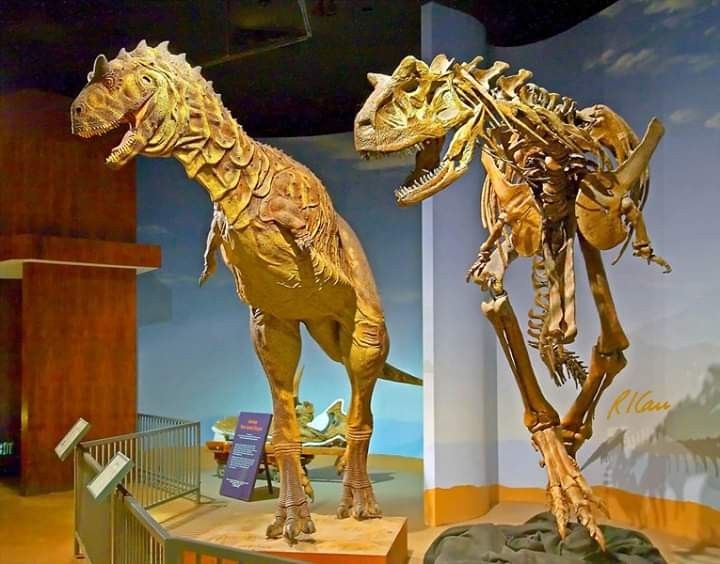
This captivating museum display features two magnificent mounted skeletons of abelisaurid theropods placed dramatically side by side, creating a powerful visual contrast that highlights evolutionary convergence and regional adaptations among Late Cretaceous carnivorous dinosaurs. On the left stands a life-sized reconstruction of Majungasaurus crenatissimus, the dominant predator of Madagascar’s Maevarano Formation around 70–66 million years ago. To its right is Carnotaurus sastrei, the famous “meat-eating bull” from Argentina’s Allen Formation, dated to roughly the same Maastrichtian stage of the Late Cretaceous.
The exhibit’s dynamic posing—with both dinosaurs in aggressive, roaring stances—evokes a hypothetical territorial confrontation, though these species never coexisted in the same ecosystem due to their geographic isolation on separate Gondwanan landmasses. The background mural of misty prehistoric landscapes, complete with distant volcanic terrain and lush vegetation, enhances the immersive experience. Informational plaques, interpretive signage, and a protective railing guide visitors while preserving the fossils. This pairing serves as an exceptional educational tool, illustrating how similar ecological pressures in isolated southern continents produced remarkably convergent body plans among abelisaurids.
Historical Discovery and Scientific Significance
Majungasaurus crenatissimus was first described in 1955 by René Lavocat based on a dentary fragment from Madagascar, though initial misidentifications (including confusion with pachycephalosaurs due to cranial ornamentation) delayed full recognition. Intensive expeditions led by teams including David W. Krause in the 1990s–2000s recovered remarkably complete material, including multiple skulls, partial skeletons, and evidence of pathologies and cannibalism—making Majungasaurus one of the best-understood abelisaurids.
Carnotaurus sastrei, discovered in 1984 by José Bonaparte in Patagonia, is known from an exceptionally well-preserved skeleton that includes skin impressions revealing rows of osteoderms. Its name (“meat-eating bull”) reflects the prominent brow horns and muscular build. Both genera belong to the family Abelisauridae within Ceratosauria, a group characterized by short, deep skulls, reduced forelimbs, and robust hindlimbs adapted for power rather than speed.
This exhibit underscores key paleontological insights: abelisaurids dominated predator niches in Gondwana after the decline of earlier large theropods, filling roles analogous to tyrannosaurids in the Northern Hemisphere but with distinct anatomical solutions.
Anatomy Tutorial: Key Features Compared Step-by-Step
Use this section as a hands-on guide for understanding abelisaurid morphology—ideal for students, educators, or anyone building 3D models or dioramas.
- Skull and Cranial Ornamentation
- Majungasaurus (left): Features a short, tall skull with a distinctive single median horn rising from the fused frontals above the eyes. The horn is hollow and porous, likely for display rather than combat. The nasal bones are rugose and swollen, and the maxilla bears numerous short, serrated teeth suited for slicing flesh.
- Carnotaurus (right): Displays two prominent supraorbital horns above the orbits, giving the “bull-like” appearance. The skull is even shorter and deeper proportionally, with extremely reduced eye sockets suggesting reliance on other senses. Both show the classic abelisaurid trait of a blunt snout and rough, textured bone surfaces. Tutorial tip: Compare bite force estimates—Majungasaurus ~4,000–6,000 N, Carnotaurus potentially higher due to skull proportions. Use CT-scan data from published studies to model jaw mechanics in software like Blender.
- Body Proportions and Posture Both exhibit the signature abelisaurid build: massive head balanced by a long, heavy tail; barrel-shaped torso; powerfully muscled hindlimbs for bursts of power; and extraordinarily reduced forelimbs (smaller than T. rex’s). Majungasaurus appears slightly more robust and stocky in this mount, while Carnotaurus shows longer, more slender legs suggesting marginally greater agility. Tutorial tip: Measure ratios—head length to femur length is ~0.8–1.0 in abelisaurids (vs. ~0.6 in tyrannosaurids). Replicate poses using armatures and clay for accurate biomechanics.
- Vertebral Column and Axial Skeleton The cervical vertebrae are robust with interlocking ribs (especially pronounced in Majungasaurus), supporting strong neck muscles for head-butting or prey manipulation. Dorsal vertebrae show extensive pneumatization (air sacs), reducing weight while maintaining strength. Tutorial tip: Study serial variation—cervical ribs in Majungasaurus are caudally bifurcate and pneumatic. Use open-access 3D scans from MorphoSource to print scaled sections.
- Limbs and Armor Hindlimbs are pillar-like with a pinched third metatarsal (arctometatarsus-like structure in some). Forelimbs are vestigial, with reduced digits. Carnotaurus preserves skin impressions showing conical osteoderms along the back and sides—Majungasaurus likely had similar armor, though less documented. Tutorial tip: For reconstructions, layer osteoderms using reference photos; apply biomechanical tests to estimate running speeds (~20–30 km/h max for bursts).
Habitat, Diet, and Behavior Insights
Majungasaurus inhabited semi-arid floodplains with sauropods like Rapetosaurus, relying on ambush predation and possibly scavenging—including documented cannibalism from bite-mark evidence. Carnotaurus lived in more open, arid environments, preying on hadrosaurs and titanosaurs with powerful bites suited to bone-crushing.
Both were apex predators in their isolated ecosystems, demonstrating how plate tectonics shaped dinosaur evolution.
Educational Value and How to Explore Further
This side-by-side display is a perfect primer on Gondwanan paleobiogeography and convergent evolution. To deepen your understanding:
- Read primary literature: Krause et al. (2007) monograph on Majungasaurus; Bonaparte’s original Carnotaurus description.
- Visit similar mounts: University of Michigan Museum of Natural History (Majungasaurus); Museo Municipal Carmen Funes (Carnotaurus cast).
- Hands-on activity: Download free 3D models from Sketchfab or DigiMorph, compare in VR, or create comparative infographics.
Whether you’re a paleontology enthusiast, teacher preparing a lesson, or museum-goer seeking inspiration, this exhibit brings the bizarre beauty of abelisaurid dinosaurs vividly to life—reminding us how evolution crafts similar solutions across separated worlds.