Unveiling the Deinosuchus Skull: A Comprehensive Guide to the Anatomy, Discovery, and Paleontological Significance of This Prehistoric Predator

Description:
Welcome to this in-depth exploration of one of the most formidable fossils from the Late Cretaceous period: the skull of Deinosuchus riograndensis. In this tutorial-style article, we’ll dissect the features of this remarkable specimen step by step, drawing from paleontological insights to provide a professional, detailed overview suitable for enthusiasts, students, and researchers alike. Whether you’re a budding paleontologist or simply fascinated by ancient life forms, this guide will walk you through the identification, anatomical breakdown, historical context, and scientific importance of this fossil, as showcased in museum displays worldwide. We’ll base our analysis on a classic example of a Deinosuchus skull exhibit, complete with visual references and explanatory notes to enhance your understanding.
Step 1: Introduction to Deinosuchus – The “Terror Crocodile”
Deinosuchus, meaning “terrible crocodile” in Greek, was an extinct genus of alligatoroid crocodilian that roamed North America approximately 82 to 73 million years ago during the Campanian stage of the Late Cretaceous epoch. Often referred to as the “terror crocodile,” this apex predator could grow up to 12 meters (39 feet) in length and weigh over 8 tons, making it one of the largest crocodilians ever to exist—dwarfing even modern saltwater crocodiles.
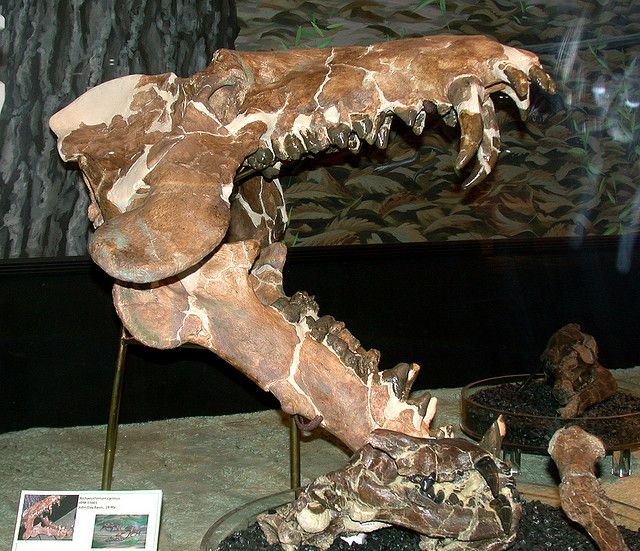
The fossil skull in question, typically displayed in museums like the Texas Memorial Museum or Big Bend National Park exhibits, represents a prime example of Deinosuchus riograndensis, a species primarily known from remains found in Texas, USA. The skull’s imposing structure, with its elongated jaws and robust build, highlights the creature’s role as a top predator capable of ambushing dinosaurs and other large prey along ancient riverbanks and coastal environments. In museum settings, such skulls are often mounted on metal stands for stability, surrounded by complementary fossils like vertebrae or smaller reptilian remains, and set against murals depicting lush, prehistoric floodplains to evoke the era’s ecosystem.
If you’re examining a similar display (as in the referenced image), note the brownish, mineralized bone texture—this results from permineralization, where groundwater replaces organic material with minerals like silica or iron over millions of years, preserving the structure in exquisite detail.
Step 2: Identifying Key Features in the Fossil Skull – A Visual Breakdown
To appreciate this fossil like a professional paleontologist, start by observing its macroscopic features. Here’s a step-by-step tutorial on how to analyze and identify a Deinosuchus skull:
- Overall Structure and Size: The skull measures around 1.5 to 2 meters in length in complete specimens, though displays often feature partial or reconstructed elements. It’s dorsoventrally flattened (wider than tall) with a triangular profile when viewed from the side. Begin your inspection by measuring the length from the tip of the snout to the back of the cranium—compare it to modern alligator skulls to gauge the scale ( Deinosuchus skulls are roughly twice as large).
- Snout and Jaw Morphology: The most striking aspect is the elongated, U-shaped snout, which tapers to a pointed tip. This design optimized for snapping at prey in water. Count the teeth sockets: Deinosuchus had up to 40-50 conical teeth per jaw half, adapted for puncturing and holding rather than slicing. In the display, observe how the lower jaw (mandible) articulates with the upper jaw (maxilla), often positioned in an open-mouthed pose to showcase the interlocking dentition. Tutorial Tip: Use a magnifying glass or digital zoom to spot wear patterns on the teeth—these indicate a diet of hard-shelled turtles, fish, and even dinosaurs like hadrosaurs.
- Orbital and Nasal Regions: Above the jaws, locate the large eye sockets (orbits), which are positioned on the top of the skull for a periscope-like view while submerged. The nasal openings (nares) are elevated, allowing breathing at the water’s surface. Note any ridges or bony protuberances—these are osteoderms, armored plates that provided protection and may have aided in thermoregulation.
- Cranial Robustness: The back of the skull features a massive quadrate bone for powerful jaw closure, estimated to exert bite forces exceeding 23,000 pounds—stronger than a T. rex in some models. Examine the sutures (joints between bones) for signs of fusion, which indicate an adult specimen.
- Preservation and Coloration: The fossil’s mottled brown and white hues stem from iron oxide and calcite infilling. In museum prep, conservators clean the bone with tools like air scribes to remove matrix rock without damaging the surface. If you’re replicating this at home with a replica, use acrylic paints to mimic the natural patina.
Surrounding elements in the display, such as smaller jaw fragments or limb bones, provide context— these are often from the same formation, like the Aguja Formation in Texas, emphasizing Deinosuchus‘s habitat.
Step 3: Historical Discovery and Excavation – Tracing the Fossil’s Journey
Understanding the provenance adds depth to any fossil study. Deinosuchus was first described in 1909 by paleontologist Ermine Cowles Case based on teeth from Montana, but complete skulls like this one were unearthed in the 1940s-1950s from Big Bend National Park by teams from the University of Texas.
- Excavation Tutorial: Fossils are located via prospecting—scanning eroding outcrops for bone fragments. Once spotted, excavators use picks and brushes to expose the skull, then apply plaster jackets for transport. In the lab, preparation involves acid baths (e.g., acetic acid) to dissolve surrounding rock. For Deinosuchus, challenges include the skull’s weight (up to 500 kg), requiring cranes for handling.
- Key Discoveries: The holotype specimen from Texas revealed bite marks on dinosaur bones, suggesting Deinosuchus preyed on tyrannosaurids. Modern CT scans (computed tomography) allow non-invasive internal views, revealing brain case structures.
If you’re interested in fieldwork, start with local fossil hunts (check permits!) and use resources like the Paleobiology Database for location data.
Step 4: Paleobiology and Ecology – Reconstructing the Life of Deinosuchus
To bring this fossil to life, consider its biology through comparative anatomy:
- Diet and Hunting: As a semi-aquatic ambush predator, Deinosuchus lurked in rivers, using its powerful jaws to crush prey. Isotopic analysis of teeth shows a mixed diet of marine and terrestrial animals.
- Growth and Lifespan: Juveniles grew rapidly, reaching maturity in 10-15 years. Scars on skulls indicate territorial fights.
- Extinction Context: Deinosuchus vanished at the Cretaceous-Paleogene boundary, likely due to the Chicxulub asteroid impact disrupting food chains.
Tutorial Exercise: Sketch a reconstruction—start with the skull outline, add flesh based on modern croc relatives, and color it with camouflage patterns for a swampy environment.
Step 5: Scientific Significance and Modern Research
This skull isn’t just a relic; it’s a window into evolution. Deinosuchus bridges modern alligators and ancient archosaurs, informing studies on crocodilian gigantism (why some grew so large). Ongoing research uses finite element analysis (FEA) to model bite mechanics, aiding biomechanics in engineering.
For further study:
- Visit museums like the Smithsonian or Perot Museum.
- Read papers: Colbert and Bird’s 1954 description.
- Tools: Use 3D scanning apps to digitize replicas.
In conclusion, the Deinosuchus skull exemplifies the wonders of paleontology, blending raw power with intricate evolutionary history. By following this guide, you’ve gained the skills to analyze similar fossils professionally. Share your thoughts or your own fossil finds in the comments below!