Two Revolutionary Science Facts That Redefine Human Origins and Climate Restoration: Ghost Archaic Hominins in West African DNA and Colossal Biosciences’ Elephant-Mammoth Hybrid Engineering Project
Discover two of the most astonishing breakthroughs in modern science—perfectly captured in our exclusive infographic—that bridge the deepest chapters of human prehistory with cutting-edge biotechnology aimed at healing our planet. This detailed, tutorial-style guide walks you through each fact step by step, explaining the science, the evidence, the visuals, and the profound implications, so you can fully appreciate how these discoveries are reshaping what we know about ourselves and our future.

1. The Hidden “Ghost” Species in Modern Human Genomes
Modern humans, especially populations in West Africa, carry detectable traces of DNA from one or more unknown archaic hominin species—often called “ghost” lineages because no physical fossils have ever been found. Genetic research shows these mysterious relatives diverged from the modern human line as long as one million years ago. Yet, tens of thousands of years ago, they interbred with our direct ancestors, leaving subtle but unmistakable genetic signatures embedded in living people today.
Advanced whole-genome sequencing and statistical modeling have now confirmed multiple independent “ghost” introgression events across different African populations. Unlike the well-documented Neanderthal and Denisovan contributions found outside Africa, these West African ghost lineages are unique: they appear only through computational detection of DNA segments that do not match any known fossil hominin. The absence of skeletal remains makes the discovery even more remarkable—science has literally reconstructed an entire extinct branch of humanity from the living genomes of people walking the Earth right now.
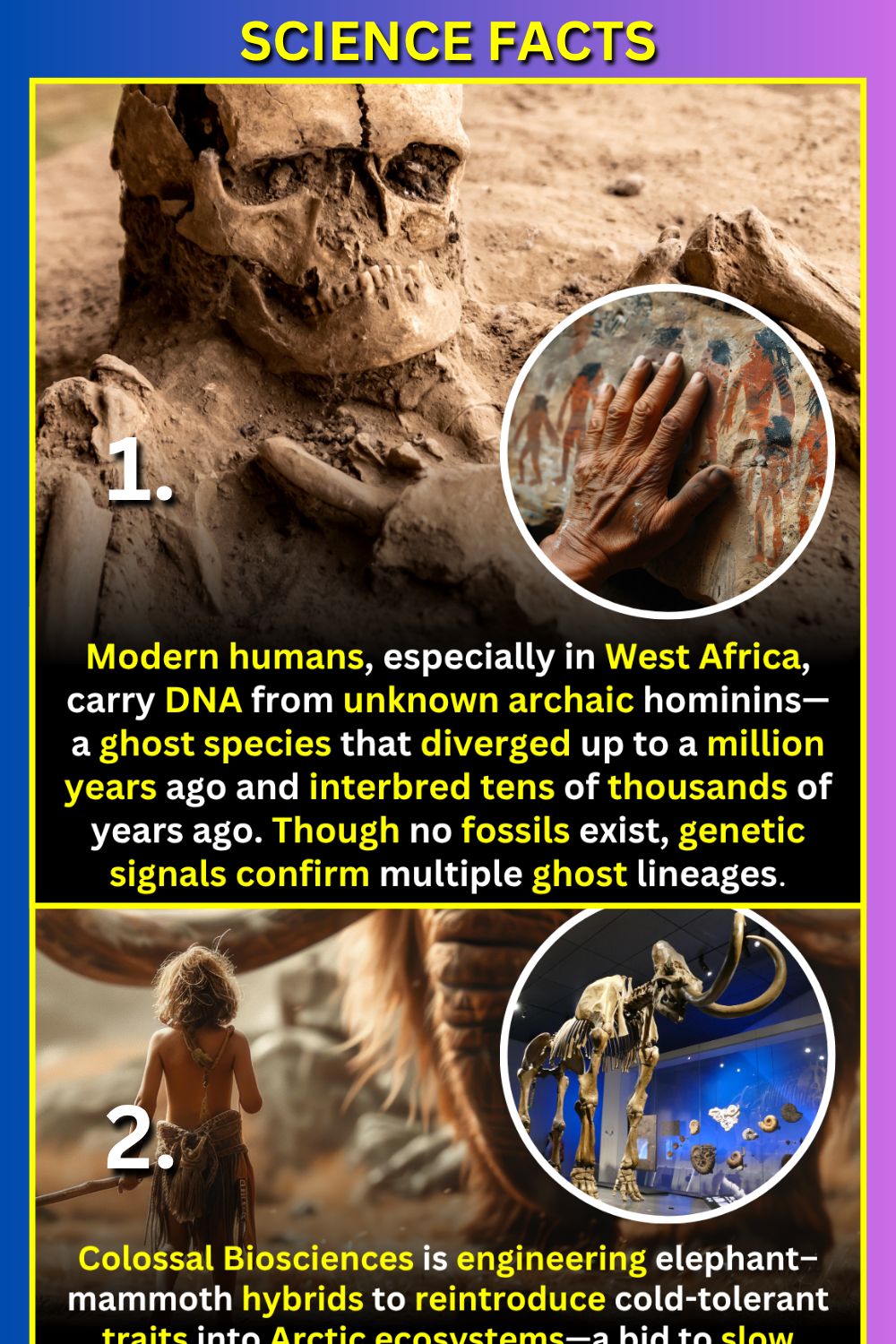
In the accompanying infographic image, a weathered archaic hominin skull emerges from desert sand while a modern human hand rests on ancient cave paintings. This powerful visual symbolizes the invisible thread connecting us to an unknown relative whose story was written only in our DNA.
Tutorial takeaway: To understand how scientists detect ghost species, researchers align modern African genomes against reference sequences from Neanderthals, Denisovans, and chimpanzees. Any unusually divergent segments that cannot be explained by known admixture are flagged as “ghost” ancestry. Divergence time is calculated using molecular clocks, and admixture dates are estimated through linkage disequilibrium decay. The result? A richer, more complex human family tree that proves interbreeding was not a rare side event but a recurring chapter in our evolutionary story.
2. Engineering Elephant-Mammoth Hybrids to Restore Arctic Ecosystems
Shifting from ancient history to tomorrow’s solutions, Colossal Biosciences is actively creating elephant-mammoth hybrids by editing the genome of Asian elephants with key woolly mammoth traits. The goal is to reintroduce cold-tolerant characteristics—thick insulating fur, specialized fat layers, smaller ears, and hemoglobin adapted to cold blood—directly into living animals. These hybrids are designed for eventual release into Arctic tundra ecosystems, where they can help slow the accelerating effects of climate change.
The project combines paleogenomics (recovering mammoth DNA from permafrost-preserved specimens) with CRISPR precision editing and synthetic biology. By inserting mammoth alleles into elephant cell lines, scientists produce viable embryos that carry the cold-adaptation toolkit of their extinct cousins. The ultimate vision is a self-sustaining population of these engineered giants that can once again roam the Arctic, trampling snow to expose grass, promoting vegetation that reflects sunlight, and stabilizing permafrost to reduce methane release—one of the most potent greenhouse gases.
The infographic’s lower panel beautifully contrasts past and future: a young prehistoric human stands beside a massive woolly mammoth while an inset shows a complete mammoth skeleton displayed in a modern museum under dramatic blue lighting. These visuals underscore the full-circle journey—from extinction 4,000 years ago to deliberate resurrection through human ingenuity.
Tutorial takeaway: The engineering process follows a clear pipeline: (1) sequence high-quality mammoth genomes from Siberian specimens; (2) identify functional genes for cold tolerance (e.g., those controlling fur growth, fat metabolism, and oxygen transport); (3) use CRISPR-Cas9 to edit elephant stem cells; (4) create embryos via somatic cell nuclear transfer or artificial gametes; and (5) plan ethical, phased rewilding trials in controlled Arctic preserves. Early prototypes already demonstrate viable cold-adapted traits in lab settings, marking the first time humanity has the tools to bring back an entire ecological engineer species to fight climate change.
These two facts together illustrate science at its most profound: one revealing the invisible ancestors who shaped us, the other showing how we can now shape the future. Whether you are a student of human evolution, a climate advocate, or simply fascinated by the power of genetics, these discoveries prove that the past and the future are closer than we ever imagined.
Share this post, explore the infographic, and join the conversation—because understanding these breakthroughs is the first step toward appreciating both where we came from and where we can still go.