48 Bizarre Facts About Fossils: Uncovering the Weird and Wonderful Side of Paleontology
Fossils aren’t just dusty bones—they’re time capsules packed with surprises, myths, oddities, and groundbreaking revelations. From ancient poop that tells tales of diets to dinosaur names born from frustration, the world of fossils is full of bizarre stories. The viral list you’ve shared (from sources like Fact Republic) highlights some of the strangest entries, blending science, history, and a touch of the absurd. Below, we’ll dive into the facts from your image, provide context, corrections where needed, and expand with related bizarre insights to give a fuller picture of why fossils never cease to amaze.
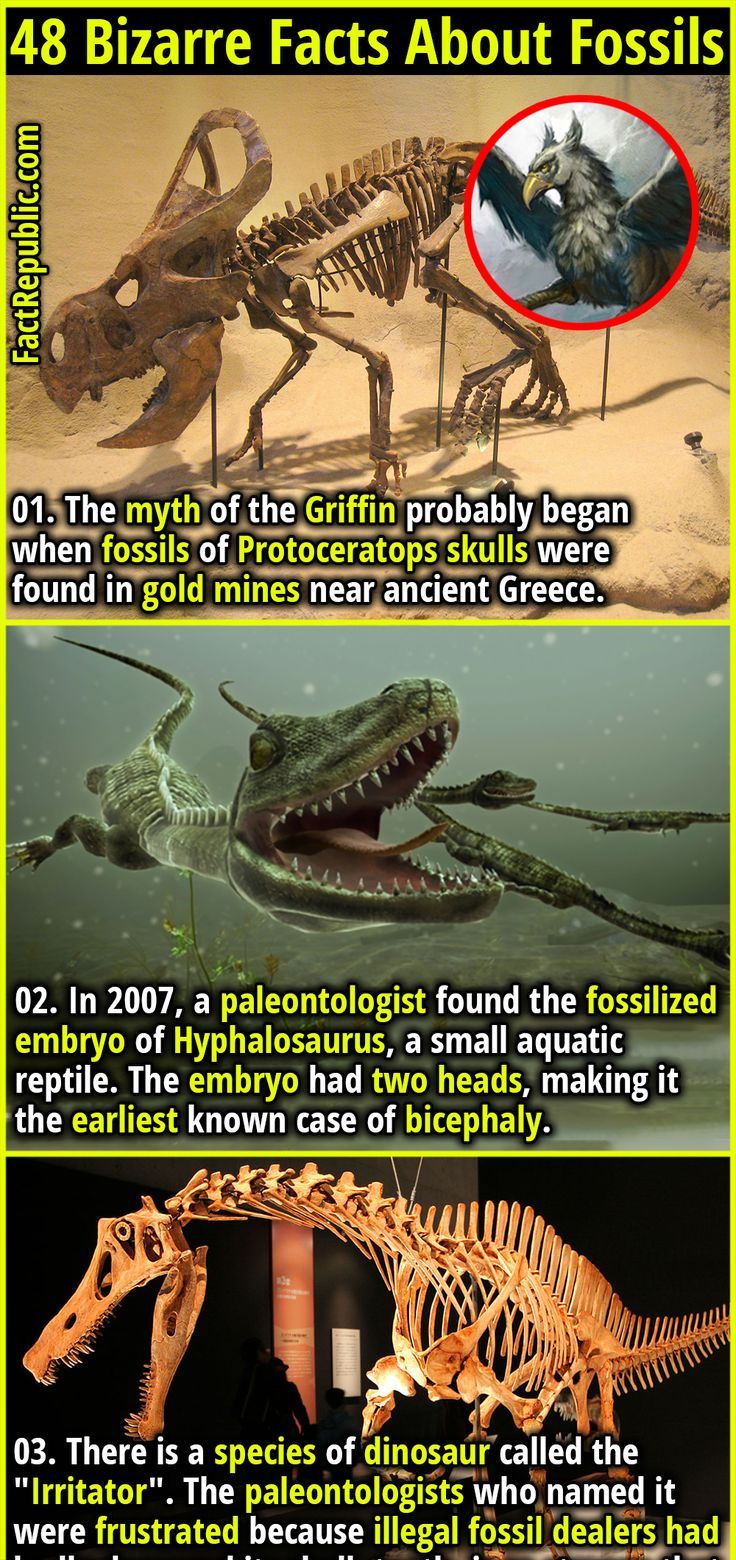
(Iconic Protoceratops skull fossil with its parrot-like beak and frill—often cited as a possible inspiration for griffin myths due to its bird-mammal hybrid appearance.)

The Griffin Myth & Protoceratops Connection (Fact #1)
The myth of the griffin—a legendary creature with a lion’s body and eagle’s head/wings—likely originated from ancient discoveries of Protoceratops fossils in the Gobi Desert region of Mongolia and China. These small horned dinosaurs (sheep-sized, Late Cretaceous ~75–71 million years ago) have beaked skulls that resemble eagle heads, with frills that could be misinterpreted as ears or even proto-wings. Fossils were often found near gold deposits or along ancient trade routes like the Silk Road, leading Greek and Roman travelers to weave tales of fierce, gold-guarding beasts. Adrienne Mayor’s research in the 1990s popularized this idea, though some experts debate the direct link (griffins predate widespread Protoceratops knowledge in the West). Still, it’s one of paleontology’s coolest “fossil-to-myth” stories.
(Artistic reconstruction of a griffin superimposed over a Protoceratops skeleton, showing the striking visual parallels in beak, quadrupedal stance, and cranial features.)
The Two-Headed Hyphalosaurus Embryo (Fact #2)
In 2006–2007, paleontologists described an extraordinary fossil from China’s Yixian Formation (~125 million years ago, Early Cretaceous): a tiny Hyphalosaurus (a small aquatic choristodere reptile) embryo or neonate with two fully formed heads and necks—the oldest known case of axial bifurcation (a developmental malformation where an embryo partially splits into twins). The specimen, just ~70 mm long, shows clear duplication from the neck forward, preserved in fine lake sediment. This rare condition (seen today in some snakes and turtles) provides a window into ancient developmental biology and proves such anomalies occurred deep in evolutionary time.
(Photograph of the famous two-headed Hyphalosaurus fossil slab, with both heads and necks clearly visible in the delicate matrix— a haunting glimpse into prehistoric birth defects.)
The “Irritator” Dinosaur Name Origin (Fact #3)
Irritator challengeri, a spinosaurid from Early Cretaceous Brazil (~113–110 million years ago), earned its genus name from pure frustration. Fossil poachers/illegal dealers heavily altered the skull with plaster to make it look more dramatic and marketable on the black market—elongating the snout artificially. When legitimate paleontologists (including David Martill and colleagues) acquired and prepared it in 1996, they discovered the tampering, calling it “irritating.” The species name honors Professor Challenger from Arthur Conan Doyle’s The Lost World. It’s a rare case of a dinosaur name directly reflecting human mischief in the fossil trade.
(Reconstructed skull of Irritator, showing the elongated, crocodile-like snout typical of spinosaurids— the artificial extensions were painstakingly removed during preparation.)
These three facts kick off the “48 bizarre” list with a perfect mix of myth-busting, freakish biology, and real-world drama. The full compilation (often shared on sites like Pinterest and fact pages) covers everything from fossilized poop (coprolites) revealing ancient diets to penguins once living in Peru or shark teeth found on mountaintops due to tectonic uplift.
Fossils continue to surprise us—whether it’s a two-headed embryo from 125 million years ago or a dinosaur named for dealer deceit. If you’re in San Francisco, check out local spots like the California Academy of Sciences for similar mind-bending specimens in their exhibits.
Which of these bizarre facts blew your mind the most? Or do you have a favorite weird fossil story to share?