Jefferson’s Ground Sloth (Megalonyx jeffersonii): An Iconic Ice Age Giant in Museum Display

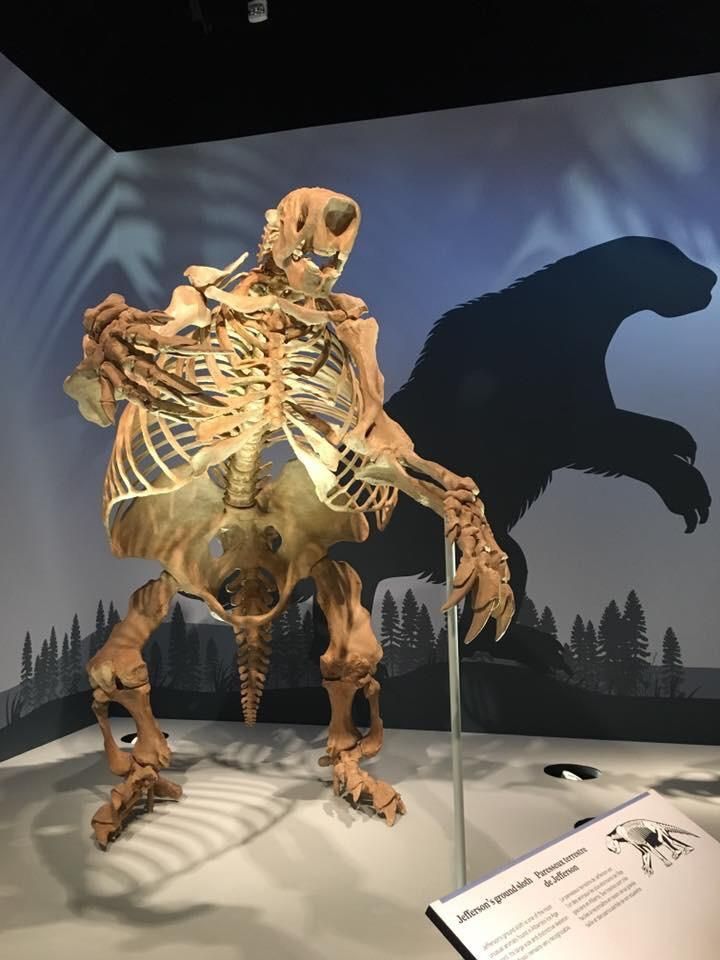
This captivating museum exhibit photo showcases a fully articulated skeleton of Jefferson’s ground sloth (Megalonyx jeffersonii), one of the most famous extinct megafauna species from the Pleistocene epoch. The mount stands in a dramatic, dimly lit diorama with a shadowy backdrop silhouette of the living animal rearing up, evoking its powerful presence in ancient North American landscapes. The skeleton—posed in a semi-upright stance with massive forelimbs raised, powerful hind legs planted firmly, and enormous claws extended—dominates the display case, illuminated by overhead lights that highlight the intricate bone structure and fossilized texture. A interpretive panel at the base provides species information, emphasizing its historical and scientific significance.
The exhibit design immerses visitors in the Ice Age world: a misty forest backdrop with stylized trees and foliage creates a sense of the humid woodlands and grasslands where these giants roamed. This setup is typical of modern paleontology displays that blend scientific accuracy with engaging storytelling to bring prehistoric life to vivid reality.
(Another view of a Jefferson’s ground sloth skeleton mounted in a museum, standing tall with claws raised against a prehistoric forest mural, capturing the animal’s imposing size and posture.)
(Close-up of the detailed skull and forelimbs of a Megalonyx jeffersonii mount, showing the blunt snout, robust jaws, and massive curved claws that define this species.)
Historical and Scientific Background
Megalonyx jeffersonii, commonly known as Jefferson’s ground sloth, holds a special place in American paleontology. The genus name Megalonyx (“great claw”) was coined in 1797 by future U.S. President Thomas Jefferson, based on fossil bones sent to him from a cave in West Virginia (then Virginia). Jefferson initially thought the remains belonged to a giant predatory cat still roaming North America, but further study revealed it as a massive herbivorous sloth. This discovery marked one of the earliest formal contributions to vertebrate paleontology in the United States and helped establish the field.
The specific epithet jeffersonii honors Jefferson’s role in describing the animal. Fossils of this species date primarily to the Late Pleistocene (around 50,000–11,000 years ago), with the youngest reliable dates placing its extinction around the end of the Ice Age, coinciding with megafaunal die-offs possibly linked to climate change, human hunting, or both.
Unlike tree sloths, ground sloths like Megalonyx were terrestrial giants adapted to browsing vegetation in forests and open habitats across much of North America, from Alaska to Mexico.
Anatomy and Adaptations
The skeleton in the photo reveals key adaptations that made Megalonyx a formidable Ice Age herbivore:
- Size and Build: Adults reached 2.5–3 meters (8–10 feet) in length and weighed up to 1,000–1,300 kg (2,200–2,900 lbs)—roughly the mass of a grizzly bear or small car. The robust skeleton features a barrel-shaped torso, powerful hindquarters for rearing up, and extraordinarily strong forelimbs.
- Claws and Limbs: The enormous, curved claws (up to 30 cm or 12 inches long) were used for pulling down branches, stripping leaves, and possibly defense. The photo’s raised forelimbs showcase these iconic “great claws,” which gave the genus its name.
- Skull and Teeth: A blunt, muscular snout with peg-like teeth suited for grinding tough plant material. The skull is relatively small compared to body size, with strong jaw muscles for processing fibrous vegetation.
- Posture and Locomotion: The semi-upright stance in mounts reflects how these sloths could rear on hind legs to reach higher foliage or intimidate threats. Quadrupedal walking was slow and deliberate, with plantigrade feet providing stability.
These features highlight convergent evolution with other megafauna herbivores, emphasizing browsing efficiency in diverse Pleistocene environments.
(Artistic life reconstruction of Megalonyx jeffersonii standing in a forested Pleistocene landscape, foraging on branches with its massive claws—illustrating how the mounted skeleton would have appeared in life.)
Significance of Museum Exhibits Like This
Displays such as the one photographed serve multiple purposes in education and outreach:
- Visual Impact: The dramatic lighting, silhouette backdrop, and life-like pose make abstract fossils tangible, helping visitors grasp the scale and majesty of Ice Age megafauna.
- Interpretive Power: Panels explain not just anatomy but historical context (Jefferson’s involvement), extinction causes, and connections to modern sloths—bridging deep time with the present.
- Conservation Message: Highlighting Pleistocene extinctions prompts reflection on current biodiversity loss and environmental change.
Similar mounts can be found at institutions like the Orton Geological Museum (Ohio State University, home to the famous “Jeff” specimen—the first mounted Megalonyx skeleton from 1896), the Burke Museum (Seattle), and others across North America.
For a deeper dive into these fascinating creatures, watch this educational video: Jefferson’s Ground Sloth: Megalonyx jeffersonii | Natural History Museum (search for clips from museums or documentaries on Ice Age megafauna).
This exhibit beautifully captures the wonder of paleontology—turning ancient bones into a window on a lost world of giants. If you’ve visited this specific display or have more photos from the same museum, share them—these glimpses into prehistoric life are always inspiring!