6 Essential Stretches to Promote Your Horse’s Back Health and Core Strength
Regular targeted stretching is one of the simplest and most effective ways to support your horse’s spinal health, improve proprioception, strengthen the core musculature, and maintain suppleness throughout the thoracolumbar region. These six exercises — often called “carrot stretches” when baited with a treat, and reflex-based mobilizations when performed manually — are widely recommended by equine physiotherapists, veterinarians, and experienced trainers.
Performed correctly and consistently (3–5 times per week), they can help prevent back pain, improve posture, enhance performance under saddle, and speed recovery from soreness or minor injuries. Always work on both sides of the horse, move slowly, and stop immediately if the horse shows discomfort. Horses with known back conditions, neurological issues, or sacral injuries should only perform these under direct veterinary or professional supervision.

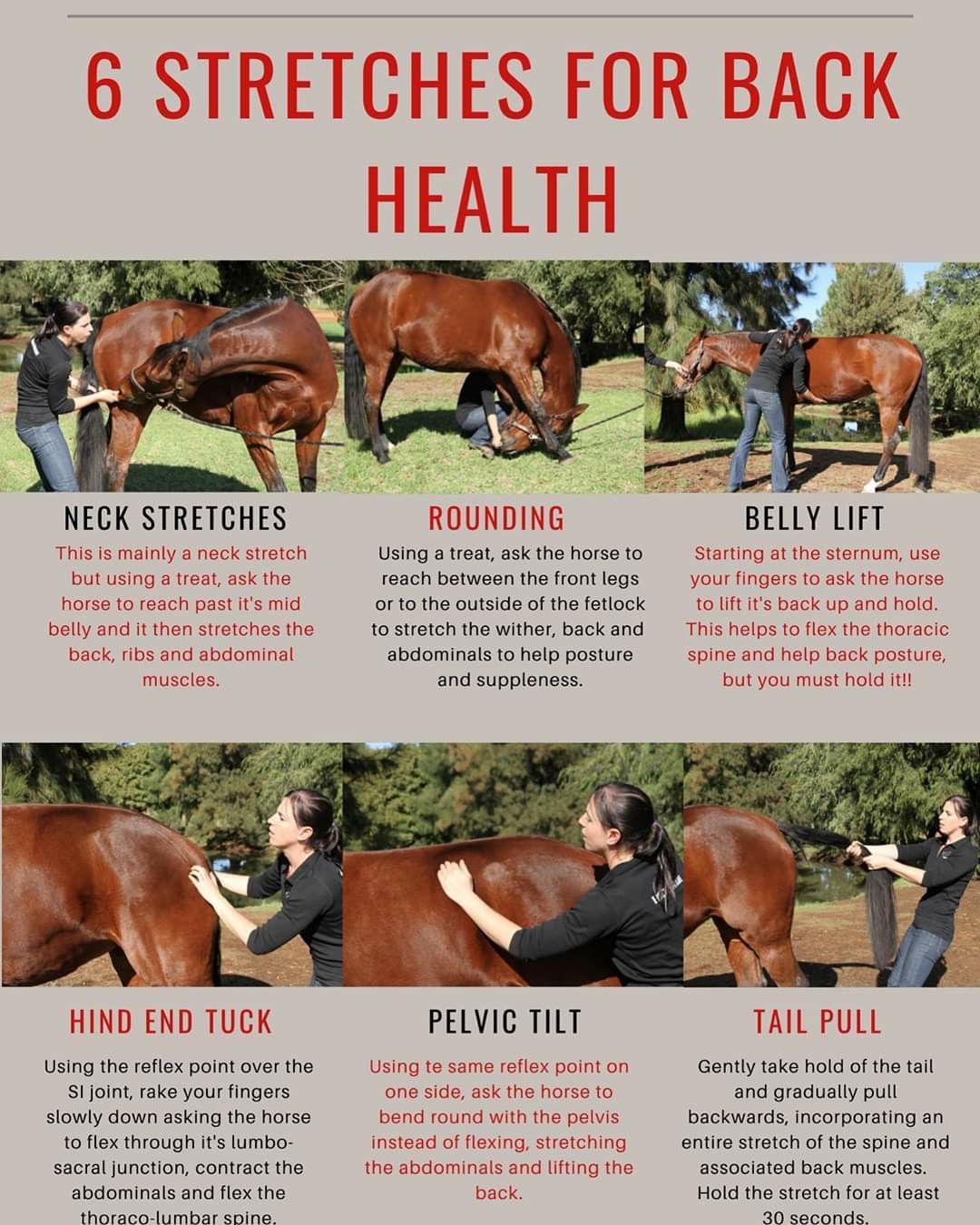
1. Lateral Neck Stretch (Carrot Stretch to Mid-Belly / Ribs)
Purpose Stretches the cervical and upper thoracic spine, lateral abdominal wall, ribcage, and intercostal muscles while encouraging mild longitudinal flexion.
How to perform
- Stand beside your horse’s shoulder, facing forward.
- Use a treat (or your empty hand if the horse understands the cue) to guide the muzzle slowly toward the girth area or slightly past the midline of the belly.
- Ask for a steady, relaxed stretch — never force or yank the head around.
- Hold the position for 10–20 seconds once the horse is stable, then release and reward.
- Repeat 3–5 times each direction.
Key tips
- The horse’s poll should stay level or slightly lower than the withers; avoid pulling the head upward.
- Watch for even weight distribution on all four feet.
2. Rounding / Deep Flexion Stretch (Between the Forelegs or Fetlock)
Purpose Promotes rounding of the thoracic spine (“breaking over the back”), stretches the withers, longissimus dorsi, and abdominal muscles, and improves overall postural tone and suppleness.
How to perform
- Stand in front of the horse, facing the chest.
- Guide the muzzle downward and back between the forelegs using a treat, aiming toward the fetlock or slightly outward along the cannon bone on more advanced horses.
- Encourage the horse to curl the neck and lift the back — you should see a gentle rounding from withers to croup.
- Hold 10–20 seconds, release slowly, reward.
- Repeat 3–5 times.
Key tips
- Keep your own body centered; do not step under the horse.
- Horses that are very stiff may only manage chest height at first — progress gradually.
3. Thoracic Belly Lift (Sternal Reflex Lift)
Purpose Strongly activates the epaxial muscles and encourages active thoracic flexion (“lifting” the back). Excellent for horses that are hollow-backed or weak through the thoracic sling.
How to perform
- Stand beside the horse at the sternum (mid-chest between the forelegs).
- Place your flattened fingers or palm firmly on the midline of the sternum and apply steady upward pressure.
- The horse should respond by lifting and rounding the thoracic spine.
- Once lifted, maintain light pressure to encourage the horse to hold the position for 10–15 seconds.
- Release slowly and praise.
- Repeat 3–4 times.
Important You must maintain contact until you decide to release; removing pressure too soon teaches the horse to drop immediately.
4. Hind-End Tuck (Lumbosacral Reflex Flexion)
Purpose Engages the abdominals, psoas, and longissimus to flex the lumbosacral junction and round the entire thoracolumbar spine. Helps horses that are stiff or “stuck” in the lower back.
How to perform
- Stand beside the croup.
- Locate the reflex point just lateral to the midline over the tuber sacrale (approximately where the croup meets the tailhead).
- Using your fingertips, apply firm, slow, raking pressure downward and slightly forward along the muscle groove.
- The horse should tuck the pelvis, contract the abdominals, and round the back.
- Hold the response for 8–12 seconds, then release.
- Repeat 3–4 times each side.
Key tips Pressure should be deliberate but not painful. Most horses lift and round within 2–3 seconds when the correct spot is found.
5. Pelvic Tilt / Unilateral Abdominal Stretch
Purpose Stretches the oblique abdominals on one side while lifting and stabilizing the back. Great for improving lateral flexibility and symmetry.
How to perform
- Use the same reflex point as the hind-end tuck, but on only one side at a time.
- Apply steady downward pressure; the horse should tilt the pelvis laterally and lift the back rather than fully tucking under.
- You will see the spine curve slightly toward the side you are stimulating.
- Hold 10–15 seconds, release slowly.
- Repeat 3–4 times each side.
6. Tail Pull (Longitudinal Caudal Traction)
Purpose Provides a gentle, full-spine stretch from poll to tail, mobilizing the sacrococcygeal junction and lengthening the epaxial musculature.
How to perform
- Stand directly behind the horse (safely to one side in case of kicking).
- Grasp the tail with both hands as close to the base as comfortable, wrapping the tail hairs securely.
- Lean back slowly, applying steady, gradual traction straight backward in line with the spine.
- The horse should relax and allow the back to lengthen.
- Hold for a minimum of 30 seconds (up to 60–90 seconds on tolerant horses).
- Release very gradually.
- Perform 2–3 repetitions.
Safety note Only attempt if your horse is accustomed to tail handling. Never yank or pull sideways.
Final Recommendations
- Warm the horse up with 10–15 minutes of walking before stretching.
- Perform the sequence in the order listed; it progresses naturally from cranial to caudal.
- Aim for symmetry — the horse should stretch equally left and right.
- Combine with regular core-strengthening groundwork (e.g., raised poles, hill work) for best results.
- If your horse resists, tenses, or shows pain (ears back, tail swishing, attempting to move away), stop and consult your veterinarian or a certified equine physiotherapist.
Incorporating these six simple stretches into your routine can make a noticeable difference in your horse’s comfort, movement, and willingness under saddle. A supple, strong back is the foundation of every healthy performance horse — and it only takes a few minutes a day!