A Comprehensive Guide to Brachiopod Fossils from Illinois: Identifying Ordovician and Pennsylvanian Specimens with Step-by-Step Analysis

Description:
Welcome to this in-depth tutorial on brachiopod fossils, focusing on a curated selection of specimens from Illinois. Brachiopods, often mistaken for clams due to their bivalve-like shells, are marine invertebrates with a rich fossil record spanning hundreds of millions of years. This guide is designed for paleontology enthusiasts, students, educators, and collectors who wish to deepen their understanding of these ancient organisms. We’ll explore four exemplary fossils depicted in the accompanying image, breaking down their identification, geological context, morphological features, and preservation details. By following this step-by-step analysis, you’ll learn how to recognize similar fossils in the field or in collections, understand their evolutionary significance, and appreciate the paleoecology of Illinois during the Paleozoic Era.
Step 1: Understanding Brachiopods – The Basics
Before diving into the specifics, let’s establish foundational knowledge. Brachiopods (phylum Brachiopoda) are sessile, filter-feeding animals that attach to the seafloor via a fleshy stalk called a pedicle. Unlike bivalve mollusks, their shells are dorsoventral (top and bottom halves differ in shape), and they possess a lophophore for feeding. Fossils are abundant in sedimentary rocks from the Cambrian to Permian periods, with peaks during the Ordovician and Pennsylvanian. In Illinois, these fossils are commonly found in limestone and shale deposits from ancient shallow seas.
- Key Identification Tips: Look for ribbed or plicated (folded) shells, hinge lines, and growth lines. Symmetry is bilateral, but the valves are unequal. Internal features like muscle scars or brachidium (lophophore support) may be visible in well-preserved specimens.
- Geological Context in Illinois: The state’s bedrock reveals a history of marine inundations. Ordovician rocks (485–443 million years ago) represent tropical seas with diverse reefs, while Pennsylvanian deposits (323–299 million years ago) reflect coal-forming swamps and deltaic environments interspersed with marine incursions.
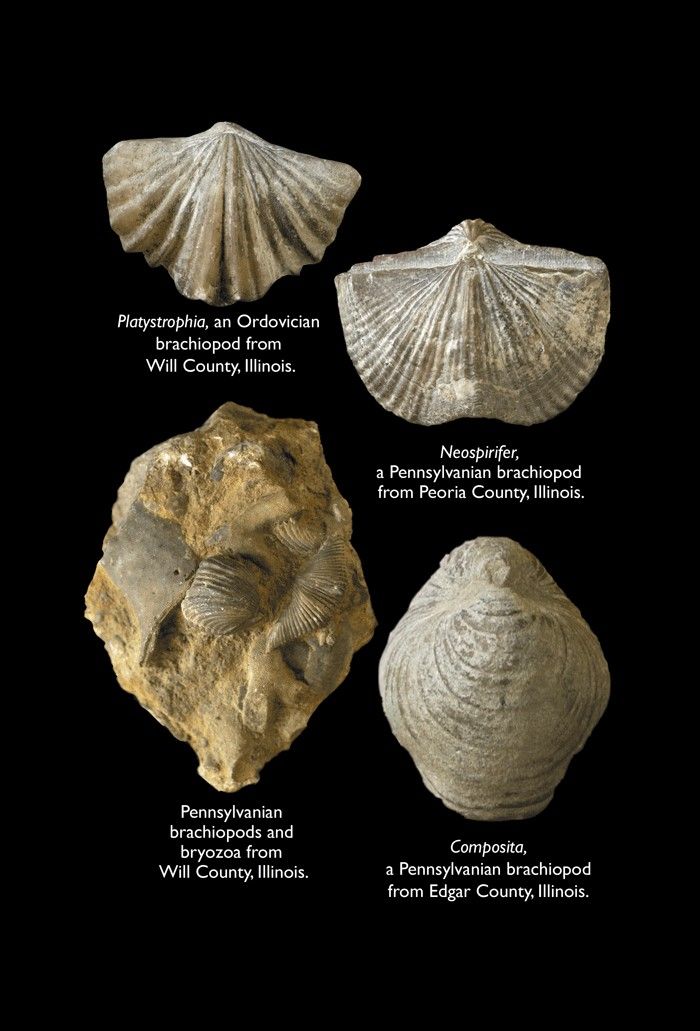
This tutorial uses the provided image as a visual reference, showcasing specimens from the Field Museum or similar collections. Each fossil is labeled with its genus, period, and locality, all from Illinois counties, highlighting the region’s paleontological wealth.
Step 2: Analyzing the First Specimen – Platystrophia (Ordovician Brachiopod from Will County, Illinois)
The top-left fossil in the image is Platystrophia, an iconic Ordovician brachiopod. This genus belongs to the order Orthida and is known for its robust, fan-shaped shell.
- Morphological Details: The shell is strongly plicated with radiating ribs that fan out from the hinge, creating a scalloped appearance. The pedicle valve (bottom) is convex, while the brachial valve (top) is flatter or slightly concave. Dimensions typically range from 2–5 cm wide. In this specimen, note the well-preserved radial costae (ribs) and the sulcus (fold) along the midline, which aided in water flow for feeding.
- Geological and Paleoecological Insights: Found in Will County, this dates to the Late Ordovician (Cincinnatian Series), a time of global marine biodiversity explosion. Platystrophia thrived in shallow, carbonate-rich seas, often associated with coral reefs and bryozoans. Preservation here is in limestone matrix, with minimal distortion, indicating calm depositional environments.
- Identification Tutorial: To identify Platystrophia in the field:
- Examine the shell’s outline: It should be semi-circular with a straight hinge.
- Count the plications: Typically 20–30 strong ribs.
- Check for internal molds: If broken, look for spiralia (coiled supports for the lophophore).
- Compare localities: Common in the Midwest, especially Illinois, Ohio, and Kentucky.
- Collecting Tips: Search in quarries or roadcuts in northern Illinois. Use a rock hammer gently to avoid damaging the delicate ribs.
Step 3: Examining the Second Specimen – Neospirifer (Pennsylvanian Brachiopod from Peoria County, Illinois)
Moving to the top-right, we have Neospirifer, a spiriferid brachiopod from the Pennsylvanian Period. This genus is part of the order Spiriferida, characterized by its internal spiral brachidium.
- Morphological Details: The shell is biconvex with a wide, winged hinge area. Prominent features include coarse radial costae and a deep sulcus on the pedicle valve, forming a V-shaped profile. The specimen shows fine growth lines and a rounded outline, approximately 4–6 cm across. The brachial valve displays plications that align with the pedicle’s, creating a symmetrical yet ornate pattern.
- Geological and Paleoecological Insights: Sourced from Peoria County, this fossil hails from the Desmoinesian Stage of the Pennsylvanian, amid cyclothem deposits (alternating marine and terrestrial layers). Neospirifer inhabited muddy seabeds in brackish to marine settings, filtering plankton amid fluctuating sea levels driven by glaciation.
- Identification Tutorial: Differentiate Neospirifer by:
- Noting the alate (winged) extensions along the hinge, which stabilized it on soft substrates.
- Observing the fold and sulcus: The median fold is elevated, aiding in current separation.
- Inspecting for punctae: Tiny pores in the shell for sensory hairs (though not always visible).
- Contextual clues: Often found with crinoids or coal seams in Illinois’ Mazon Creek lagerstätte equivalents.
- Preservation Notes: This specimen is silicified, enhancing durability, but watch for pyrite oxidation in similar finds.
Step 4: Exploring the Third Specimen – Pennsylvanian Brachiopods and Bryozoa from Will County, Illinois
The bottom-left features a cluster of Pennsylvanian brachiopods intermixed with bryozoans, embedded in a matrix rock.
- Morphological Details: The brachiopods are small (1–3 cm), with convex, ribbed shells similar to productids or spiriferids. Bryozoans appear as encrusting, lace-like colonies with zooecia (tiny pores). The matrix is a brownish limestone, preserving multiple organisms together, suggesting a colonial assemblage.
- Geological and Paleoecological Insights: From Will County, this represents the Atokan Stage, a period of warm, shallow seas. Bryozoans (phylum Bryozoa) are filter-feeders that formed reefs, providing habitats for brachiopods. This co-occurrence illustrates symbiosis in Carboniferous ecosystems.
- Identification Tutorial: For mixed assemblages:
- Isolate components: Use a loupe to spot brachiopod hinges vs. bryozoan branching.
- Test hardness: Brachiopods are calcitic; bryozoans may be more fragile.
- Look for associations: Common in Illinois’ coal measures.
- Advanced: Acid dissolution can separate elements for study.
- Educational Value: This specimen teaches about biodiversity; tutorials like this encourage microfossil hunting with sieves.
Step 5: Detailing the Fourth Specimen – Composita (Pennsylvanian Brachiopod from Edgar County, Illinois)
The bottom-right is Composita, another Pennsylvanian athyridid brachiopod.
- Morphological Details: Globose and smooth-shelled, with subtle concentric growth lines and a small pedicle opening. The valves are equally convex, giving a balloon-like shape (3–5 cm diameter). Lacks strong plications, distinguishing it from spiriferids.
- Geological and Paleoecological Insights: From Edgar County, in the Missourian Stage, Composita favored clear, oxygenated waters in reef-like settings. It’s a index fossil for dating Carboniferous strata.
- Identification Tutorial:
- Profile check: Rounded, with no sulcus.
- Internal view: If open, spiralia are looped.
- Compare to relatives: Smoother than Neospirifer.
- Locality match: Abundant in southern Illinois shales.
- Conservation Tip: Handle with care; use ethanol for cleaning.
Step 6: Synthesis and Further Exploration
These Illinois brachiopods span 150 million years, from Ordovician diversity to Pennsylvanian resilience amid climate shifts. As a tutorial, practice by sketching features or visiting sites like Mazon Creek. For advanced study, consult resources like the Treatise on Invertebrate Paleontology. Remember, ethical collecting: Obtain permits and document finds.
This guide equips you to identify and appreciate these fossils, turning a simple image into a portal to Earth’s ancient oceans. If you’re in San Francisco (noted from your location), consider virtual tours of Illinois museums or local fossil exhibits at the California Academy of Sciences. Happy fossil hunting!