Eocene Mud Crab Fossil: A Stunning Specimen of Harpactocarcinus punctulatus from Monte Baldo, Italy

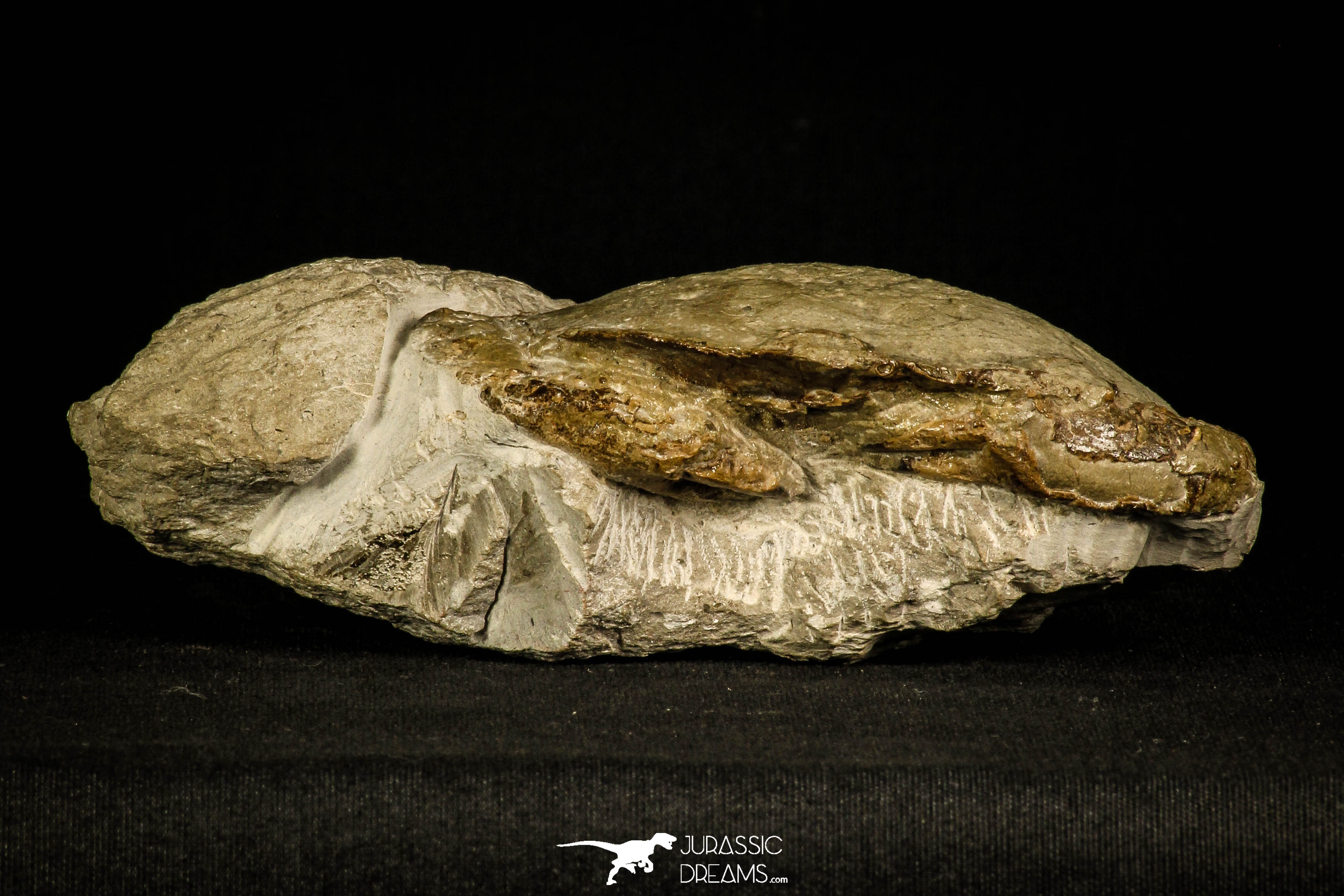
This exceptional museum-quality photograph captures a beautifully preserved fossil crab of the extinct genus Harpactocarcinus (most likely Harpactocarcinus punctulatus), displayed on its original limestone matrix. The specimen, labeled as originating from the Monte Baldo region near Verona, Italy, dates to the Eocene epoch approximately 50 million years ago. The crab is positioned in a classic dorsal view, showcasing its broad, rounded carapace, powerful chelae (claws), and segmented walking legs—all remarkably articulated and intact, a rarity among decapod crustacean fossils.
The carapace appears smooth yet subtly textured with faint punctations (small pits) characteristic of the species, and the overall preservation is three-dimensional with excellent relief. The matrix is a warm, beige-to-tan sedimentary rock typical of the Lessini or Rialo Formation, showing natural weathering and minor iron staining that enhances contrast. A professional exhibit label in the foreground reads: “CRAB Harpactocarcinus Eocene Epoch 50 Million Years Monte Baldo, Italy”, confirming its provenance and age.
Here are several high-quality examples of similar Harpactocarcinus punctulatus fossils from Monte Baldo and comparable Eocene localities to illustrate the detail and variation in these iconic specimens:


Geological and Paleontological Context
During the Early to Middle Eocene (Ypresian to Lutetian stages, ~56–40 million years ago), the Monte Baldo area was part of the western Tethys Sea—a warm, shallow marine environment with carbonate platforms and lagoons. Rapid burial in fine sediments, combined with low-oxygen conditions, created ideal lagerstätten-like preservation for delicate invertebrates like crabs.
Harpactocarcinus belongs to the family Xanthidae (mud crabs or rubble crabs), a group still abundant today in tropical and subtropical soft-bottom habitats. These prehistoric crabs were likely opportunistic omnivores or detritivores, using their robust claws to forage in muddy substrates for worms, small mollusks, and organic debris. The genus is known from Eocene deposits across Europe, North Africa, and even Texas, reflecting wide dispersal during the warm “Eocene Greenhouse” climate.
Monte Baldo quarries, historically worked for building stone and fossils, have yielded some of the finest European Eocene decapods. Many classic specimens now reside in museums (e.g., Houston Museum of Natural Science, Verona Natural History Museum) or private collections, though active quarrying has largely ceased.
Tutorial: How to Identify and Appreciate Eocene Crab Fossils Like This One
Follow these steps to analyze similar specimens professionally:
- Examine Carapace Shape and Texture — Harpactocarcinus features a subquadrate to hexagonal carapace with rounded anterolateral margins and prominent orbital notches. Look for punctate (pitted) ornamentation on the dorsal surface—H. punctulatus shows fine dots, while related species like H. quadriobatus may have different patterns.
- Assess Claw Morphology — The unequal chelae (one larger crusher claw, one smaller cutter) are diagnostic. In well-preserved examples, both claws remain attached, as seen here—a sign of rapid burial before disarticulation.
- Check Preservation Quality — True three-dimensional preservation (vs. flat compression) indicates minimal compaction. Articulated legs and intact antennae are exceptional; most crab fossils lose limbs post-mortem.
- Verify Provenance and Matrix — Monte Baldo specimens sit on creamy limestone with subtle bedding planes. Labels often note “Eocene” and “50 million years” (a rounded figure for ~48–52 Ma deposits).
- Compare to Modern Analogs — Compare to living xanthid crabs (e.g., mud crabs like Panopeus or Menippe) for behavioral insights. Fossil claws suggest similar burrowing or scavenging habits.
- Care and Display Tips — Handle with cotton gloves to avoid oils. Clean gently with a soft brush and distilled water (avoid acids on calcite matrix). Stabilize with Paraloid B-72 if fragile. Ideal display: angled lighting to highlight texture, in a glass case to prevent dust.
This fossil offers a tangible connection to the post-Cretaceous recovery of marine ecosystems, when modern crab families diversified amid rising sea temperatures and expanding shallow seas. It serves as both a collector’s prize and an educational tool illustrating decapod evolution.
Perfect for paleontology enthusiasts, museum displays, or as a striking conversation piece on a shelf with subtle backlighting. Have you collected Eocene marine fossils or visited Italian fossil sites? Share your experiences in the comments below!