Unveiling Sarcosuchus Imperator: A Comprehensive Guide to the Prehistoric SuperCroc Fossil Exhibit

Description:
Introduction to Sarcosuchus Imperator
Sarcosuchus imperator, often dubbed the “SuperCroc,” stands as one of the most awe-inspiring prehistoric reptiles ever discovered. This extinct crocodyliform, a distant relative of modern crocodiles, roamed the Earth during the Early Cretaceous Period, approximately 95 to 115 million years ago. Unlike today’s crocodilians, Sarcosuchus was a true giant of its time, with estimates placing its maximum length between 9 to 12 meters (about 29.5 to 40 feet) and its weight up to 8 tons—comparable to a modern African elephant. The fossil skeleton depicted in this exhibit showcases the remarkable anatomy of this ancient predator, providing a window into a world where massive reptiles dominated freshwater ecosystems.
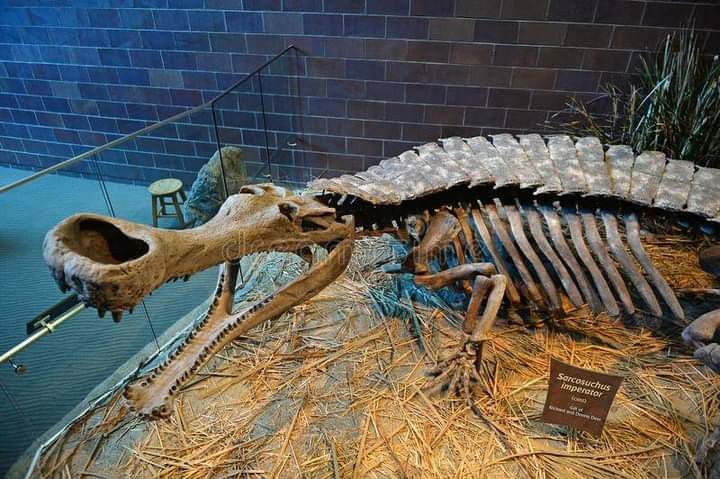
In the image, we see a meticulously reconstructed skeleton displayed in a museum setting, likely part of an educational exhibit. The skeleton is positioned on a bed of simulated straw and earth, evoking the riverine habitats where Sarcosuchus once thrived. A prominent sign reads “Sarcosuchus Imperator,” confirming the species, while the background features tiled walls, a glass railing, and naturalistic elements like rocks and plants to enhance the immersive experience. This display highlights the creature’s elongated snout, robust vertebral column, and armored back, offering visitors a tangible connection to paleontological history.
Historical Context and Discovery
To fully appreciate Sarcosuchus imperator, it’s essential to understand its place in Earth’s timeline. The Early Cretaceous was a period of significant evolutionary diversification for reptiles, following the dominance of dinosaurs in the Jurassic. Sarcosuchus inhabited the lush, river-filled landscapes of what is now North Africa, particularly in regions like modern-day Niger. Fossil evidence suggests it lived in freshwater environments, ambushing prey much like contemporary crocodiles but on a far grander scale.
The discovery of Sarcosuchus dates back to the mid-20th century, with initial fragments found in the 1940s and 1950s by French paleontologists in the Sahara Desert. However, it wasn’t until the 1990s and early 2000s that renowned paleontologist Paul Sereno led expeditions to Niger, unearthing more complete specimens. Sereno’s team recovered over 50% of the skeleton from one individual, allowing for accurate reconstructions like the one shown in the image. These finds were part of a larger effort to explore the Elrhaz Formation, a geological site rich in Cretaceous fossils. The name “Sarcosuchus” translates from Greek as “flesh crocodile,” while “imperator” means “emperor,” reflecting its regal size and dominance.
For those interested in replicating a similar educational display or studying paleontology at home, start by researching primary sources such as Sereno’s publications or visiting institutions like the University of Chicago’s fossil labs. Tools like 3D modeling software (e.g., Blender) can help visualize reconstructions based on scanned fossil data available from open-access databases.
Anatomy and Physical Characteristics: A Step-by-Step Breakdown
Sarcosuchus imperator’s anatomy is a masterclass in evolutionary adaptation for predation. Let’s dissect the key features visible in the fossil skeleton, treating this as a tutorial for aspiring paleontologists or educators building their own models.
- Skull and Snout Structure: The most striking element in the image is the elongated, narrow snout, which could measure up to 1.5 meters long in adults. This gharial-like feature was lined with over 130 conical teeth—66 on each side of the upper and lower jaws. Unlike modern crocodiles, whose teeth interlock perfectly, Sarcosuchus had slightly overlapping dentition optimized for grasping slippery fish or even small dinosaurs. The nostrils are positioned at the tip of the snout, an adaptation for breathing while mostly submerged. In the display, note the hollowed nasal opening and the robust jaw hinges, which could exert tremendous bite force, estimated at over 18,000 pounds per square inch—far surpassing that of a great white shark.
- Vertebral Column and Rib Cage: Moving along the body, the spine consists of a series of interlocking vertebrae, visible as a segmented chain in the image. This flexible yet sturdy backbone supported the creature’s massive frame, allowing for powerful swimming motions. The rib cage, prominently displayed, protected vital organs and anchored strong limb muscles. Sarcosuchus had osteoderms (bony plates) embedded in its skin, forming armored ridges along the back—evident as textured scutes in the reconstruction. These provided protection from rivals or larger predators like spinosaurid dinosaurs.
- Limbs and Tail: The short, sturdy limbs suggest Sarcosuchus was semi-aquatic, capable of lumbering on land but excelling in water. The forelimbs and hindlimbs end in clawed digits, ideal for gripping riverbanks or prey. The tail, though partially obscured in the image, would have been muscular and laterally compressed for propulsion through water, much like a modern crocodile’s but scaled up for efficiency in hunting.
- Size Comparison and Growth Patterns: Based on the largest known specimen, Sarcosuchus grew throughout its life, with juveniles starting at about 1-2 meters and reaching full size over decades. To contextualize, imagine this beast alongside a school bus—its length matches perfectly. For a hands-on tutorial, use scaling exercises: Measure a modern Nile crocodile skeleton (average 5 meters) and extrapolate proportions using ratios (e.g., Sarcosuchus was roughly 2-2.5 times longer).
Paleontologists determine these details through comparative anatomy, CT scans of fossils, and biomechanical modeling. If you’re creating a digital model, import fossil scans from repositories like MorphoSource and apply textures using Photoshop or GIMP for realism.
Habitat, Diet, and Behavior
Sarcosuchus imperator thrived in tropical river systems teeming with fish, turtles, and early dinosaurs. Its diet likely included large fish like coelacanths, as well as opportunistic attacks on dinosaurs wading in shallow waters—think of it as an ambush predator waiting in murky rivers. Evidence from tooth wear and associated fossils indicates a piscivorous (fish-eating) lifestyle, though its size allowed it to tackle larger prey.
Behaviorally, Sarcosuchus may have been territorial, with males competing for mates during breeding seasons. Fossil sites show multiple individuals, suggesting social groupings or communal nesting areas. To simulate this in an educational setting, build a diorama: Use clay for the terrain, wire armatures for the skeleton, and LED lights to mimic underwater ambush scenarios.
Significance in Paleontology and Modern Science
This fossil isn’t just a relic; it’s a key to understanding crocodyliform evolution. Sarcosuchus bridges the gap between ancient pseudosuchians and modern crocodiles, showing how body size scaled with environmental changes. Its discovery has fueled debates on gigantism in reptiles, influenced by factors like oxygen levels and prey availability during the Cretaceous.
In today’s context, studying Sarcosuchus aids conservation efforts for endangered crocodilians, highlighting how climate shifts impacted ancient species. Museums worldwide, such as the Australian Museum or the Field Museum in Chicago, feature similar exhibits—plan a visit or virtual tour for deeper immersion.
Conclusion: Bringing Prehistory to Life
The Sarcosuchus imperator skeleton in this image encapsulates the thrill of paleontology: a blend of science, artistry, and storytelling. Whether you’re a student, educator, or enthusiast, use this guide as a tutorial to explore further—dive into books like “SuperCroc” by Paul Sereno, join fossil digs, or even 3D-print your own model. By understanding creatures like Sarcosuchus, we gain perspective on our planet’s dynamic history and the fragility of life across epochs. If you’re posting this on your website, consider adding interactive elements like zoomable images or quizzes to engage visitors.