Timeless Fossils: A Beautiful Watercolor Illustration Poster Featuring Iconic Prehistoric Specimens from Trilobites to Archaeopteryx – An Educational Guide to Earth’s Ancient Life
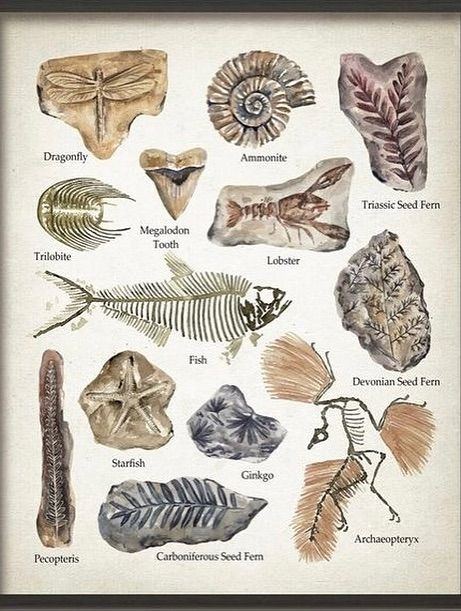
This elegant, vintage-inspired watercolor art print serves as both stunning wall decor and an accessible introduction to paleontology. Arranged in a classic naturalist’s grid on a clean cream background, the composition showcases meticulously rendered fossil specimens in soft sepia, brown, gray, and subtle color accents. Each fossil is labeled with its common name, creating an instant visual encyclopedia of evolutionary highlights spanning hundreds of millions of years—from the Cambrian explosion to the dawn of birds.
The artwork captures the delicate beauty of preservation: delicate wings preserved in stone, coiled ammonite chambers, serrated megalodon teeth, intricate plant fronds, and the transitional skeleton of Archaeopteryx. The hand-painted style evokes 19th-century scientific illustrations while remaining modern and approachable, making it perfect for classrooms, home offices, children’s rooms, or any space celebrating natural history.

Featured Specimens – Tutorial-Style Breakdown
- Dragonfly – A beautifully detailed impression showing vein patterns in delicate wings, representing giant Carboniferous insects that thrived in oxygen-rich ancient atmospheres (~300 million years ago).
- Megalodon Tooth – A massive, triangular shark tooth with serrated edges, symbolizing the apex predator of the Miocene oceans (~23–3.6 million years ago). Its size and sharpness highlight why Megalodon dominated marine food webs.
- Ammonite – The iconic spiral shell with intricate suture patterns, a cephalopod relative of modern nautiluses that went extinct at the end of the Cretaceous (~66 million years ago). Ammonites are zone fossils, helping date rock layers precisely.
- Trilobite – One of the most recognizable Paleozoic arthropods (~521–252 million years ago), complete with segmented body, compound eyes, and spiny thorax. Trilobites dominated early seas and offer insights into arthropod evolution.
- Lobster – A well-preserved crustacean fossil, showing claws and segmented tail, illustrating the longevity of decapod body plans from ancient oceans to modern tables.
- Fish Skeleton – A delicate, fully articulated bony fish with fin rays and skull details, representing widespread vertebrate diversification in Devonian and later periods.
- Starfish – A classic echinoderm with five arms, demonstrating radial symmetry and the resilience of sea stars through mass extinctions.
- Ginkgo – A fan-shaped leaf fossil of the “living fossil” tree Ginkgo biloba, whose lineage dates back to the Permian (~270 million years ago) and survives today virtually unchanged.
- Seed Ferns (Triassic, Devonian, Carboniferous, Pecopteris, Carboniferous Seed Fern) – Various frond impressions showing fern-like plants that were not true ferns but seed-bearing pteridosperms. These dominated coal-forming swamp forests of the Carboniferous (~359–299 million years ago) and later periods.
- Archaeopteryx – The famous “first bird,” depicted with feathered wings, long bony tail, teeth, and clawed fingers—a transitional form between theropod dinosaurs and modern birds (~150 million years ago, Late Jurassic).
Why This Print Is Educational and Inspiring
- Chronological Sweep: The selection spans key geological eras—Cambrian (trilobites), Devonian (early seed ferns, fish), Carboniferous (giant insects, coal forests), Triassic/Jurassic (early dinosaurs/birds), and Cenozoic (megalodon)—offering a mini-tour of life’s history.
- Art Meets Science: The soft watercolor technique highlights textures (cracked matrix, delicate impressions) while the clean layout and labels make it instantly informative, ideal for sparking curiosity in children or deepening appreciation in adults.
- Display Tips: Frame in a simple white or natural wood frame to let the subtle colors shine. Pair with real fossils, geology books, or a small ammonite specimen for a cohesive paleontology nook.
This poster bridges art, education, and wonder, reminding us that every fossil tells a story of survival, adaptation, and extinction across deep time. Whether you’re a lifelong fossil enthusiast, a teacher introducing geologic time, or someone decorating with meaningful science, this piece transforms any wall into a window on prehistoric Earth.
Perfect for gifting to students, science lovers, or anyone fascinated by the distant past. Search online marketplaces like Etsy for “paleontology watercolor fossil print” to find high-quality reproductions in various sizes—many are printed on archival paper for lasting beauty.
Share this post if you love blending natural history with beautiful design, and consider adding a similar print to your collection. The ancient world never looked so inviting!