How Do Fossils Form? A Detailed Museum Exhibit Guide to the Processes of Fossil Preservation – From Permineralization to Molds, Casts, and Impressions
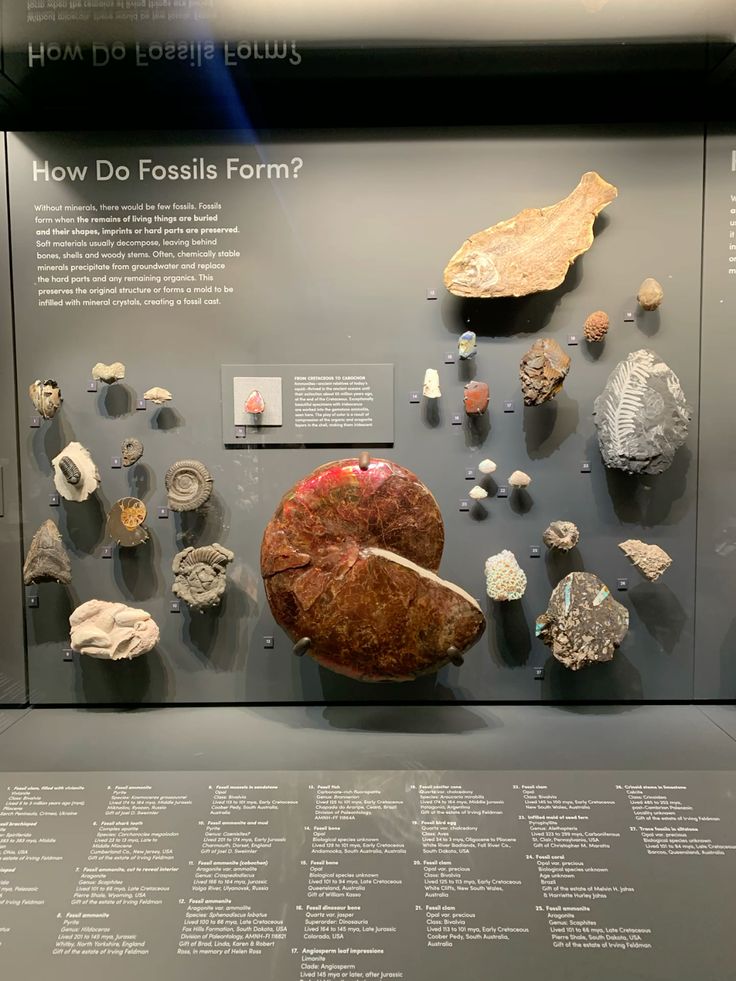
This captivating museum display panel, titled “How Do Fossils Form?”, provides one of the clearest and most visually rich explanations of fossilization processes available in natural history exhibits. Mounted on a sleek dark background with dramatic overhead lighting, the exhibit combines concise explanatory text, a large introductory diagram of a fossil fish, and an extensive array of real fossil specimens—ranging from tiny shells and seeds to massive ammonites and petrified wood—to illustrate every major mode of preservation. Numbered labels (1 through 28 or more) correspond to a detailed legend at the bottom, identifying each fossil’s type, age, location, and donor, turning the panel into both an educational centerpiece and a catalog of geological treasures.
The core message is clear: without the right minerals and rapid burial, soft tissues and even hard parts decay completely—no fossils would exist. The exhibit emphasizes that fossils preserve shapes, structures, or chemical traces when groundwater carries dissolved minerals that precipitate into organic remains or fill voids left behind.

Tutorial-Style Guide: Understanding Fossil Formation Through This Exhibit
- The Basic Requirement – Burial and Mineral Replacement The opening text explains the foundation: an organism dies and must be buried quickly by sediment (mud, sand, volcanic ash) to protect it from scavengers, oxygen, and decay. Soft tissues usually rot away, but hard parts (bones, shells, woody stems) can persist long enough for groundwater to introduce stable minerals. These minerals either fill pores (permineralization), replace original material (replacement), or infill molds to create casts. The large fossil fish at the top demonstrates a classic permineralized specimen where bone structure is beautifully preserved in stone-like form.
- Permineralization – Filling the Pores The most common process shown here, permineralization occurs when mineral-rich groundwater seeps into the microscopic pores and cavities of bones, wood, or shells. Minerals (often silica, calcite, or iron oxides) precipitate out, hardening the structure while retaining much of the original microscopic detail.
- Exhibit examples: Petrified wood slices (often colorful due to iron and manganese oxides), dinosaur bone fragments, and many vertebrate fossils labeled as permineralized. These specimens appear denser and rock-like but preserve cellular-level textures.
- Science takeaway: This process creates “petrified” fossils (a term often used interchangeably with permineralized). The original organic material remains partially intact, but the added minerals make it durable over millions of years.
- Replacement – Mineral Substitution In replacement (sometimes called recrystallization or petrifaction in extreme cases), the original hard parts dissolve completely, and minerals take their place atom by atom or molecule by molecule. This can preserve fine external details but often loses internal microstructure.
- Exhibit examples: Certain shells, teeth, or bone fragments where the original calcium carbonate or phosphate has been swapped for silica or other minerals, resulting in a faithful replica in a different composition.
- Science takeaway: Replacement is common in marine invertebrates and explains why some fossils feel unusually heavy or have a glassy sheen.
- Molds, Casts, and Impressions – Negative and Positive Forms When an organism decays or dissolves entirely after burial, it leaves a cavity in the surrounding rock called a mold (external mold for outer shape, internal mold or steinkern for the interior fill). If mineral-rich sediment or water later fills that cavity, it hardens into a cast that replicates the original organism’s form. Impressions are flat compressions (common in plants or soft-bodied animals).
- Exhibit examples:
- Large, polished ammonite with vibrant red-brown banding (likely a permineralized or replaced shell).
- Spiral gastropods, brachiopods, and bivalves showing external molds or casts.
- Plant impressions, trace fossils like leaf compressions, and carbon films (thin black carbon residues from compressed organic matter).
- Science takeaway: Molds preserve negative space (a depression); casts are the positive infill. These are especially important for soft-bodied organisms that rarely preserve directly.
- Exhibit examples:
- Special Cases and Variety in the Display The panel showcases diversity across geological time:
- Carbonization: Thin carbon films from compressed leaves or insects (volatiles driven off under pressure).
- Trace fossils and impressions: Leaf prints, fish scales, or burrows.
- Permineralized invertebrates: Trilobites, ammonites, belemnites.
- Vertebrate elements: Shark teeth, bone fragments from various eras. The legend lists specifics: e.g., Permian brachiopods from Australia, Jurassic ammonites from England, Cretaceous dinosaur bones from the USA, and gifts from notable collectors or estates.
- Why This Exhibit Is Exceptional Unlike simple text panels, this display uses dozens of hand-picked, high-quality specimens mounted at eye level with pinpoint LED lighting to highlight textures, colors, and details. The numbered system allows self-guided learning—visitors can match each fossil to its description, learning ages (from Devonian to Cretaceous), locations (global sites like Australia, USA, Russia), and preservation modes. It subtly teaches that fossilization is rare: rapid burial + mineral-rich groundwater + minimal disturbance over eons are required.
This exhibit is an ideal resource for students, educators, families, and anyone curious about paleontology. It demystifies how the rock record captures snapshots of ancient life, turning decay into enduring evidence of Earth’s history.
Visit your local natural history museum to find similar panels—they often include interactive elements or touchable casts. Understanding fossil formation deepens appreciation for every specimen on display, reminding us that each fossil is a improbable survivor of deep time.
Share this post to highlight the science behind the stones, and consider exploring paleontology resources or museum tours to see these processes in even more detail. The story of fossils begins with how they form—one mineral crystal at a time.