Reconstructing Ancient Pottery: A Step-by-Step Archaeological Exhibit Showing How Broken Sherds Reveal Prehistoric Vessel Forms, Techniques, and Daily Life
This meticulously curated museum display offers a complete masterclass in ceramic archaeology, demonstrating exactly how scientists transform thousands of scattered pottery fragments (sherds) into accurate reconstructions of vessels used by ancient communities thousands of years ago. The exhibit combines real excavated artifacts, scientific illustrations, line drawings, and fully restored pots to walk visitors through the entire process—from raw material to finished object—making it one of the clearest and most educational presentations of archaeological conservation techniques on view anywhere.
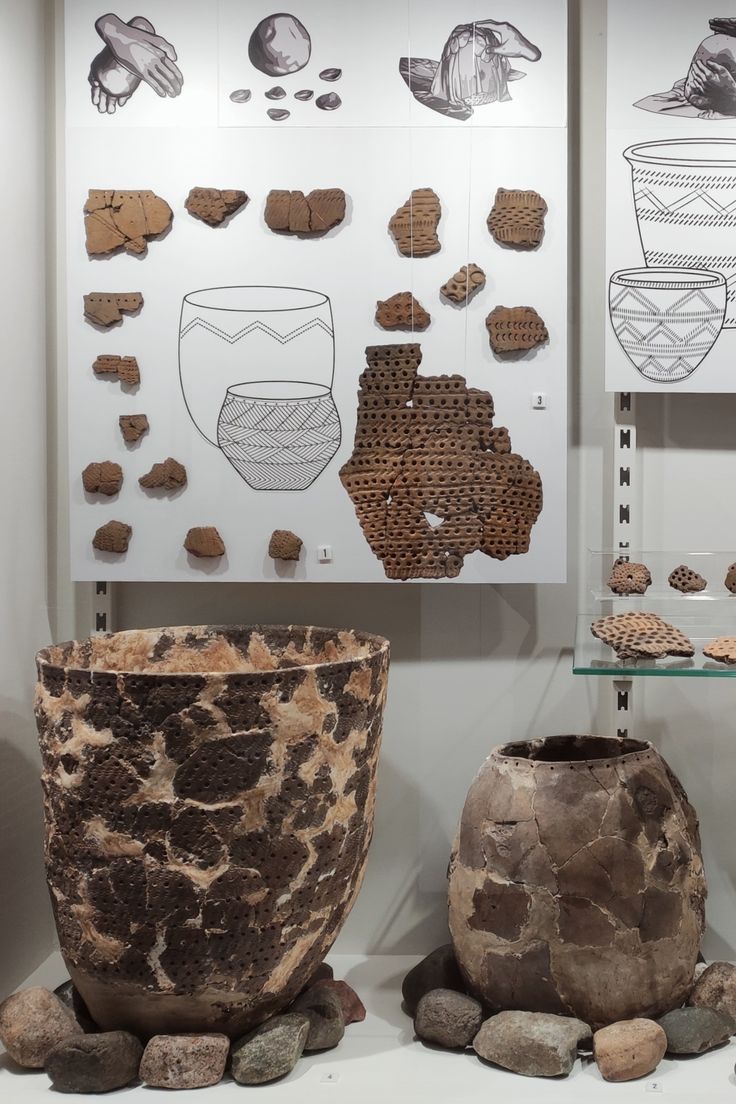
The installation is divided into two main levels. The upper wall-mounted panel presents dozens of carefully arranged terracotta sherds alongside interpretive graphics and reconstruction drawings. The lower level features two life-sized, fully reassembled vessels displayed on beds of natural river stones, evoking the ground-level context in which they were originally found. A small glass shelf to the right holds additional study-grade fragments, inviting close examination.

Tutorial-Style Guide: How Archaeologists Reconstruct Ancient Pottery (Exactly as Shown in This Exhibit)
- Raw Material & Manufacturing Process (Top Illustrations) The display begins with three large black-and-white diagrams showing the hands-on craft of pottery making:
- Hands gathering and wedging clay balls to remove air pockets.
- Coiling or pinching techniques used to build vessel walls without a potter’s wheel (common in most prehistoric societies).
- Smoothing and decorating the surface. These illustrations remind us that every sherd once belonged to a living object shaped entirely by human hands.
- The Sherds: Evidence from the Field (Middle Panel) The dozens of broken pieces are grouped to demonstrate key identification principles:
- Fabric & Temper: Notice the visible grit, sand, or crushed shell mixed into the clay—each culture had its own “recipe” that helps archaeologists assign sherds to specific time periods and peoples.
- Surface Treatment & Decoration: Zigzag lines, cross-hatching, and incised patterns are preserved on many fragments, allowing experts to match pieces that once formed the same pot.
- Perforations & Function: A large, heavily perforated sherd (labeled “3”) and several smaller rim fragments with rows of drilled holes indicate these were likely sieves, steamers, colanders, or incense burners—specialized vessels for food processing or ritual use. Number “1” marks a cluster of rim and body sherds that have already been conjoined (physically fitted together) to reveal the original vessel profile.
- Reconstruction Drawings (Overlaid Line Art) Transparent or white-line outlines superimposed on the sherd groups show the complete vessel forms the archaeologists have deduced: tall jars with everted rims, rounded bowls with geometric banding, and the distinctive perforated strainer type. These profile drawings are created using rim curvature, wall thickness, and decoration continuity—standard laboratory techniques still used today.
- The Finished Reconstructions (Floor-Level Display) Two complete, conservation-grade vessels demonstrate the final result:
- Left Vessel (tall, wide-mouthed storage or processing jar): Its surface shows dramatic fire-clouding (uneven dark patches caused by uneven firing) and the same perforations seen in the sherds above. The visible joins between restored pieces are deliberately left apparent so visitors can see the puzzle-solving process.
- Right Vessel (more globular form): A beautifully reassembled pot with visible crack lines stabilized by conservators using reversible adhesives. Its base rests on stones exactly as it might have been found in a buried context. Both pots are placed on a low platform surrounded by river cobbles, simulating an archaeological feature and reminding viewers that these objects were once part of daily life—storage, cooking, or ceremonial use.
- Conservation Techniques Demonstrated The exhibit subtly teaches modern methods:
- Cleaning and sorting sherds by type.
- Conjoining (dry-fitting) pieces before gluing.
- Filling gaps with tinted plaster or resin that can be removed later.
- Creating supportive mounts for display. Labels and numbering (1, 2, 3, 4, 7 visible) guide visitors through the scientific workflow.
Why This Exhibit Matters Every sherd is a time capsule. By mastering the skills shown here, archaeologists can determine trade networks (different clay sources), diet (residue analysis), social organization (decorative styles), and technological advancement (firing temperatures). What looks like “just broken pottery” becomes a detailed story of human ingenuity when reconstructed using the methods on display.
This installation is a perfect introduction for students, educators, and anyone fascinated by how we recover the past one fragment at a time. The combination of real artifacts, clear graphics, and dramatic full-size reconstructions makes complex science immediately understandable and deeply engaging.
Next time you visit a natural history or archaeology museum, look for similar pottery reconstruction cases—they are among the most powerful ways to connect directly with the hands that shaped our shared human history thousands of years ago.
Share this post to celebrate the quiet brilliance of archaeological conservation, and consider exploring hands-on pottery workshops or museum programs that let you try these ancient techniques yourself. The past is literally pieced back together—one sherd at a time.