Animal Defense Mechanisms: A Comprehensive Museum Exhibit Showcasing Nature’s Brilliant Survival Strategies Through Real Specimens and Taxidermy
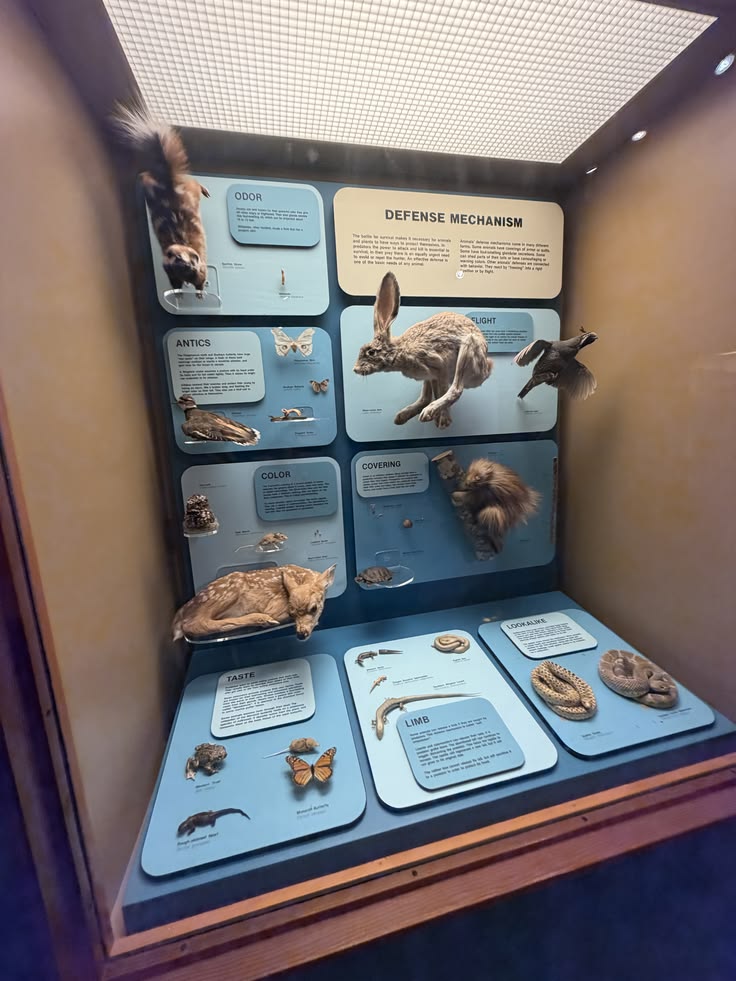
Step inside one of the most engaging and educational natural history displays you will ever encounter—this stunning, multi-panel museum exhibit brings to life the incredible ways animals protect themselves from predators. Designed as a hands-on learning experience, the case features real taxidermy specimens, preserved skins, and carefully selected examples arranged around the central theme “DEFENSE MECHANISM.” Each strategy is illustrated with actual animals, clear explanatory labels, and vivid visuals that make complex biology instantly accessible to visitors of all ages.
The exhibit is thoughtfully organized into eight distinct categories, each highlighting a different evolutionary solution to the universal problem of survival. Mounted on a deep-blue background under professional museum lighting, the display uses clear acrylic stands to float specimens in dynamic poses, creating the illusion that the animals are still in motion. From a skunk dramatically raised in defense to a leaping jackrabbit and two nearly identical snakes demonstrating mimicry, every element is chosen to teach a specific lesson in adaptation.

Tutorial-Style Guide: How to Read and Understand This Exhibit
- ODOR – Chemical Warfare At the top left, a taxidermy skunk is posed in its classic warning stance, tail raised and ready. The label explains how skunks (and many other mammals) deploy pungent, sulfur-based sprays from anal glands to deter predators. The exhibit also includes a small insect example (likely a bombardier beetle) to show that this defense appears across the animal kingdom. Science takeaway: These chemicals are not just unpleasant—they can cause temporary blindness or nausea, buying precious escape time.
- FLIGHT – Speed and Escape Dominating the center is a large jackrabbit mid-leap, powerful hind legs extended, alongside a flying bird (possibly a grouse or quail) bursting into the air. The panel details how sudden, explosive flight confuses predators and puts distance between hunter and hunted. Science takeaway: Many prey species have evolved oversized leg muscles or burst-flight capability specifically for this split-second survival tactic.
- ANTICS – Distraction and Deception This section features butterflies with eye-spots and small birds or ducks performing “broken-wing” displays. The label describes how animals deliberately draw attention to themselves or feign injury to lure predators away from nests or young. Science takeaway: These theatrical behaviors are learned or instinctive and often more effective than simply running.
- COLOR – Camouflage and Warning A beautifully spotted fawn lies motionless on the lower shelf, perfectly illustrating cryptic coloration that blends into dappled forest light. Nearby, monarch butterflies show aposematic (warning) coloration—bright orange and black signaling toxicity. Science takeaway: Color can hide an animal completely or advertise that it is dangerous to eat.
- COVERING – Physical Armor and Weapons A porcupine or similar spiny mammal is shown with quills raised, while an armadillo-like specimen demonstrates bony plates. The panel explains how specialized coverings—quills, scales, or shells—act as both passive armor and active weapons. Science takeaway: These structures are often modified hairs or skin derivatives that can be shed, regrown, or actively deployed.
- TASTE – Chemical Deterrence Several amphibians (frogs and toads) and insects are displayed here. The label highlights species that taste bitter or are outright toxic due to skin secretions. Predators learn quickly to avoid anything with this flavor profile. Science takeaway: Many “tasty-looking” animals are actually loaded with alkaloids or bufotoxins that can cause illness or death.
- LIMB – Regeneration and Sacrifice This fascinating panel includes lizards or similar reptiles capable of autotomy (voluntarily shedding a tail or limb). The detached limb continues to wiggle, distracting the predator while the animal escapes and later regrows the missing part. Science takeaway: This is one of nature’s most extreme trade-offs—losing a limb to save a life.
- LOOKALIKE – Mimicry The exhibit concludes with two coiled snakes side-by-side: a venomous coral snake and its harmless mimic (likely a milk or king snake). Their nearly identical red-yellow-black banding patterns demonstrate Batesian mimicry, where a non-dangerous species copies the warning colors of a deadly one. Science takeaway: Predators that learn to avoid the venomous model also avoid the harmless copy, protecting both.
Educational Impact and Design Excellence The entire display is engineered for maximum learning: every specimen is labeled with common and scientific names, short explanatory text, and arrows pointing to the exact feature being discussed. The layout flows logically from passive defenses (color, covering) to active ones (flight, odor, antics), guiding visitors through an evolutionary progression. Lighting from above highlights textures—soft fur, glossy scales, delicate wings—while the enclosed glass case protects the irreplaceable specimens for future generations.
This exhibit is a masterclass in museum education, turning abstract biology into something you can see, compare, and remember. It proves that every animal, no matter how small or seemingly ordinary, carries sophisticated survival technology refined over millions of years.
Whether you are a student studying ecology, a parent teaching children about nature, a photographer capturing museum displays, or simply someone who loves wildlife, this display rewards close observation. Next time you visit a natural history museum, seek out similar defense-mechanism cases—you will never look at a skunk, butterfly, or snake the same way again.
Share this post to spread appreciation for the hidden genius of animal adaptations, and consider planning a museum visit to experience these strategies in person. Nature’s defenses are far more creative than any action movie!