20 Gesture Drawing Poses Every Artist Should Practice
The first time I set a timer for a 60-second gesture drawing, I panicked. One minute to capture an entire figure in motion? I’d spend that long just deciding where to put the head. The drawing that came out looked like a startled stick figure had a bad fall. But here’s the thing: that was exactly the point. Gesture drawing doesn’t ask you to be precise — it asks you to be present. To see the whole shape of a person before your brain starts fussing over fingers.
After a few months of daily practice — two sets of timed sessions each morning before any ‘real’ drawing — something shifted. My figures stopped looking like they were standing in front of an invisible wall. They started to lean, twist, reach, and breathe on the page. Gesture drawing is a skill that compounds. Boring at first, genuinely transformative over time. These 20 gesture drawing poses are the ones I keep coming back to — each one targets a different technical problem that figure drawers get stuck on.
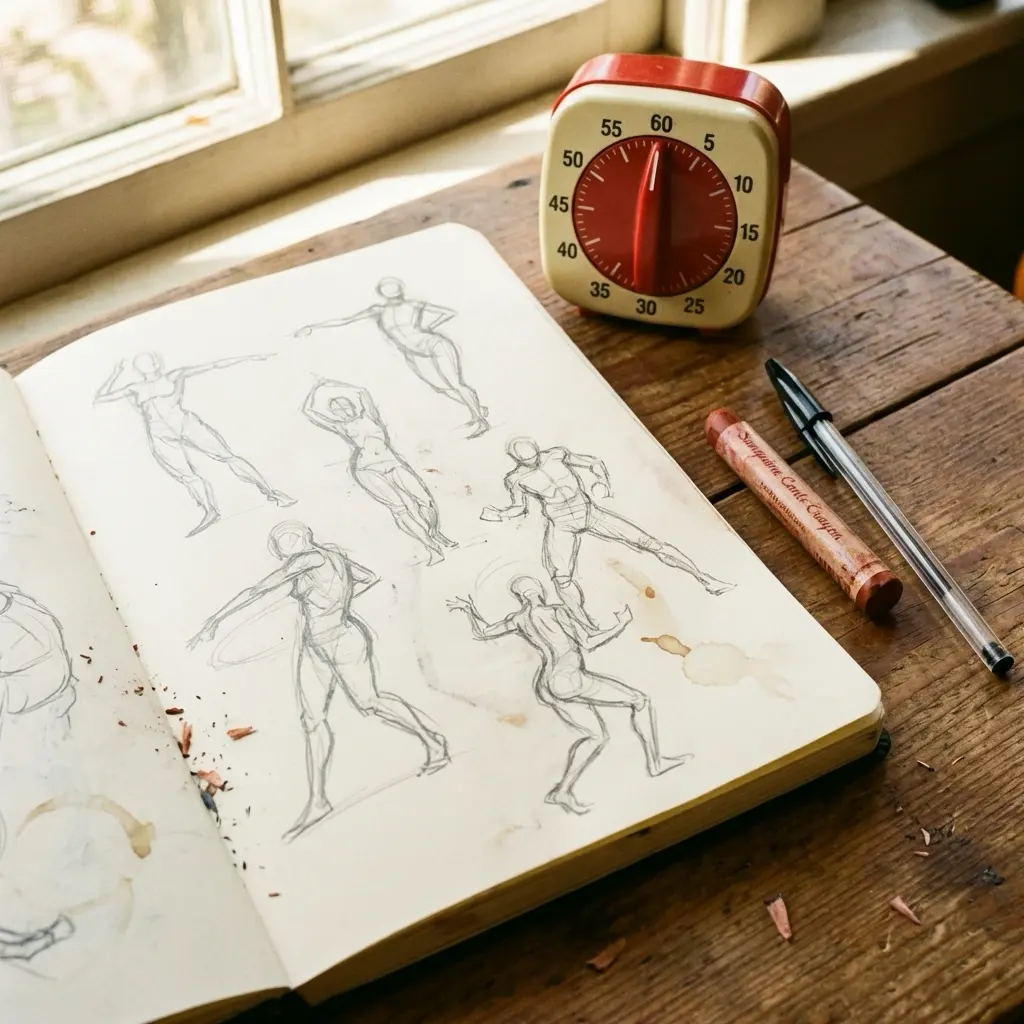
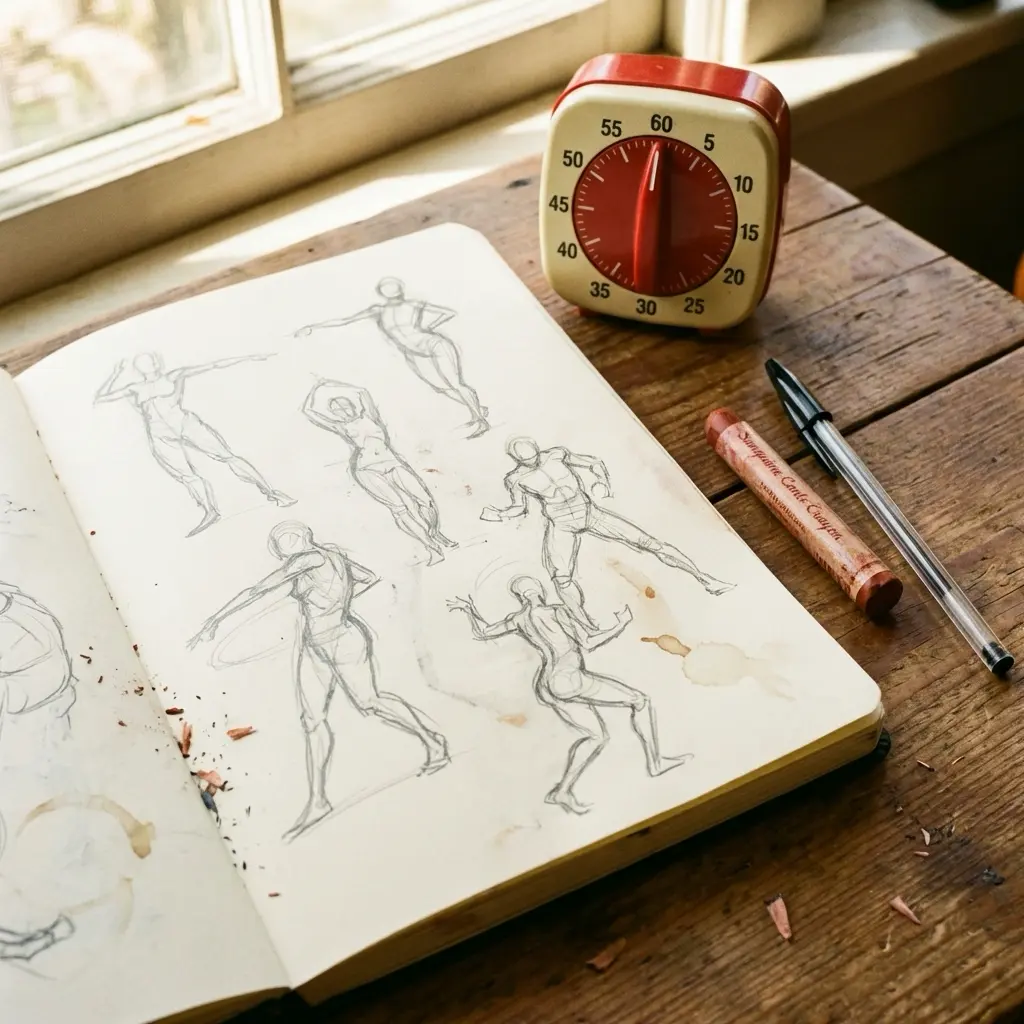
Work through this list in order, or jump to the poses that challenge you most. Either way: set a timer, use Quickposes or Line of Action for references, and prioritize the energy of the pose over the accuracy of the details. Details come later. Energy has to be built in from the start.
1) Dynamic Standing Pose
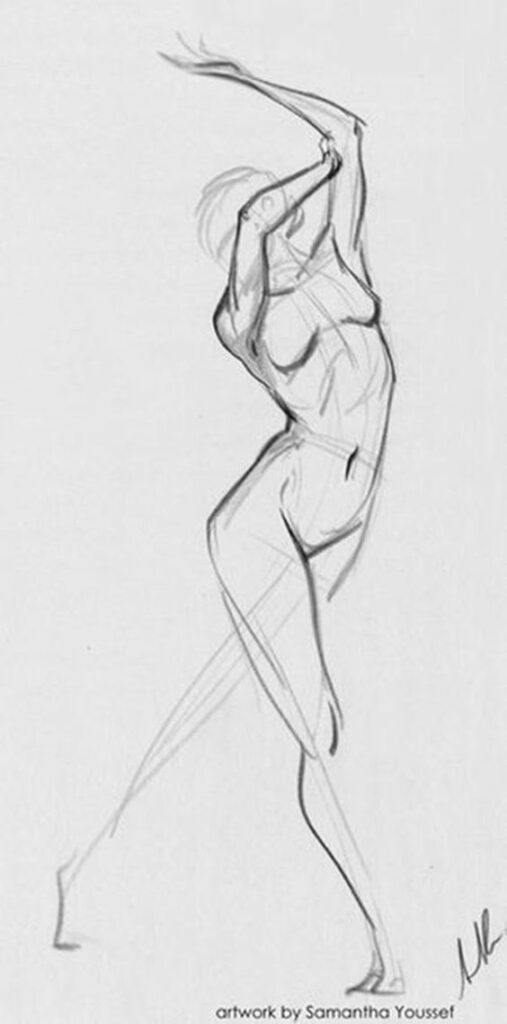
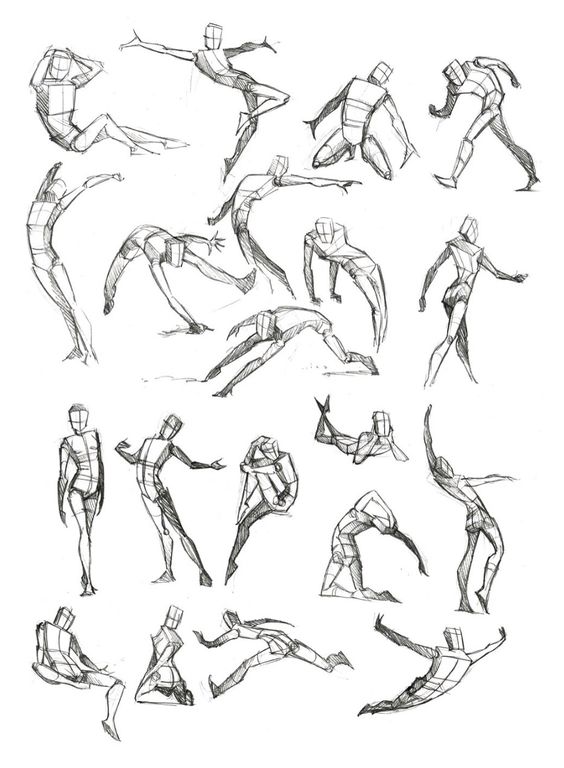
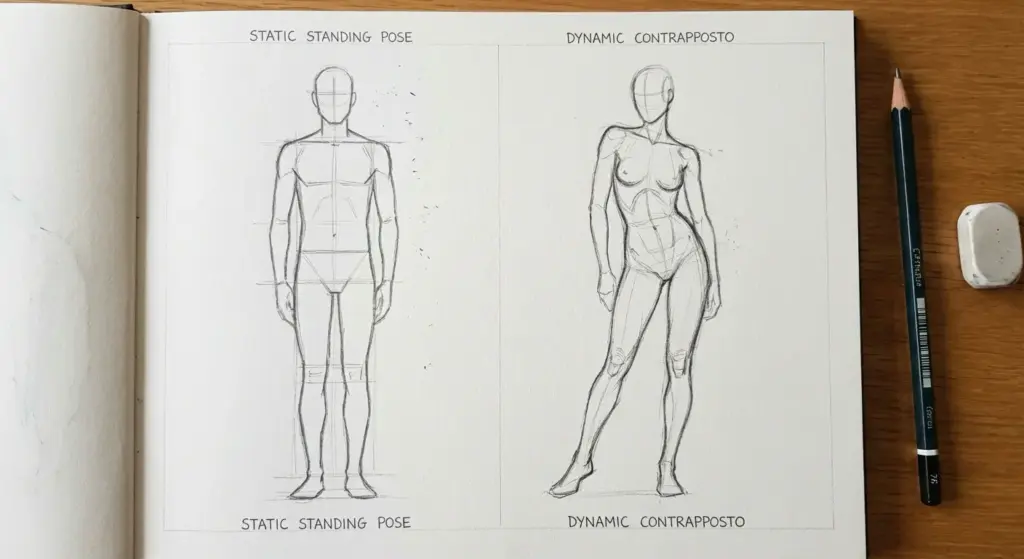
The dynamic standing pose is where most artists start — and where most get stuck for longer than they should. The mistake is almost always the same: you draw a figure that’s technically standing but visually frozen. Two parallel legs, shoulders perfectly level, weight distributed nowhere in particular. The pose reads as ‘person shaped’ rather than ‘person.’
The fix is the hip-shoulder counter-rotation. Almost no one stands with their hips and shoulders perfectly parallel. When you shift your weight onto one leg, that hip rises — and the opposite shoulder drops to compensate. This is called contrapposto, and it’s been the foundation of dynamic figure drawing since ancient Greece. In a gesture, you can capture this with two diagonal lines — one for the shoulder line, one for the hip line — that tilt in opposite directions. Everything else hangs off those two tilts.
- Start with the weight-bearing leg: which one takes the load? Draw that hip up.
- The non-weight-bearing leg either extends, bends, or shifts — it rarely just mirrors the other leg.
- Arms rarely hang perfectly straight. A relaxed arm has a subtle curve; a tense arm has angles.
In my experience, the single most useful thing you can draw first in any standing pose is the spine line — a single curved stroke from the base of the skull to the pelvis. If that line has rhythm, the figure will too. If it’s straight, the pose is dead before you’ve drawn anything else.
✏ Pro tip: Practice this pose in 30-second sessions on Quickposes, forcing yourself to draw only the spine, shoulder line, and hip line before adding anything else.
2) Leaping Action Pose
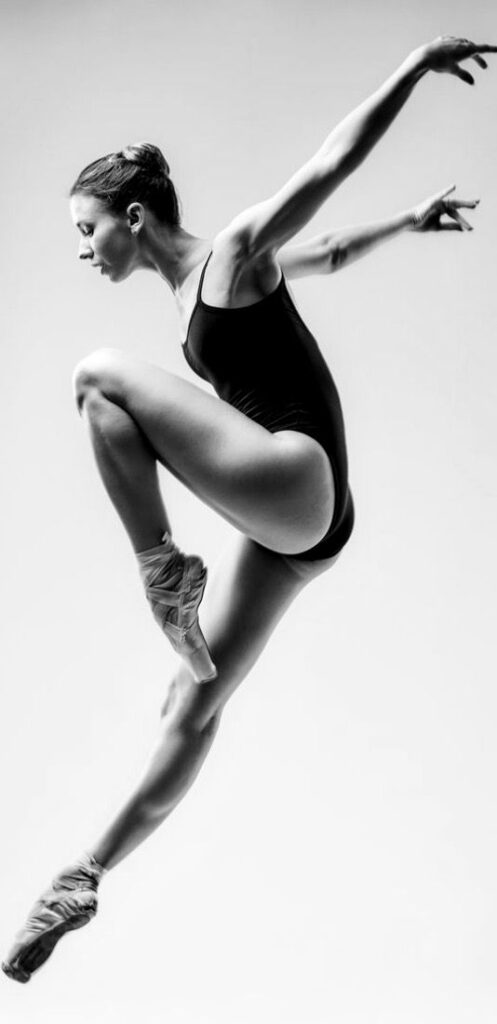
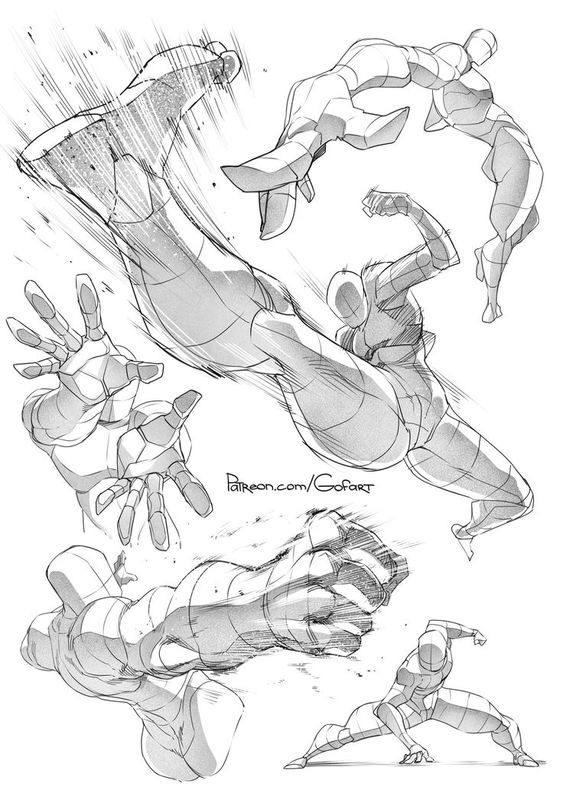
A leaping figure is, technically, a problem of inventing gravity. The figure is airborne — which means there’s no ground contact to anchor the pose, no weight pressing down. Everything about the drawing has to convince the viewer that this person left the ground, is currently somewhere above it, and will eventually land again. That’s a lot to communicate in a line drawing.
The line of action is everything here. Before you draw a single body part, sketch the arc of the leap — the primary trajectory of the body through space. For most leaps, this is a long, sweeping curve that travels through the chest or the center of the torso. Limbs radiate outward from this arc. When the arc is clear, the whole figure reads as unified and airborne. When it’s missing, you get a figure with their limbs spread out who just looks like they fell sideways.
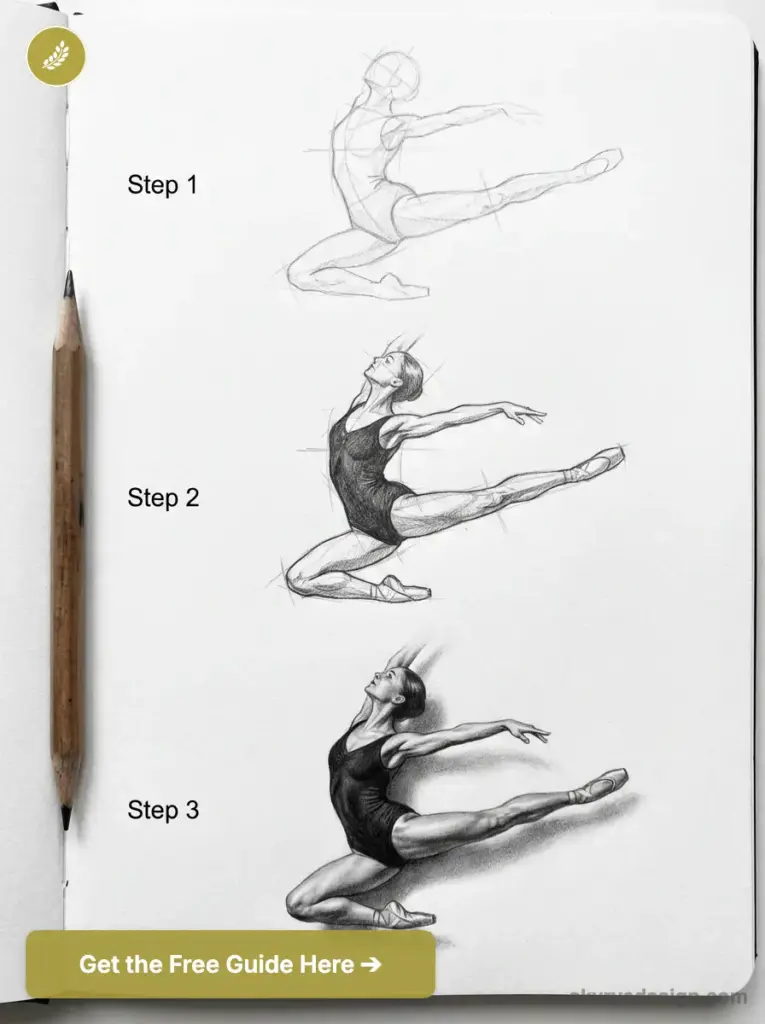
Ballet jumps are some of the best references for this pose because professional dancers have trained their bodies to make the arc visible — their technique literally exaggerates the line of action that gesture drawers are trying to capture. Spend time with ballet reference images even if you’re drawing athletes, fighters, or fantasy characters. The underlying geometry is identical.
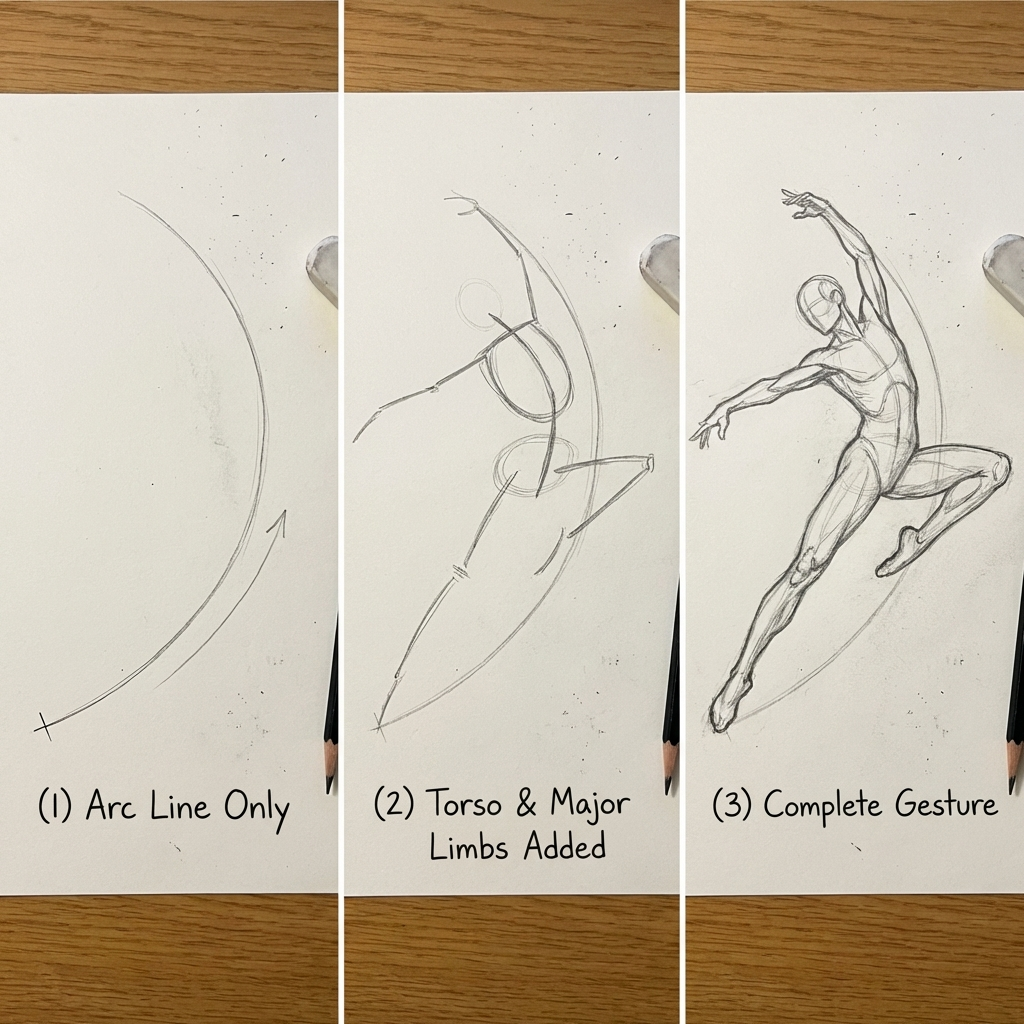
- Draw the arc of the leap before the figure: a single curve from takeoff direction to landing direction.
- Stretch the leading limbs in the direction of travel; contract the trailing limbs.
- The torso tilts toward the direction of the leap — if it’s vertical, the pose reads as falling rather than leaping.
✏ Pro tip: For this pose specifically, try drawing with just your arm — not your wrist. Large, full-arm gestures capture the arc better than small, tight lines.
3) Elegant Ballet Pose
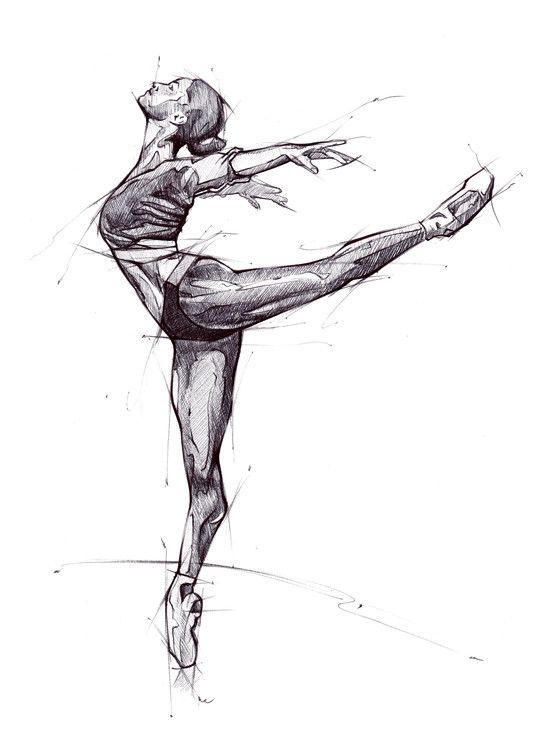
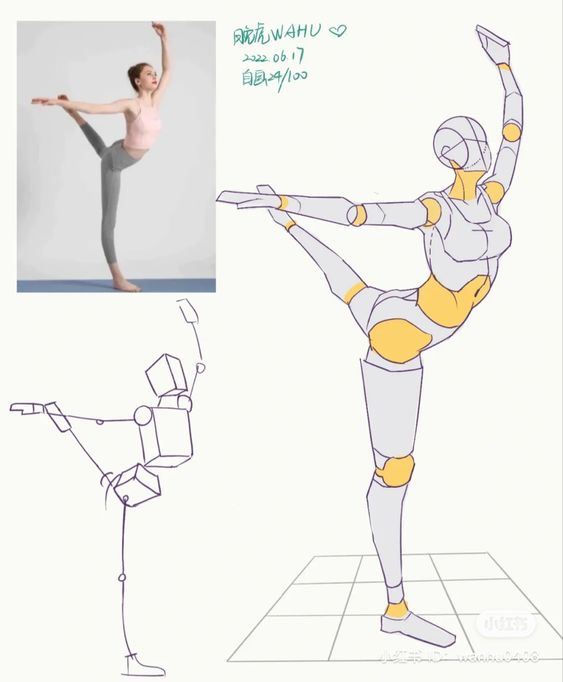
Ballet poses are a masterclass in line extension — the visual principle that a good pose creates long, unbroken lines that carry the eye across the entire figure and off the edge of the body. Every classical ballet position is designed around this: arms that extend and curve outward, legs that reach far past the body’s natural range, a head that tilts to complete the arc rather than break it.
The arabesque is probably the most drawn ballet pose for exactly this reason. One leg extends back as far as possible while the standing leg supports the weight — creating a nearly horizontal line from fingertip to pointed toe that travels the full length of the figure. For gesture drawers, this is a gift: the line of action is handed to you on a plate. The challenge is not inventing it — it’s trusting it enough to commit to the full extension without timidly shortening the reach.
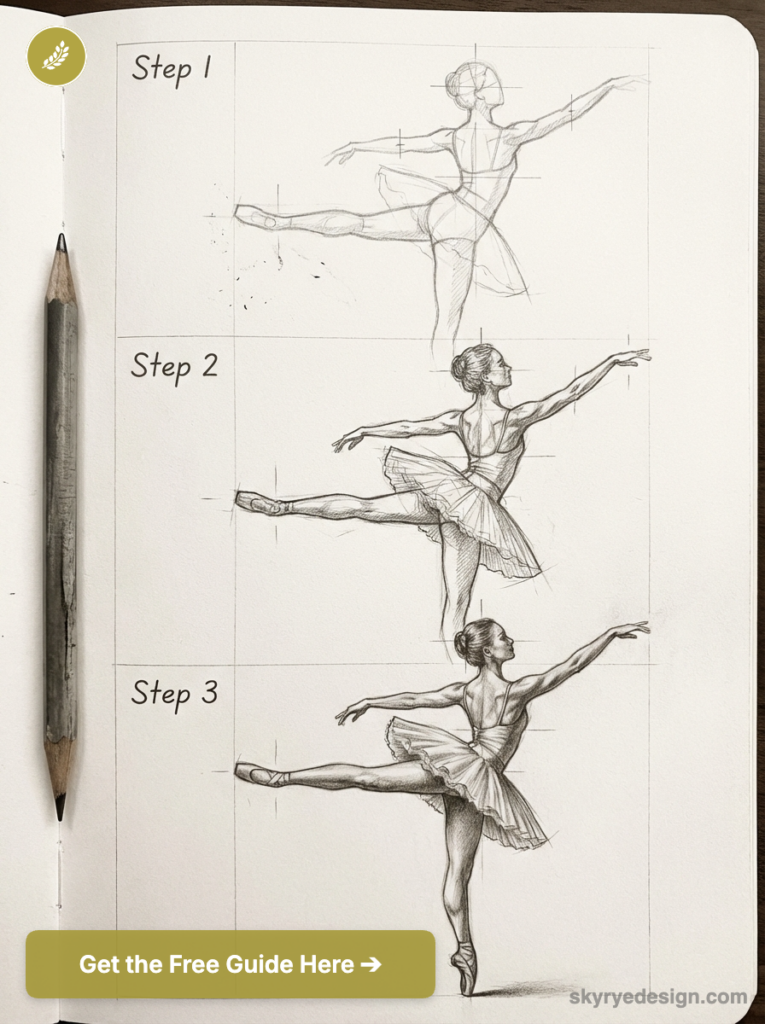
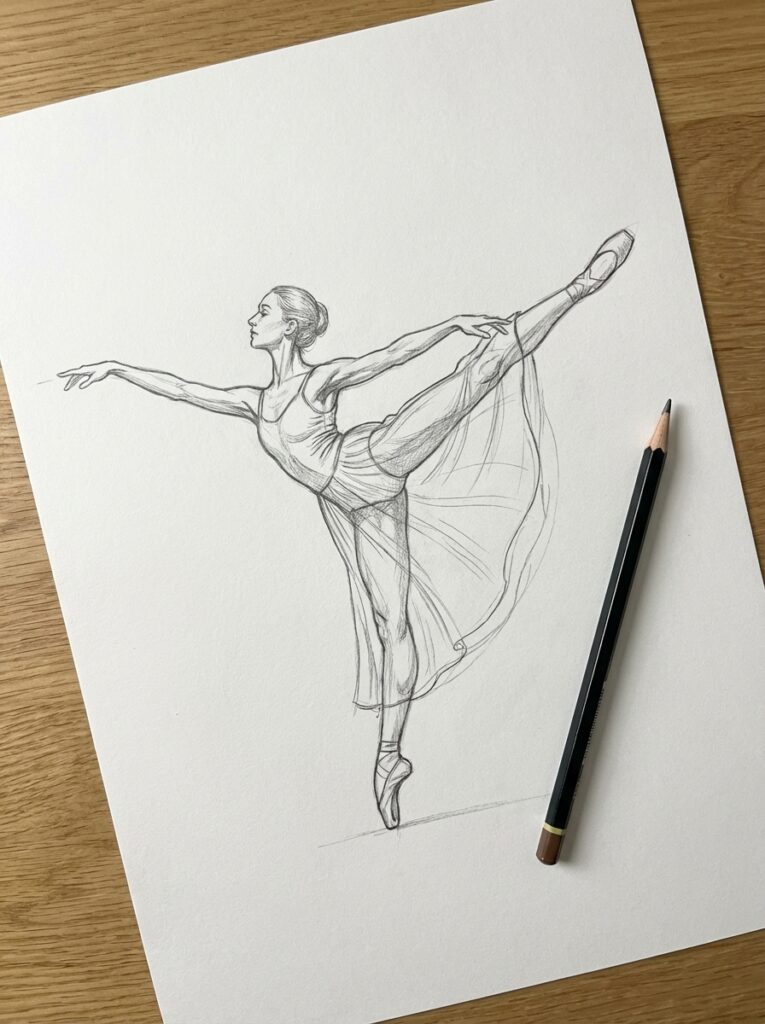
I’ve watched a lot of students (and done this myself) pull back on the extended leg in an arabesque. It feels exaggerated on paper. But look at the reference: the extension is the point. The discomfort with exaggeration is exactly what you’re training yourself past.
- Arabesque: the primary line runs from the tip of the extended front hand to the tip of the back foot — draw this single line first, then build the figure around it.
- Attitude: one leg bends at the knee and lifts — the bent leg creates a triangular counterpoint to the long lines of the arms.
- The standing foot’s position (flat, demi-pointe, full pointe) changes the whole geometry of the pose — check which one you’re drawing.
✏ Pro tip: Set your timer to 2 minutes for ballet poses instead of the usual 60 seconds — the level of extension and line quality rewards slightly more time.
4) Reaching Forward Pose
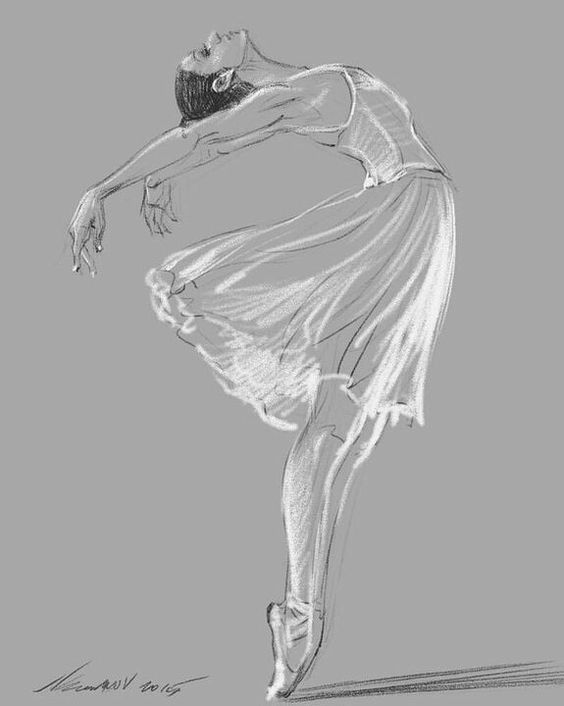
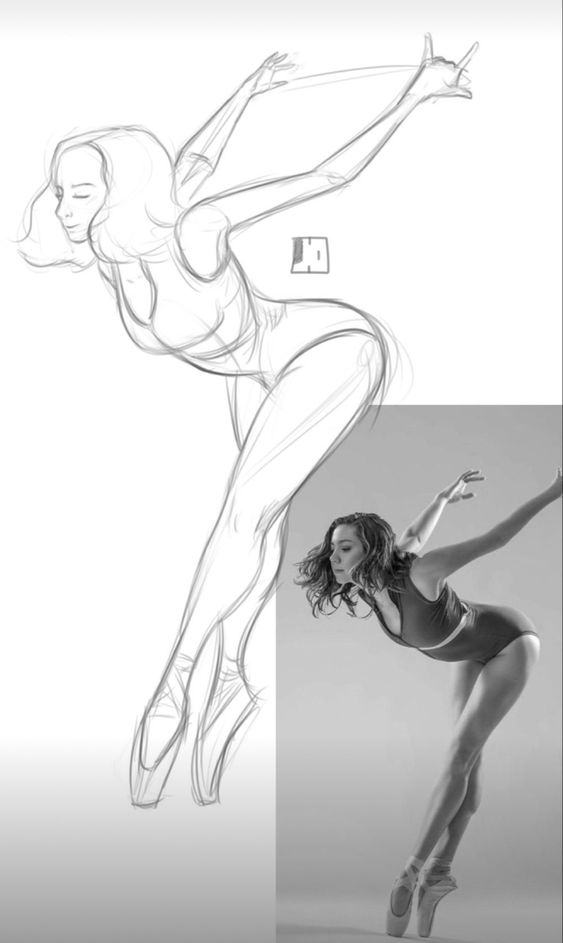
Reaching forward seems simple — arm extends, body follows — but it’s one of the most technically informative poses you can study, because it makes visible two things that most beginner drawings get wrong: foreshortening and weight shift.
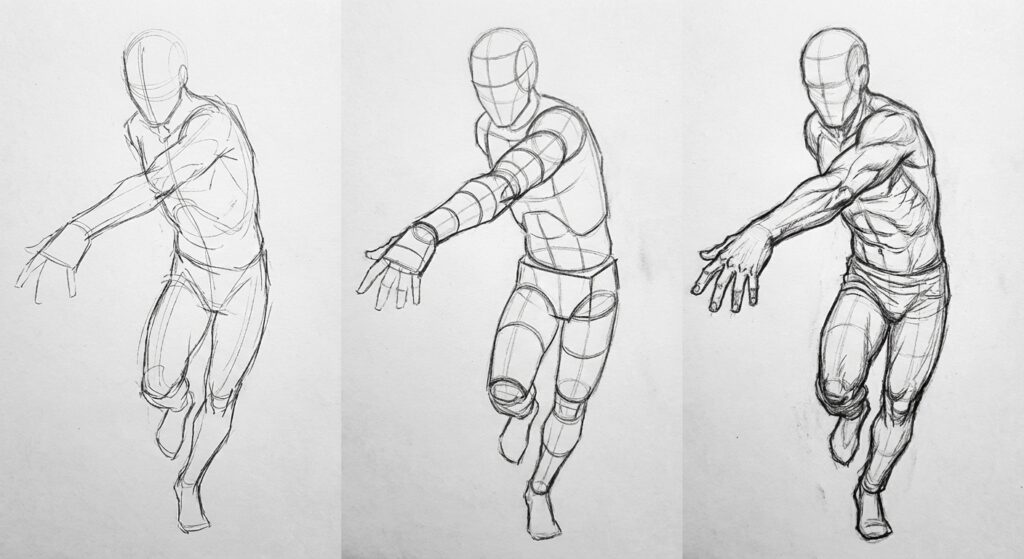
When an arm extends directly toward the viewer, you’re drawing foreshortening: the arm appears dramatically shorter than it actually is because most of its length is moving away from you rather than across your field of view. A reaching arm in three-quarter perspective isn’t a long arm drawn shorter — it’s a series of overlapping ellipses (shoulder, upper arm, elbow, forearm, wrist, hand) where each cylinder overlaps the one before it. Getting comfortable with this cylinder-overlap approach for foreshortened limbs is one of the single most useful skills in figure drawing.
The weight shift is equally important. When you extend one arm forward significantly, your body compensates — the torso leans back slightly, or the opposite leg steps back to maintain balance. A figure reaching forward with no corresponding weight adjustment looks like a cardboard cutout. The weight shift is what makes the reach feel effortful and real.
- For the reaching arm: draw from the shoulder socket forward, thinking about cylinders rather than outlines.
- The torso rotates toward the reaching side — the opposite shoulder pulls back.
- Check where the weight-bearing foot is: for a strong reach, one foot typically steps forward.
✏ Pro tip: Place your own arm in a reaching position and study it in a mirror — notice how much shorter it looks from the front vs the side. This is the foreshortening you need to draw.
5) Crouching Tiger Pose
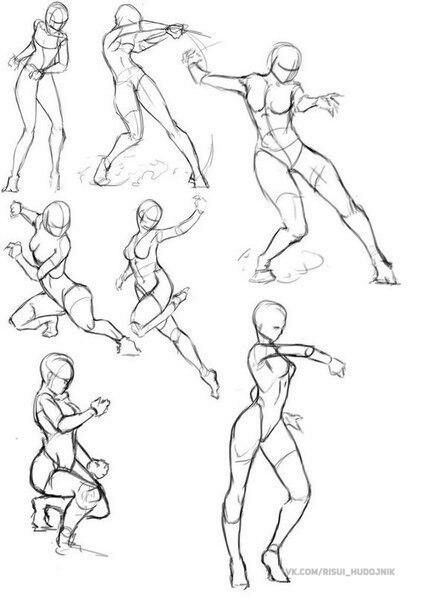
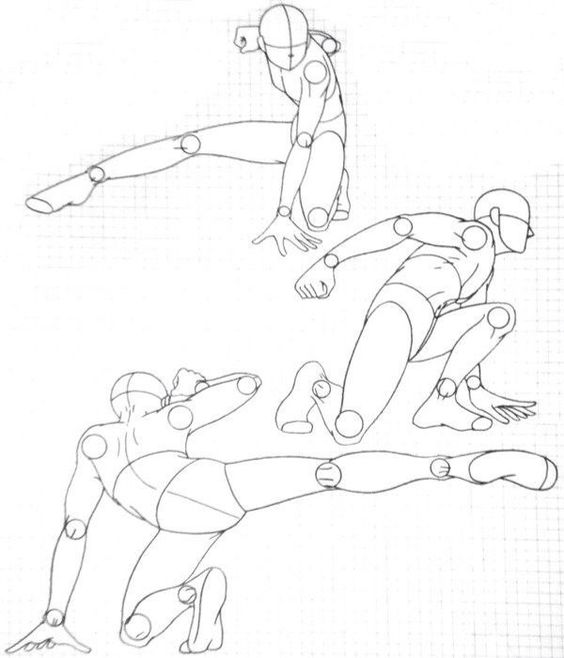
Low-to-the-ground poses are dramatically underrepresented in most artists’ practice sessions — which is exactly why drawing them feels hard. If you’ve spent most of your time drawing standing figures, the compressed geometry of a crouch is unfamiliar: the limbs fold against the body, the silhouette becomes compact and wide rather than tall and narrow, and the relationship between the torso and legs changes completely.
The crouching pose teaches compression. Where a standing figure’s energy moves vertically, a crouching figure’s energy coils — it’s the visual equivalent of a spring under pressure.
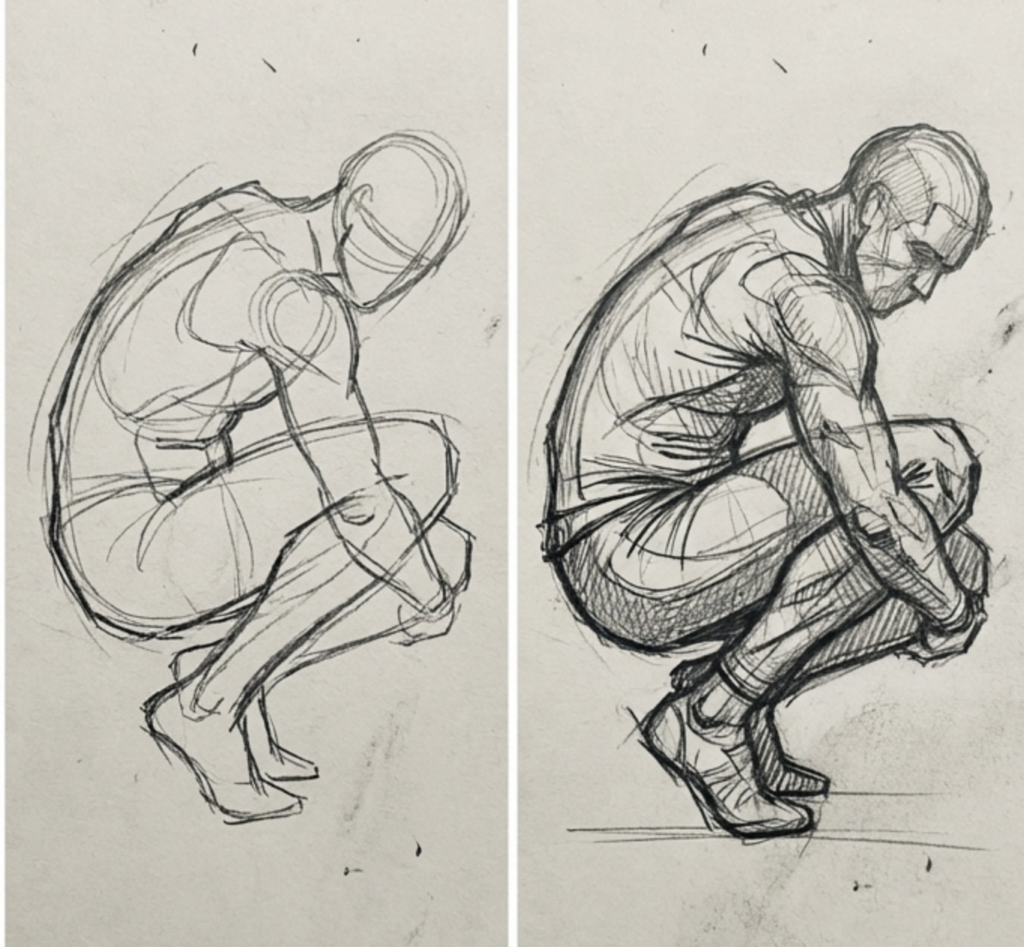
The best crouching gesture drawings make you feel the stored energy, the potential to explode upward or spring forward. That tension lives in the angle of the spine (usually more horizontal than you’d expect), the placement of the knees (typically outside the hips, creating width), and the position of the feet (often high on the ball of the foot, adding to the coiled-spring feeling).
- The spine angle in a crouch: much closer to 45 degrees than vertical — most students draw it too upright.
- Both knees typically push outward, creating a wide diamond shape in the lower body.
- The head usually tilts forward and down — following the spine’s angle.
One thing that genuinely surprised me about crouching poses: the silhouette reads as more powerful than a standing pose in many contexts. The compressed form implies containment, readiness, intention. Characters about to do something important often crouch before they do it — not just for physical reasons, but because visually it signals preparation.
✏ Pro tip: Sketch just the silhouette outline of a crouching figure before adding internal lines — the silhouette itself should read as compressed energy.
6) Sitting Cross-Legged Pose
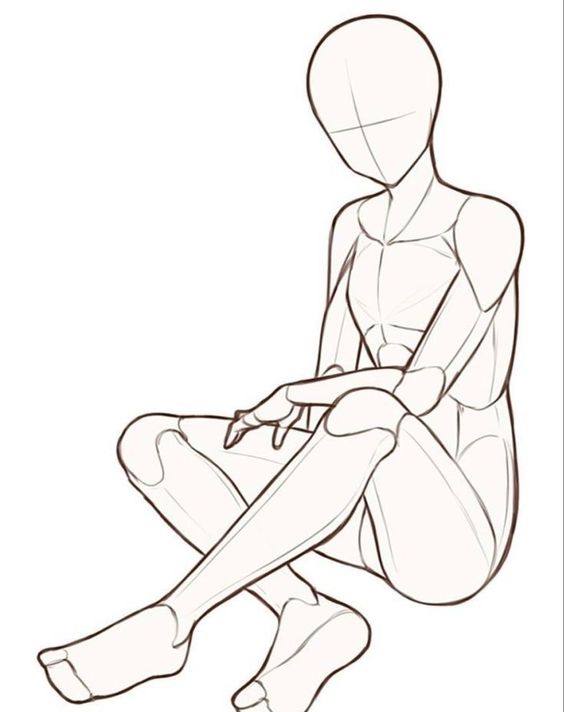
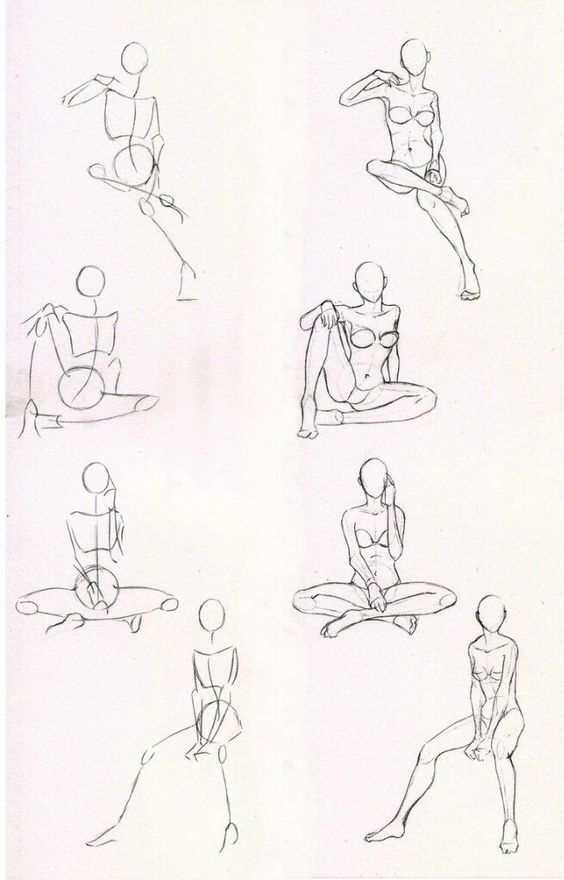
Sitting poses are deceptively challenging. Everyone assumes they’re easier than standing or action poses — less going on, more time to be careful. But sitting poses introduce a problem that standing poses mostly avoid: the compression of the lower body against a surface, and the completely different logic of how legs and hips read when the figure is grounded.
The cross-legged sit is a great starting point because it creates clear, readable shapes. The legs form a diamond or triangle in the lower body — a stable, graphic form that anchors the whole figure. The interesting variation comes from what the upper body and arms do on top of that stable base. Arms resting on knees read as calm and settled. Arms gesturing or reaching read as animated and expressive. The same crossed-leg position reads entirely differently depending on the spine’s angle (straight and alert vs. rounded and relaxed) and the head’s tilt.
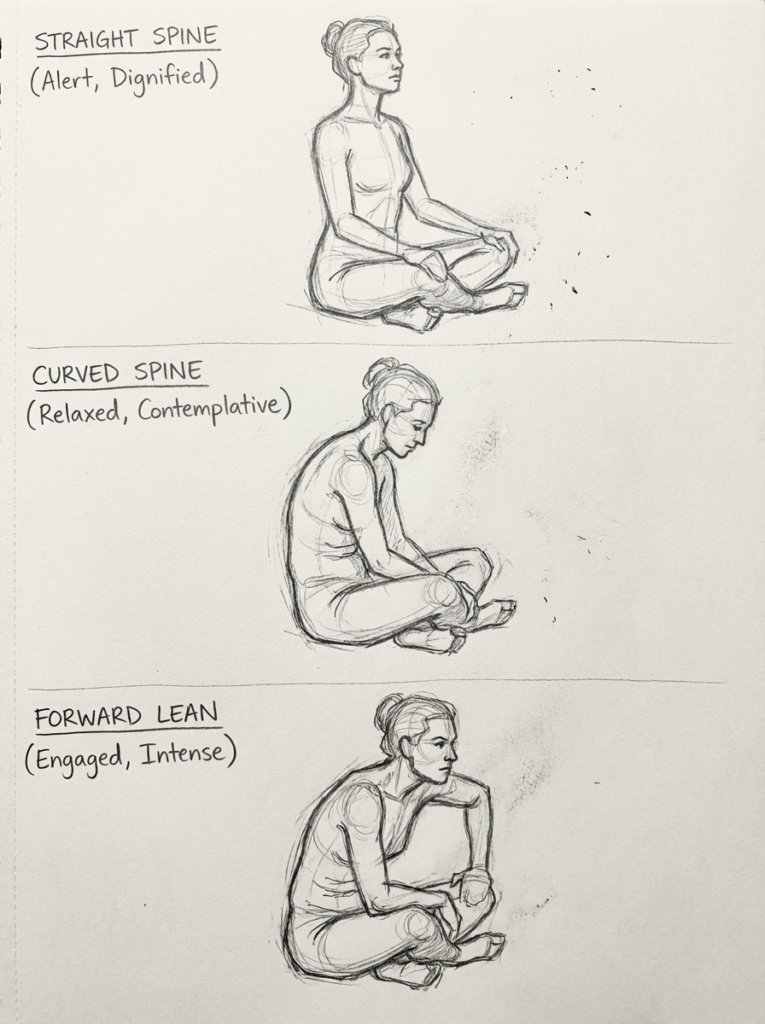
- The diamond shape of the crossed legs: draw the overall shape before drawing individual legs.
- The spine angle tells the story: straight = alert, meditation, focus; curved = relaxed, tired, introspective.
- Hand placement changes everything — resting, gesturing, supporting the chin — each shifts the mood completely.
For fashion illustration and character design, the cross-legged pose is one of the most versatile sitting positions because it photographs and reads clearly from multiple angles and works equally well for casual, formal, and intimate emotional contexts.
✏ Pro tip: Practice this pose drawing only the lower body first — the leg shapes alone should be readable as a specific sitting posture before the torso is added.
7) Running in Motion Pose
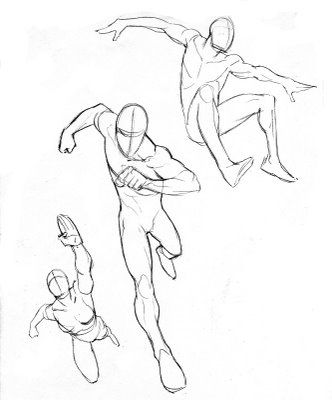
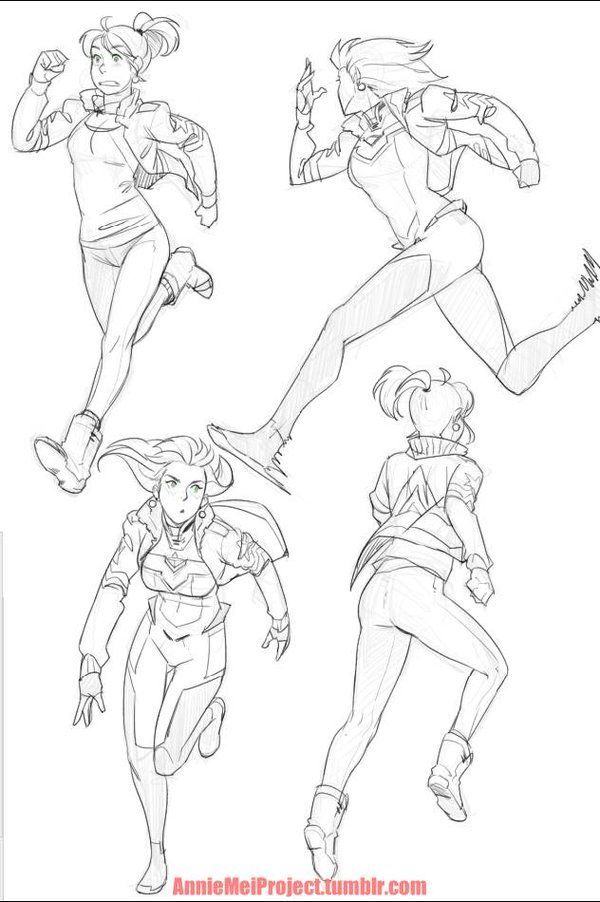
Running is the most technically demanding of the common action poses — not because it’s the most extreme in range of motion, but because it’s so familiar that even small errors are immediately visible. Everyone knows what running looks like. An arm that swings the wrong way, legs in an impossible combination, or a torso that doesn’t lean into the movement — your viewer catches these mistakes without consciously analyzing them.
The fundamental rule of running is opposition: the right arm moves forward with the left leg, and vice versa. This cross-body pattern is the body’s natural way of balancing rotational forces during forward motion — it keeps the runner from spinning. In a gesture drawing, establishing this opposition early (before adding any detail) immediately makes the pose read as running rather than walking or falling.
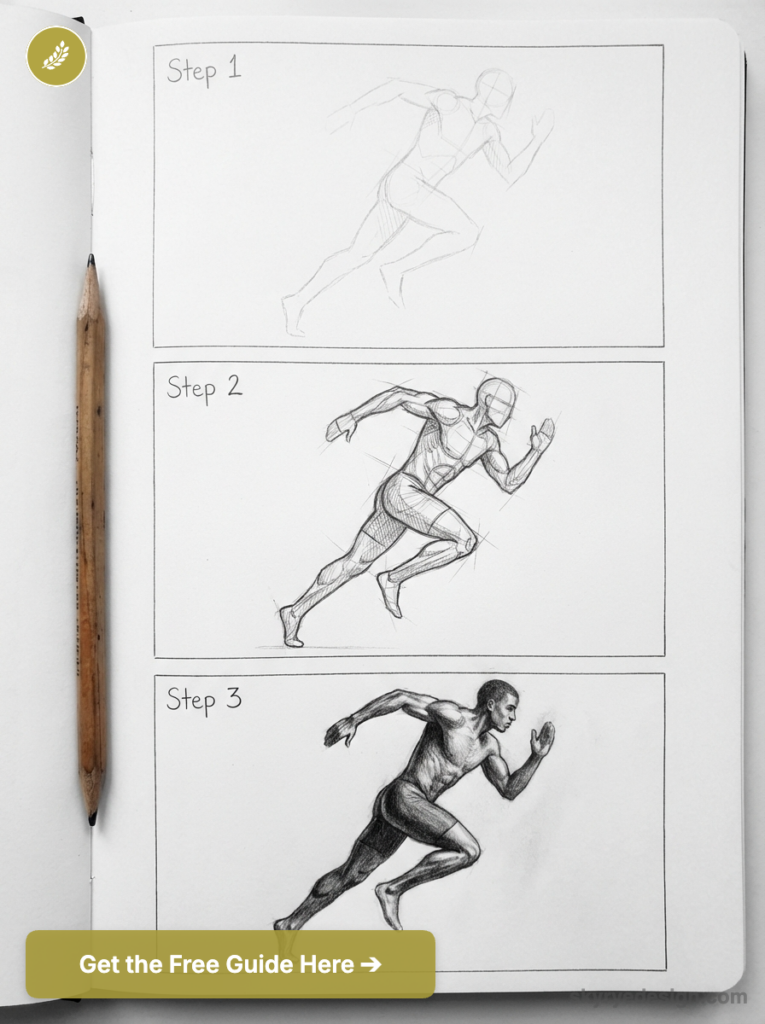
The torso lean is the second key element. A running figure leans into their direction of travel — the center of gravity is slightly ahead of the feet, which is what forces the feet to keep moving. No lean, no convincing run. The amount of lean signals speed: a gentle jog has a slight lean; a full sprint has a dramatic one.
- Opposition first: if the left leg is forward, the right arm is forward. Draw these two lines before anything else.
- The lean: a jogging figure leans about 10-15 degrees forward; a sprinting figure can lean 20-30 degrees.
- The non-weight-bearing leg bends sharply at the knee in a sprint — this bent knee is the most distinctive visual cue of running fast.
✏ Pro tip: Watch slow-motion running footage before your practice session — you’ll see the opposition, lean, and bent knee in isolation that normal speed hides.
8) Expressive Hands Pose
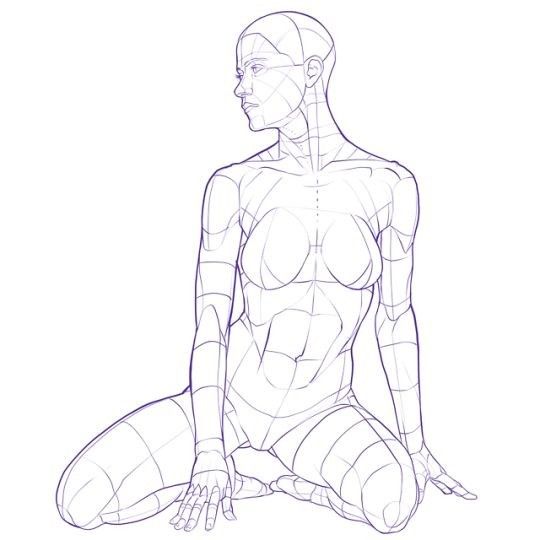
Hands are, famously, the hardest part of the human figure to draw — and also the most expressive. A figure with a beautifully drawn body but stiff, awkward hands immediately reads as unfinished. Hands carry more emotional information per square centimeter than almost any other body part, which is why artists who can draw them confidently have an enormous advantage.
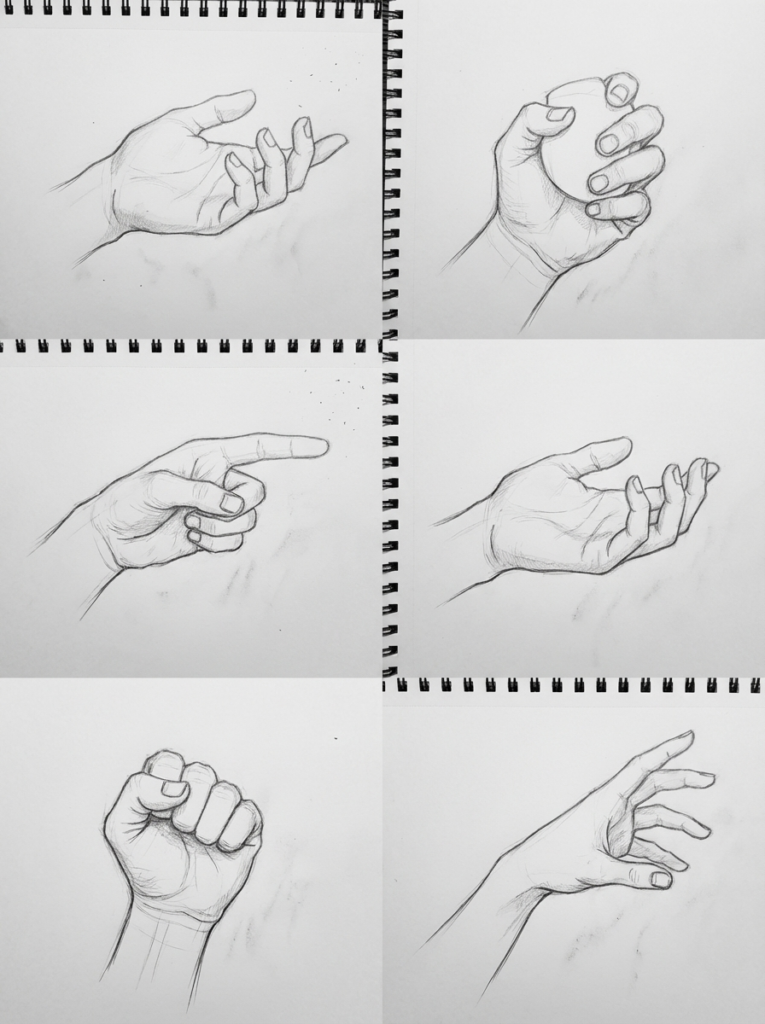
The key insight that changed how I approach hand drawing is this: stop drawing fingers and start drawing shapes. A relaxed hand is not five cylinders attached to a palm — it’s a collection of overlapping planes and folded shapes that only resolve into individual fingers at the very end of the drawing process. Sketch the overall mass of the hand first (palm as a flat wedge, roughly rectangular), then the thumb’s direction and position (the most expressive element of any hand gesture), then the general direction and curl of the fingers as a group, then individual finger definition last.
For gesture practice specifically, isolated hand studies are enormously valuable. Set your timer for 20 seconds per hand pose and just fill pages. The volume of practice you need to get comfortable with hands is genuinely higher than for any other body part — but it compounds quickly once the basic forms are internalized.
- The palm as a wedge: wider at the knuckles, narrower at the wrist — draw this shape first.
- The thumb sets the emotional tone: tucked = tension, open and relaxed = calm, extended and pointing = direction and intention.
- Fingers in a gesture curve together — they rarely spread independently unless that’s the specific gesture.
✏ Pro tip: Try drawing your own non-dominant hand in different positions for 10 minutes before any figure drawing session — it’s the best warm-up specifically for hand skill.
9) Dramatic T-pose
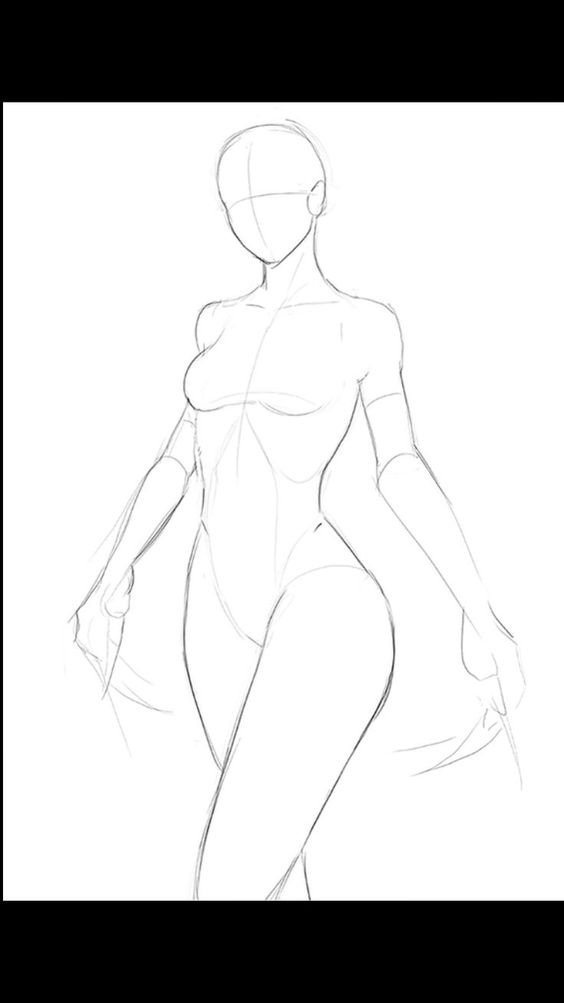
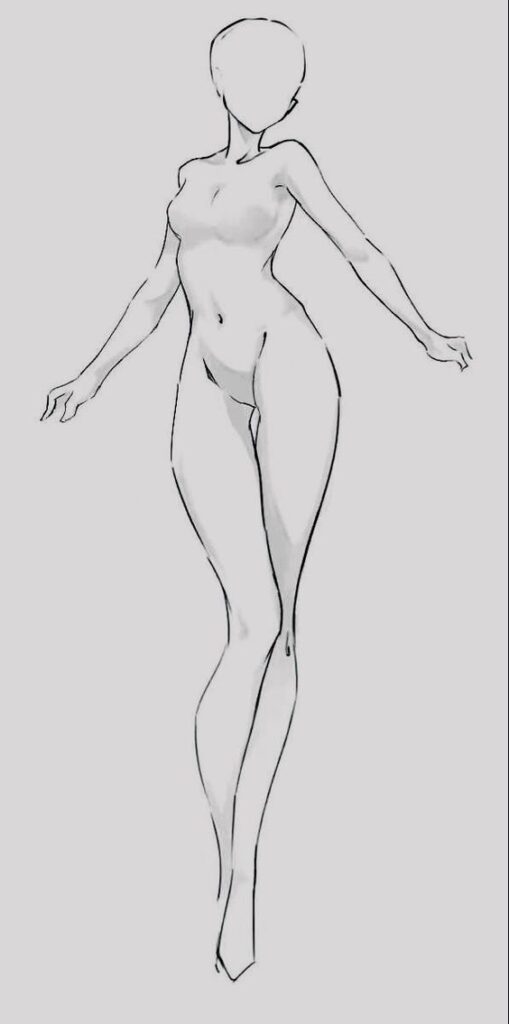
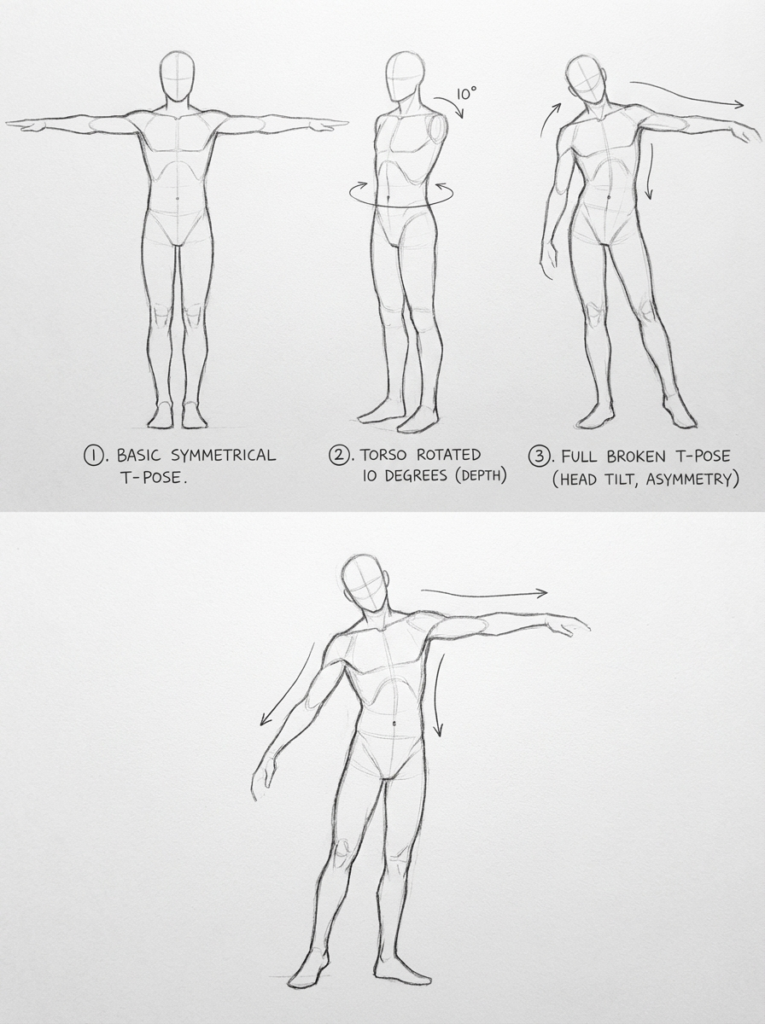
The T-pose has a reputation as the most boring figure drawing pose in existence — the default animation rig, the placeholder, the ‘I haven’t thought about what this character is doing yet.’ And it’s true that a straight-up symmetrical T-pose is fairly useless as a drawing challenge. But a dramatically rendered T-pose — or a broken, asymmetrical variant of it — is actually one of the best poses for studying bilateral symmetry, proportion, and the geometry of extended arms in three-dimensional space.
The useful version of this pose is the one where you deliberately break the symmetry. Rotate the torso slightly. Tilt the head. Raise one arm marginally higher than the other, or bend one elbow. The moment you introduce any asymmetry into a T-pose, it stops reading as a default and starts reading as intentional — a figure asserting their presence in space, or a superhero landing shot, or a character being displayed or examined.
For practical figure drawing, the T-pose is also the best pose for establishing correct shoulder width and arm proportions before moving into more complex poses. Get a T-pose right and you’ve calibrated your proportional system for the session.
- In a straight T-pose, check that both arms are at the same height and that the shoulder line is level — asymmetry here reads as error rather than intention.
- A 10-degree rotation of the torso transforms a dead T-pose into a confident, dynamic stance.
- From a three-quarter view, one arm foreshortens significantly — practice drawing the near arm shorter than your instincts suggest.
✏ Pro tip: Use the T-pose at the start of a new character design session as a proportion check — establish your character’s arm span, shoulder width, and overall height ratio before moving to expressive poses.
10) Warrior Stance Pose
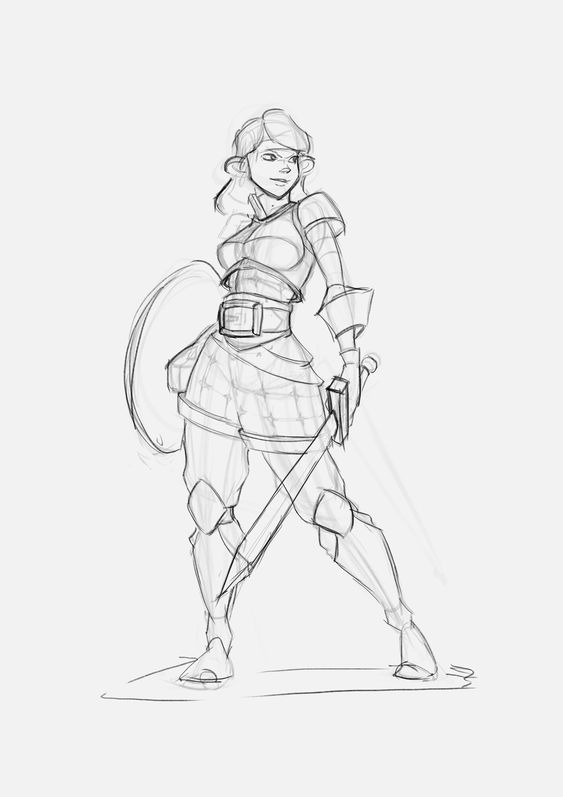
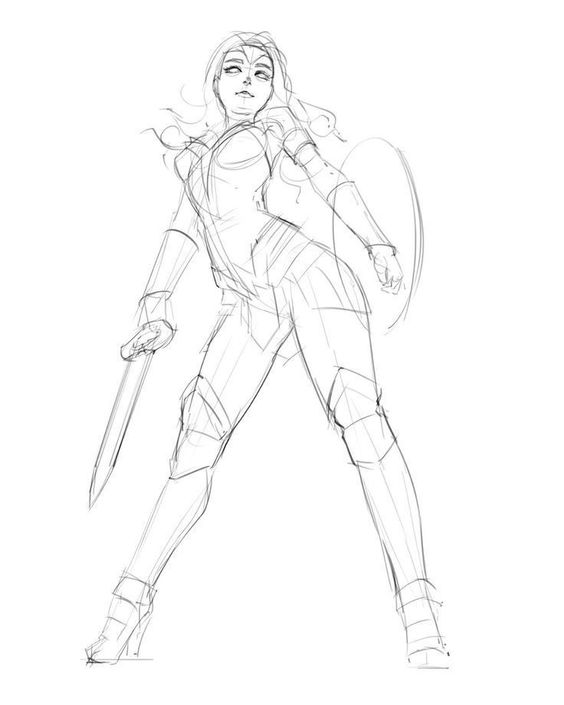
The warrior stance is fundamentally a pose about directed energy — all the visual force of the figure pointing toward a specific target. One leg plants back for power, one steps forward for reach, the torso leans into the action, and the arms position for whatever the character is about to do. The whole body is an arrow.
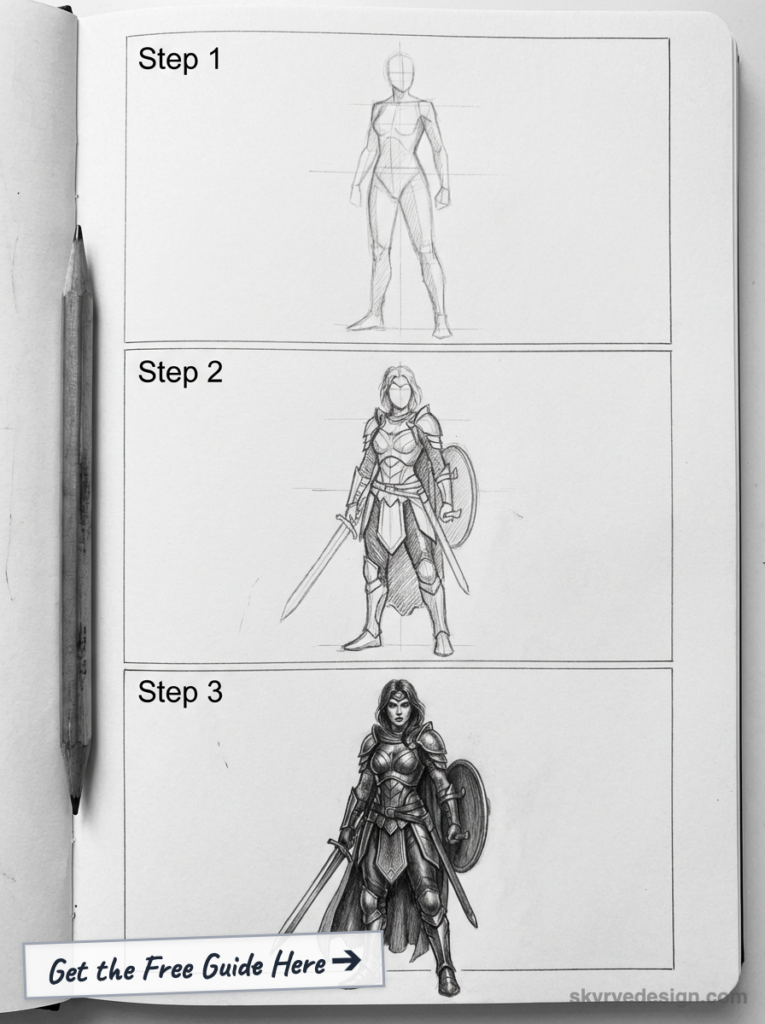
What makes warrior stances challenging to draw is the complexity of the weight distribution. Unlike a standing pose where weight is primarily vertical, a warrior stance distributes weight diagonally across the body — back leg absorbs the push, front leg receives the forward momentum. The tension this creates in the torso and hips is what makes these poses feel powerful rather than just aggressive. Students who miss this tension often produce figures that look like they’re acting threatening rather than being powerful.
I find it useful to think about the ground connection first in warrior poses. Where the back foot plants, how the heel digs in, the angle of the back leg — these establish the base from which all the upper-body energy radiates. A warrior stance with a weak ground connection looks like someone leaning dramatically rather than someone who could actually fight.
- The back leg: nearly straight, heel pressing into the ground, angled backward from the hip.
- The front knee: bent at roughly 90 degrees or less, directly above the front foot.
- The torso lean: forward and toward the target — the spine angle points at whatever the figure is confronting.
✏ Pro tip: Add a horizon line to your warrior stance sketches — it forces you to think about the figure’s relationship to the ground plane, which makes the weight distribution visible.
11) Twisted Torso Pose
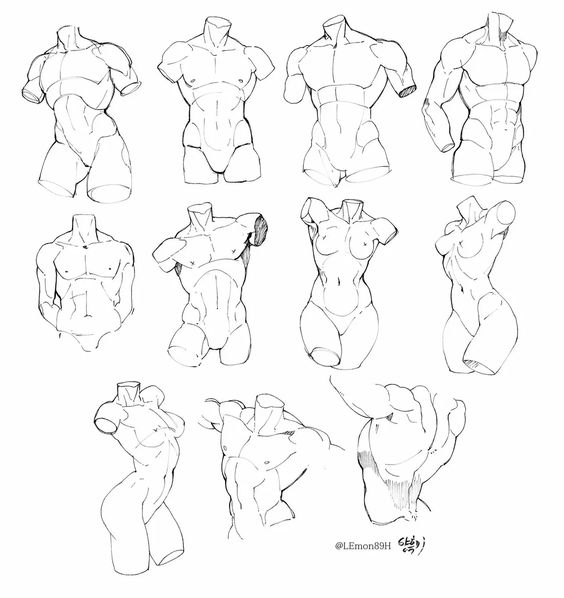
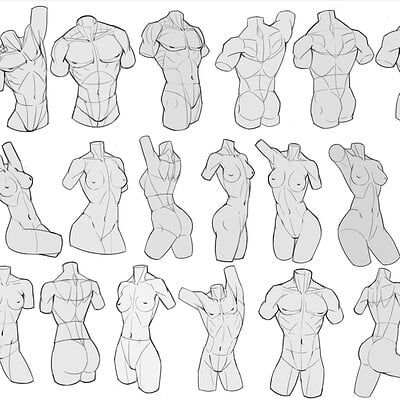
Torso twists are the single most important pose category for anyone who draws figures in action, combat, sports, or dance — because the twist is what makes a figure look like it’s moving through time rather than frozen in a single moment. A twisted torso implies a before and an after: the figure is partway through a rotation, and the viewer’s eye can predict where it came from and where it’s going.
The technical challenge of a twisted torso is accurately depicting how the ribcage and pelvis move independently. The ribcage can rotate significantly relative to the pelvis — a full twist might show the shoulders pointing almost perpendicular to the hips. In a gesture drawing, this is captured with two opposing lines: the shoulder line tilting one way, the hip line tilting the other. Between these two lines, the torso wraps in a spiral that compresses on one side and stretches on the other. The compressed side gets shadow; the stretched side gets light.
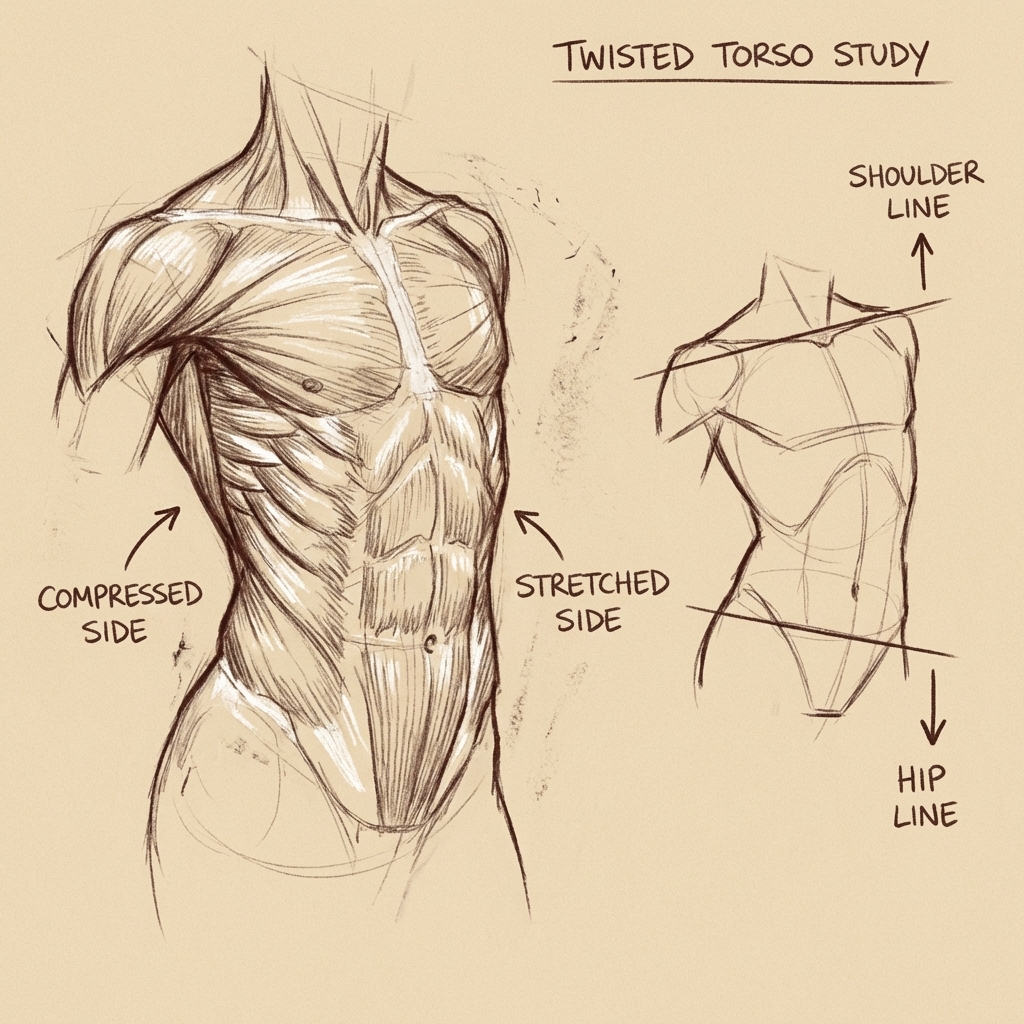
This is the pose that most directly trains your understanding of three-dimensional form in a two-dimensional drawing — because to draw a twist convincingly, you have to understand that the body is a volume rotating in space, not a flat shape being distorted.
- Draw the shoulder line and hip line first, then establish which direction each is pointing.
- The compressed side of the twist foreshortens: the ribcage stacks closer on that side.
- The stretched side lengthens: the distance between the last rib and the hip crest increases visibly.
✏ Pro tip: Sit in a chair and twist your own torso as far as you can in both directions. Notice how one side compresses while the other stretches — feel it, then draw what you felt.
12) Gesture with Flowing Scarf
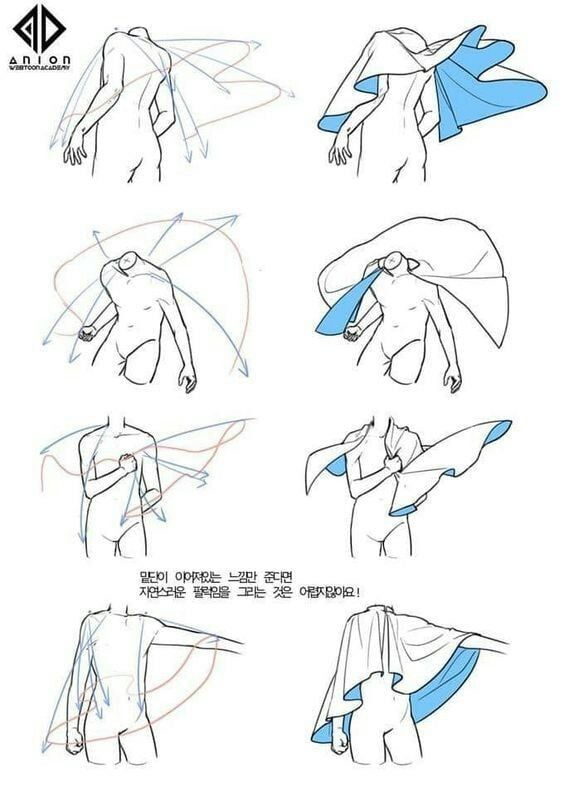
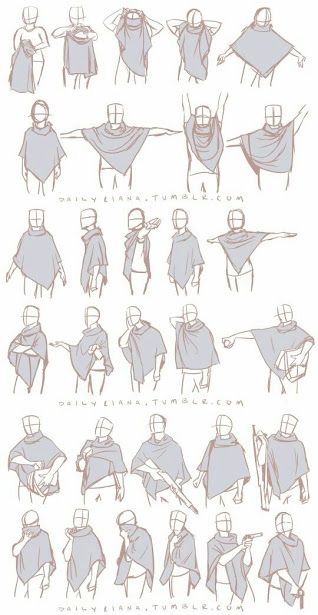
Props are underused in gesture drawing practice, which is a mistake — drawing a figure interacting with a prop teaches you things that pure figure drawing can’t. The flowing scarf pose is particularly useful because it introduces two challenges simultaneously: capturing fabric physics (how cloth moves and hangs relative to the figure’s motion) and using secondary movement to reinforce the primary gesture.
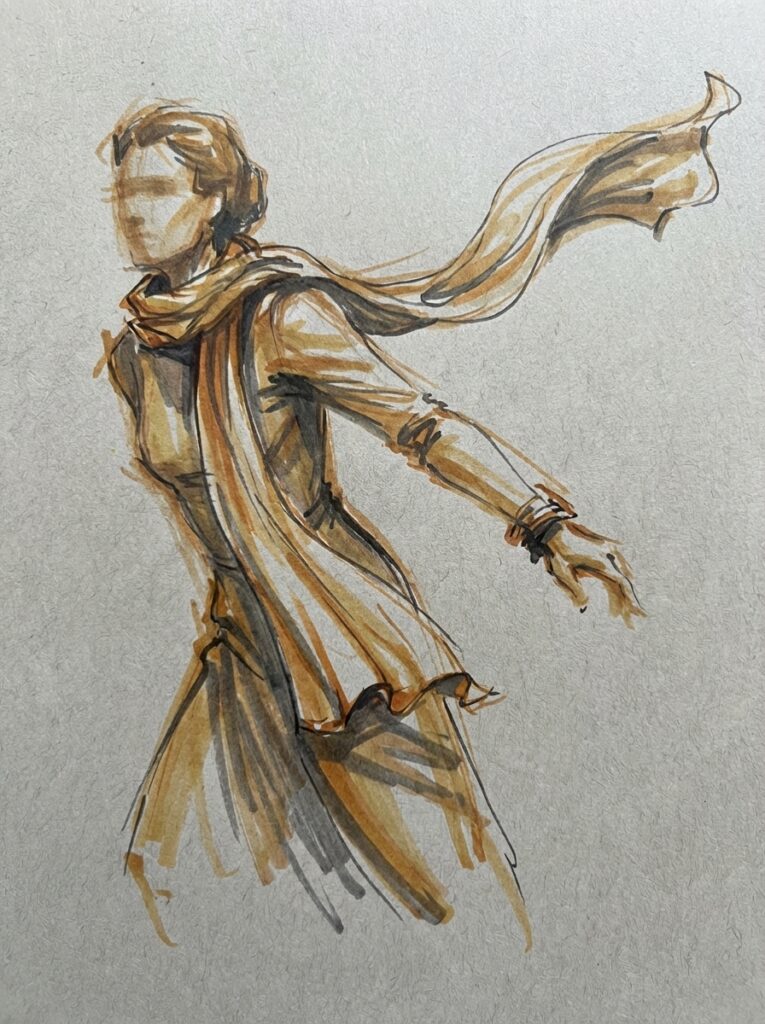
Secondary movement is the animator’s term for the way secondary elements — hair, clothing, capes, scarves — move in response to the primary action of the figure. If a figure leaps to the right, a scarf trails to the left and upward, following the physics of the leap a fraction of a second behind. Drawing this correctly means you’ve understood the physics of the pose well enough to extend it into a different material. It’s a sophisticated test of whether you’ve actually read the gesture or just copied a surface.
The scarf itself teaches drapery — how cloth folds, where tension points occur, how fabric hangs between two points of support versus how it flows from one. These are directly applicable to drawing clothing, capes, dresses, and any other textile element in figure drawing.
- The scarf’s direction should be the inverse of the figure’s primary movement — if the figure leans forward, the scarf trails backward.
- Fabric folds radiate from anchor points (where the scarf is held or tied) and hang in catenary curves between them.
- Use the scarf to extend and amplify the pose’s line of action — it should make the gesture feel bigger, not add visual noise.
✏ Pro tip: Draw the scarf’s movement path as a single line first — this should echo and extend your line of action — then add the fabric’s volume around that line.
13) Yoga Stretch Pose
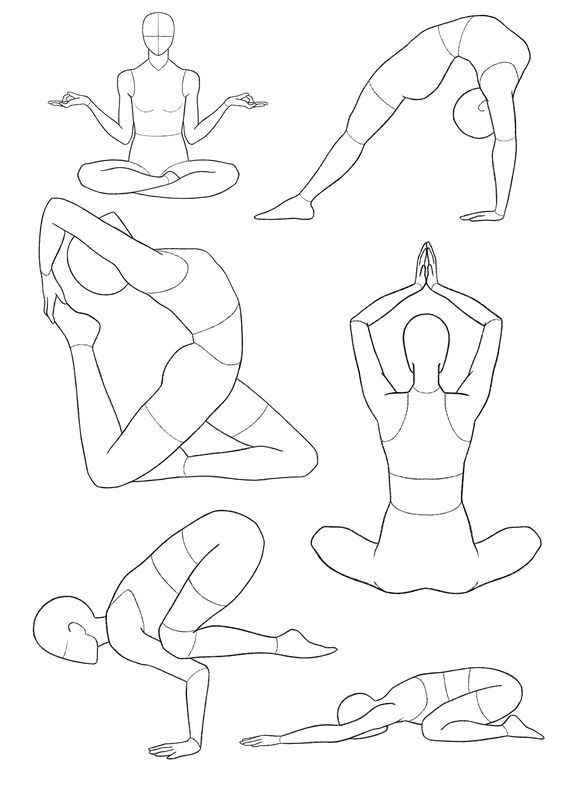
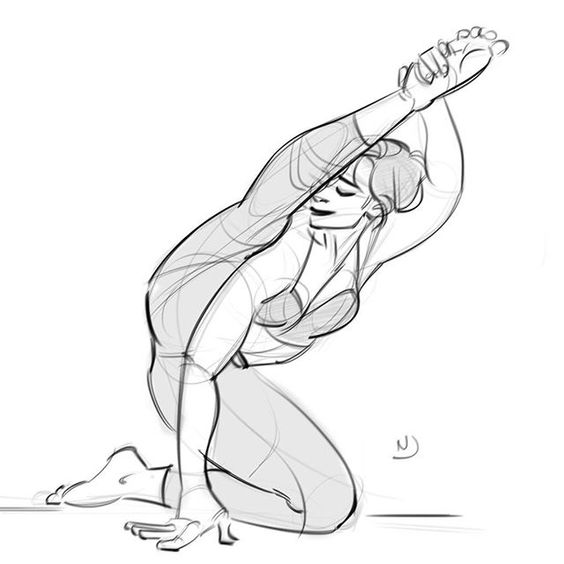
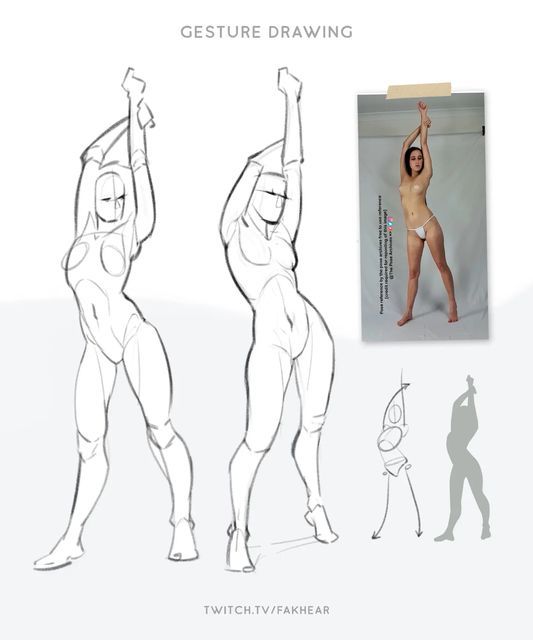
Yoga poses are a gift for gesture drawers: they’re held, well-documented in photographs, range from beginner-accessible to extremely complex, and they specifically test your ability to draw extreme ranges of motion that everyday movement never produces. The extended arms-overhead stretch is the simplest entry point — and it teaches the full-length line of action in its clearest possible form.
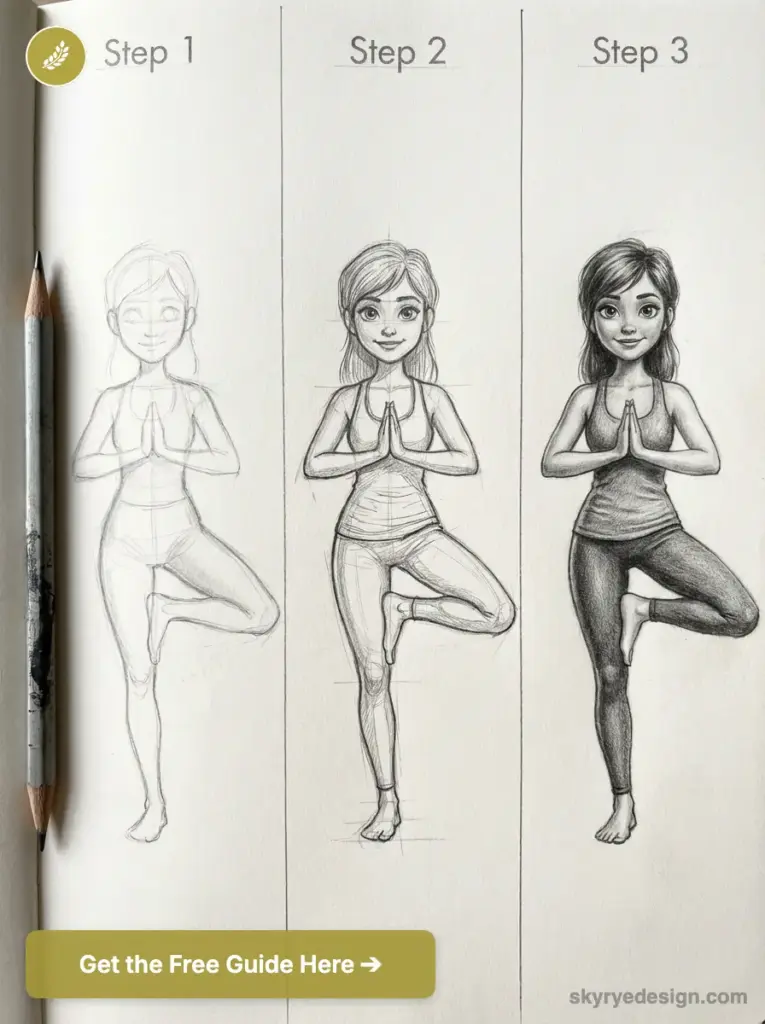
When both arms extend upward and the body lengthens, the entire figure becomes one vertical line from the planted feet to the fingertips. Every joint — ankle, knee, hip, spine, shoulder, elbow, wrist — contributes to this line. If any joint breaks the continuity (a knee that doesn’t fully extend, a shoulder that doesn’t reach its full height), the line loses its power. Gesture drawing the overhead stretch trains you to see and preserve that full-length continuity.
More advanced yoga poses like the standing split (one leg raised vertical, body folded forward), the warrior series, and backbends take this further — they’re essentially organized extreme ranges of motion that human bodies can achieve, and they’re far more dynamic than they look in photographs. A full-depth backbend has astonishing line-of-action geometry once you locate it.
- Arms overhead: the shoulder blades lift and press upward — the trapezius engages visibly and changes the upper back’s silhouette.
- The spine in a full stretch: slightly arched (not perfectly straight), with the curve starting at the lower back.
- Check the ankle angle: a full vertical stretch usually involves raising slightly onto the ball of the foot.
✏ Pro tip: Use yoga pose photograph collections (Pinterest boards of yoga asanas work well) for gesture practice — the variety of extreme-range poses is huge and the photographs are consistently clear.
14) Gesture with Sword
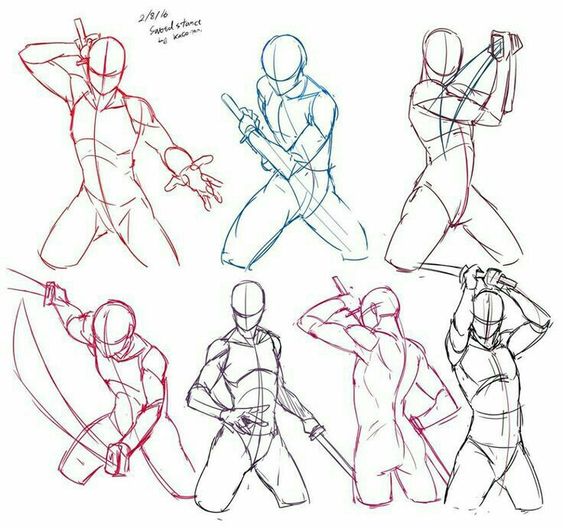
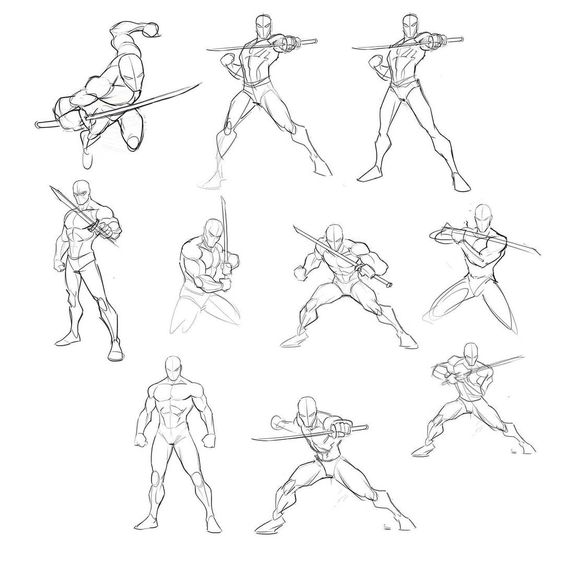
Prop gestures involving weapons — swords, staffs, axes — test a specific skill that’s central to action illustration and character design: the ability to integrate an object into the body’s gesture so that figure and prop form a single unified action rather than a person standing near something they’re holding.
A figure holding a sword who looks like they’re actually about to use it has their entire body oriented around the weapon. The feet are positioned for the specific action (advancing, defending, pivoting), the core engages in the direction of the sword’s movement, and the grip hand’s position telegraphs the intended action. A figure just ‘holding’ a sword — standing neutrally with a prop in their hand — looks like a costume shoot. The difference between these two is the full-body commitment to the gesture.
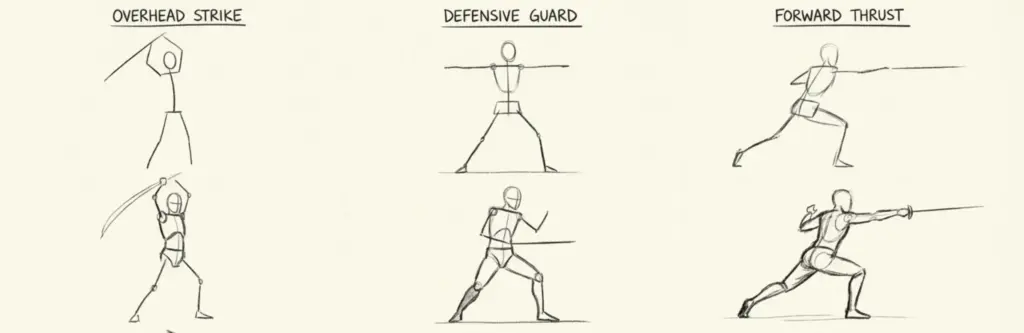
Sword poses are also excellent for practicing foreshortening of the weapon itself. A sword pointed directly at the viewer foreshortens to almost nothing — it reads as a hilt with a short stub extending from it. A sword swinging in an arc foreshortens progressively from the hilt outward. Getting weapon foreshortening right is the same skill as getting limb foreshortening right, just with a simpler, more regular form to work with.
- The grip hand: draw this first — it establishes the sword’s angle and direction, which then determines the whole body’s orientation.
- The stance should match the action: advancing strike (front-weighted), defensive guard (back-weighted), overhead swing (spine arched back).
- For foreshortened swords, think of the blade as a series of diminishing rectangles in perspective rather than a flat shape.
✏ Pro tip: Study kendo, fencing, and historical European martial arts (HEMA) reference photos — these show authentic full-body weapon integration that game and film poses often exaggerate incorrectly.
15) Holding Object Pose
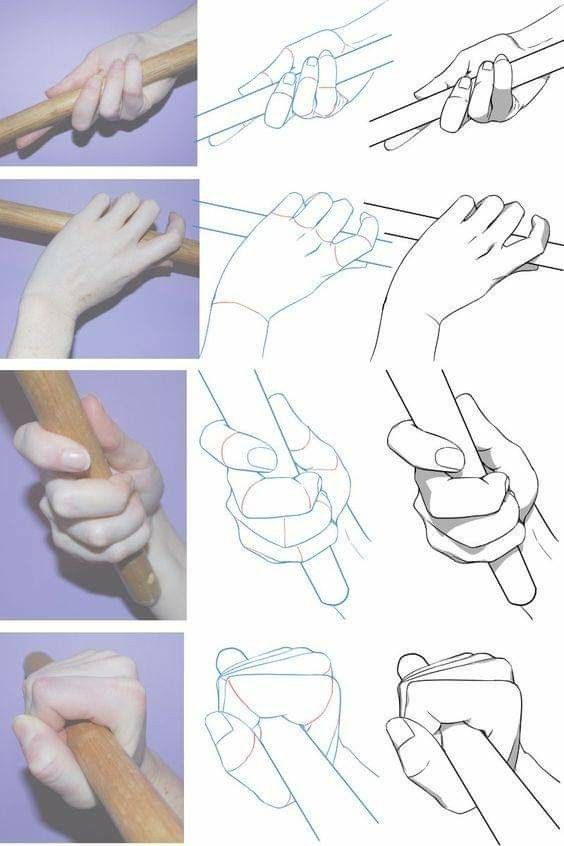
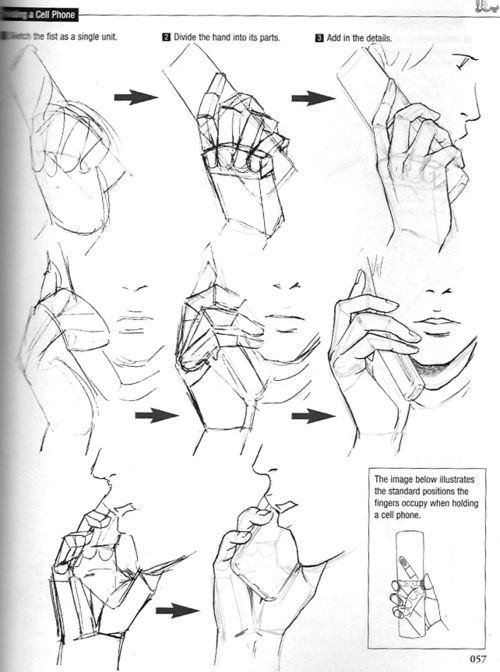
Every object a figure holds changes two things simultaneously: the hand configuration and the body’s weight distribution. A figure holding a heavy suitcase leans away from it and raises the opposite shoulder slightly. A figure cradling a baby curves their arms and rolls their shoulders forward in a protective gesture. A figure reading a book tilts their head down and often shifts their weight to one hip. Object interaction is character interaction — the way someone holds something tells you who they are and how they feel about what they’re doing.
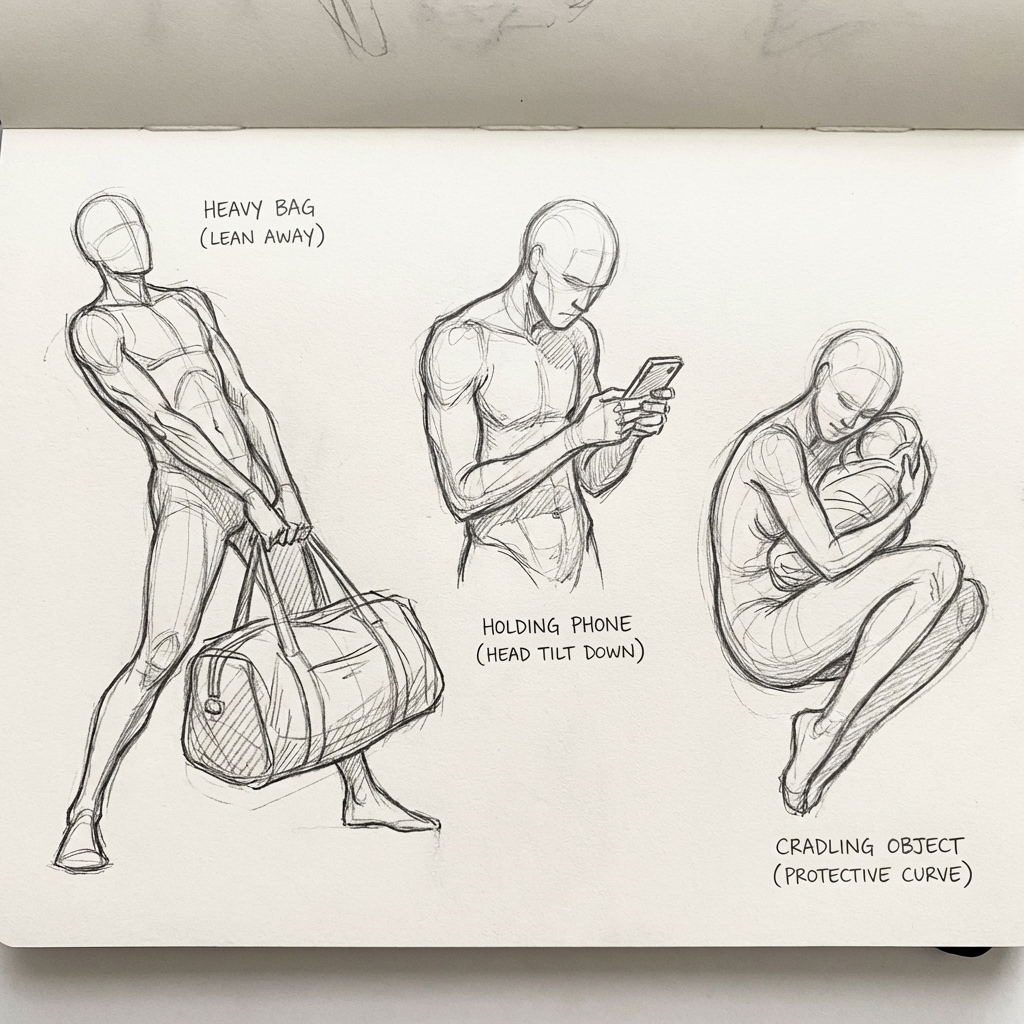
For gesture drawing practice, object poses are valuable precisely because they ground the figure in a specific context. Floating poses with no props or environment can feel abstract; a figure holding a coffee cup, a phone, a tool, or a shopping bag immediately exists in a recognizable situation. This makes the gesture easier to read and easier to criticize constructively — you can ask whether the weight feels right, whether the grip makes sense, whether the body’s response to the object is accurate.
- Draw the object first: its size, weight, and position relative to the body determines everything about the figure’s response.
- Grip type varies with object weight and intention: precision grip (fingertips, light objects), power grip (full hand, heavy objects), cradling grip (both arms, fragile or precious objects).
- The body’s lean: a figure holding a heavy object on one side leans toward the opposite side — exaggerate this slightly in gesture drawings to make the weight readable.
✏ Pro tip: Pick up five different objects (a book, a mug, a heavy bag, a pen, a pillow) and observe your own grip and posture changes for each one before drawing.
16) Jumping Jack Pose
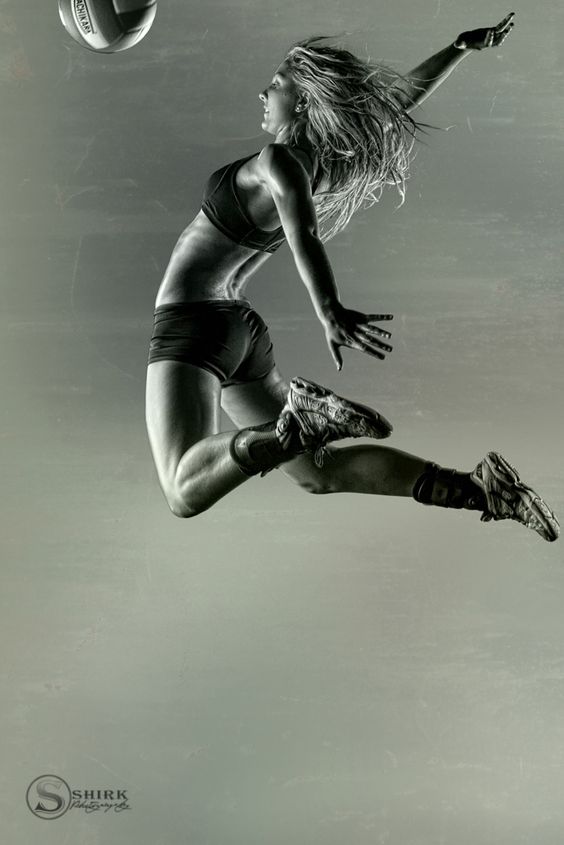
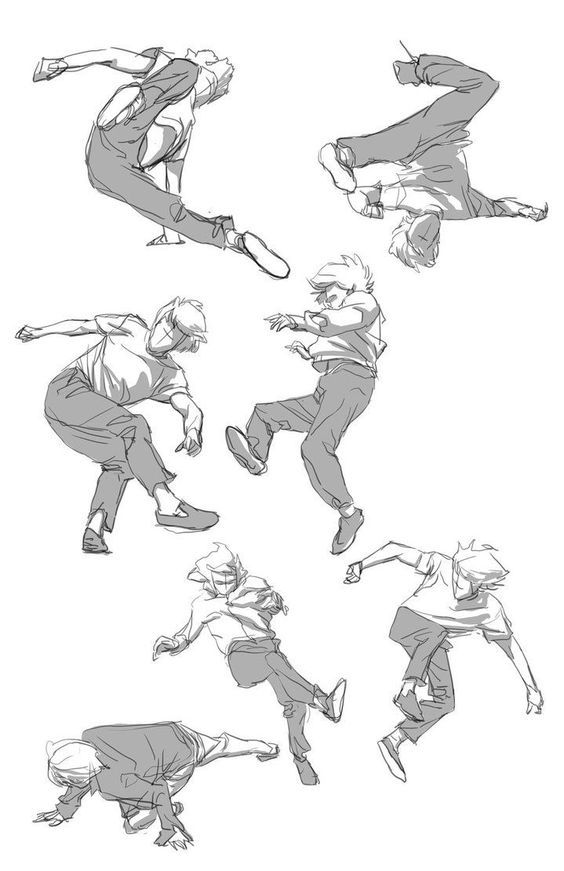
The jumping jack pose — arms and legs spread wide, body airborne — is a compressed study of bilateral symmetry in motion. Unlike most action poses where the body is asymmetrical (one arm forward, one back; one leg bent, one straight), the jumping jack is symmetrical: both arms rise together, both legs spread simultaneously. This symmetry makes it an excellent diagnostic pose — if your proportions are off, a symmetrical pose reveals it immediately. One arm that’s slightly longer, one leg at a slightly different angle, a torso that’s slightly off-center: these errors are invisible in an asymmetrical pose and glaring in a symmetrical one.
Beyond proportional accuracy, the jumping jack teaches airborne energy. The figure is mid-jump, and the spread limbs should read as reaching outward against the gravity pulling the body downward. The tension between upward momentum and gravitational pull is what gives airborne poses their energy — and it’s specifically visible in the joint angles. Elbows and knees that fully extend signal energy and lift; joints that hang loosely signal falling.
- Establish the central axis of the figure first — a vertical line through the head, chest, navel, and pelvis.
- Arms and legs should spread symmetrically around this axis — check both sides against each other during drawing.
- Fully extended joints (elbows, knees, fingers) read as ‘up’ energy; slightly bent joints read as ‘falling’ — choose deliberately.
✏ Pro tip: Use the jumping jack as a proportional calibration exercise at the start of a session — drawing the symmetrical spread figure forces you to commit to your scale and axis before moving on to asymmetrical poses.
17) Curled Up Pose
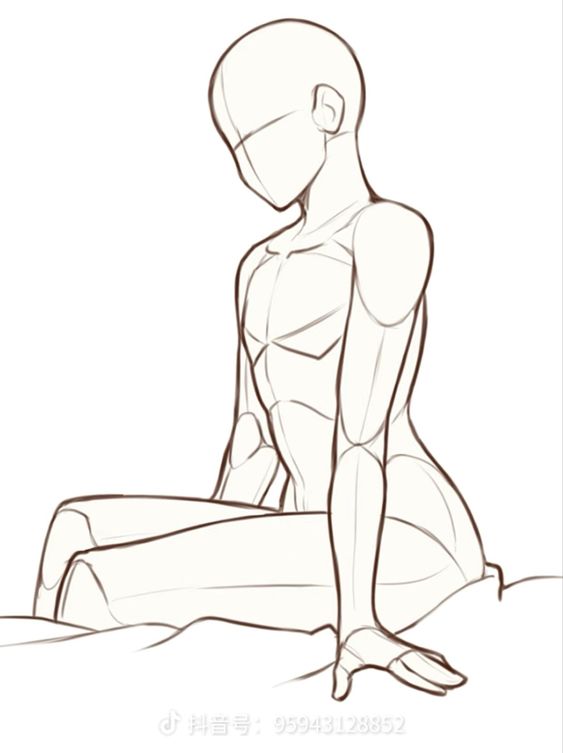
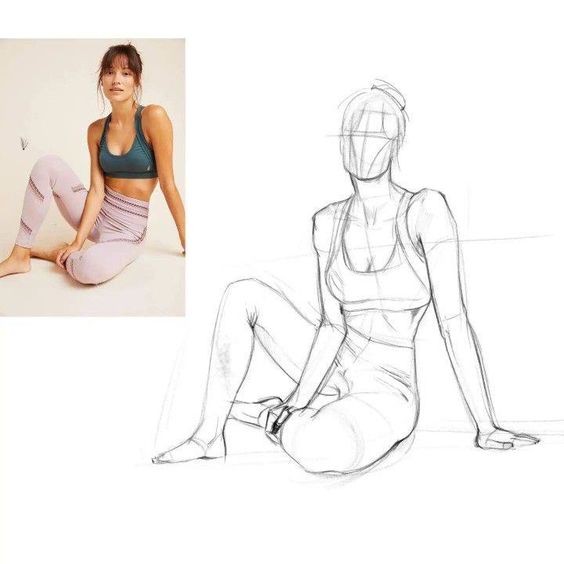
The curled-up pose is the most emotionally specific on this list — and that specificity is what makes it valuable. Unlike action poses that prioritize physical dynamism, the curled-up figure is about internal states: comfort, vulnerability, grief, exhaustion, protection. When you draw it well, the viewer feels the emotional content before they process the technical details. That’s what it means for a gesture to carry meaning.
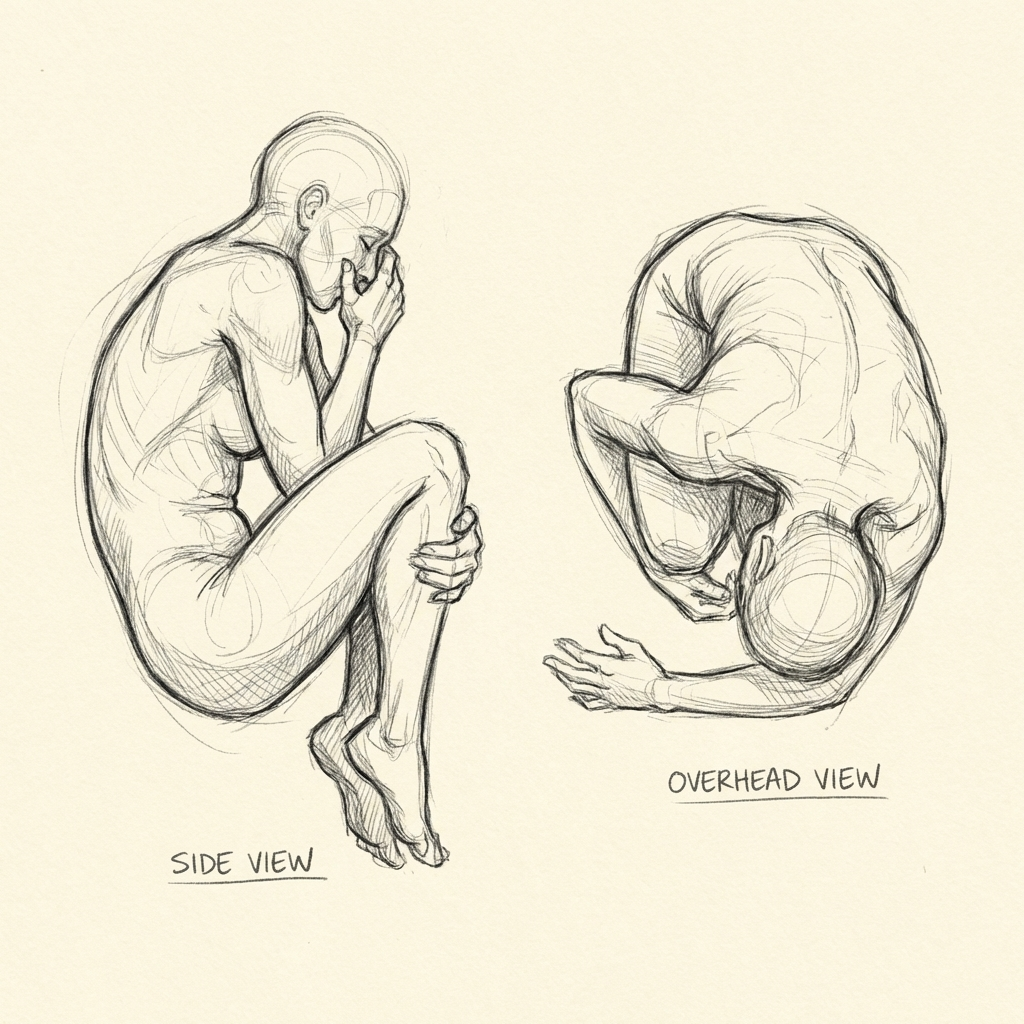
Technically, the curled-up pose is a study in how the body becomes self-referential — the limbs fold inward, the spine curves toward the knees, the overall silhouette becomes compact and rounded. The challenge is avoiding the trap of drawing this as a ball with protrusions. The body in fetal position still has structure: the spine has a specific curve (not a straight line, not a random zigzag), the knees press into the chest at specific angles, the hands find specific resting places that tell you something about the emotional state.
From above is one of the most interesting perspectives for this pose — you see the full circular silhouette of the figure, the curvature of the spine, and the way the limbs tuck. Try it from this angle.
- The spine’s S-curve in fetal position: the lower back rounds outward, the neck curves forward — this double curve is the skeleton of the whole pose.
- Knee-to-chest distance: knees pressed firmly into the chest reads as protective; knees held loosely reads as resting.
- Hands: tucked under the face (sleeping), wrapped around the knees (protecting), loosely open on the floor (exhausted) — choose for your emotional intent.
✏ Pro tip: Practice this pose from above as well as from the side — the overhead view teaches you to see the figure as a three-dimensional volume in space rather than a two-dimensional profile.
18) Suspended Mid-air Pose
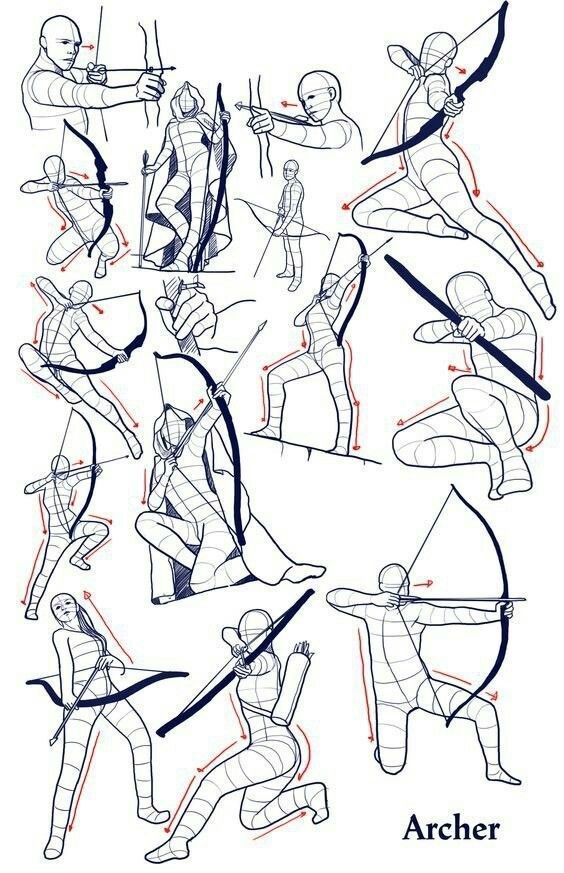
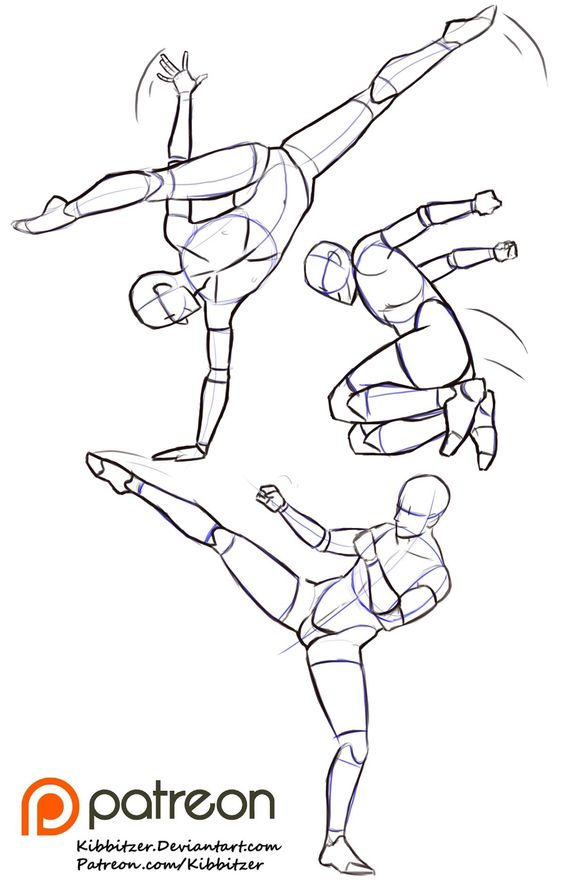
The suspended mid-air pose is different from a leap: where a leap has a clear direction and trajectory, the suspended pose suggests hovering — weightlessness, floating, or the peak of a jump where gravity is briefly overridden. This is the pose of superheroes, of dancers at the height of a grand jeté, of characters who exist in spaces where normal physics don’t fully apply.
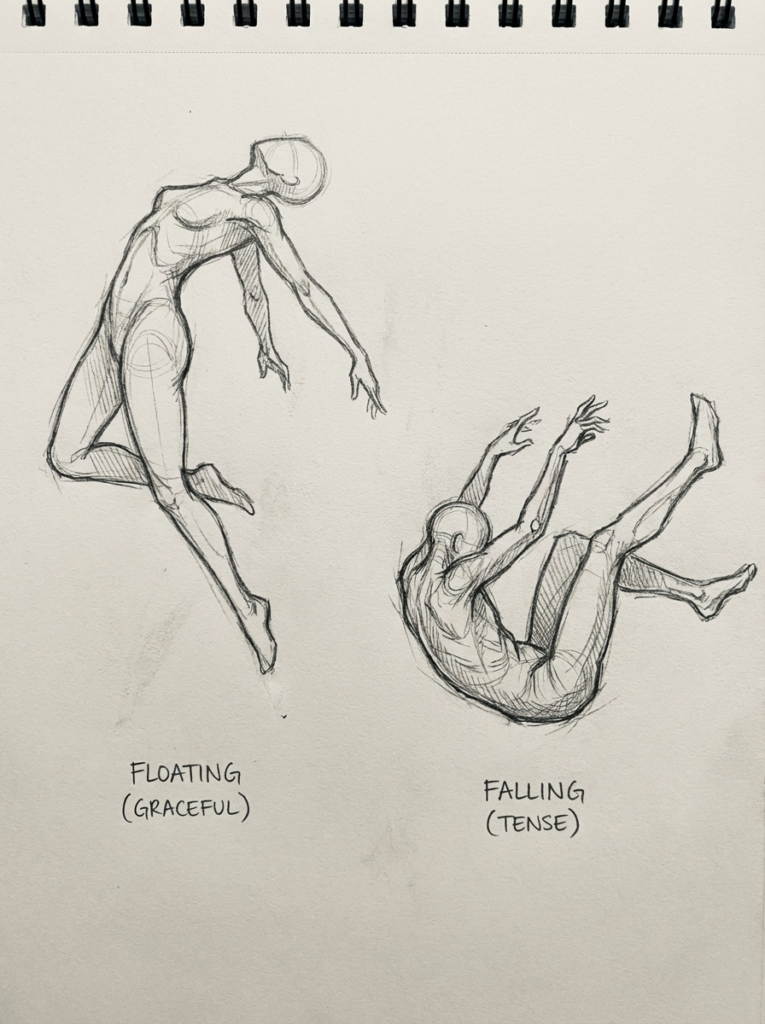
What makes this pose work visually is the absence of compression. When a figure is suspended, no joint is bearing weight against gravity. The limbs can spread in any direction, the spine can lengthen, the head can float at any angle. The challenge is drawing this absence of compression convincingly — it’s much easier to draw a figure under gravity (where the body tells you which joints are compressed) than a figure released from it (where you have to invent the lightness).
The key is in the extremities: fingers spread rather than curl, feet extend through the toes rather than flexing upward, the spine lengthens rather than compressing. These small joint-state details signal weightlessness more effectively than any amount of speed lines or FX.
- Spread extremities: extended fingers and pointed toes read as weightless; curled fingers and flexed feet read as landing or falling.
- The spine: slightly arched (not hunched) in a floating pose — this convex curve reads as released from gravity.
- Limb angles: suspended poses can have limbs at unusual angles (arms above the head, legs at angles that would be impossible while standing) — lean into this freedom.
✏ Pro tip: Study photographs of underwater dancers or synchronized swimmers — they’re physically achieving what you’re trying to draw, and the body language of weightlessness is unmistakable.
19) Gesture with Long Hair
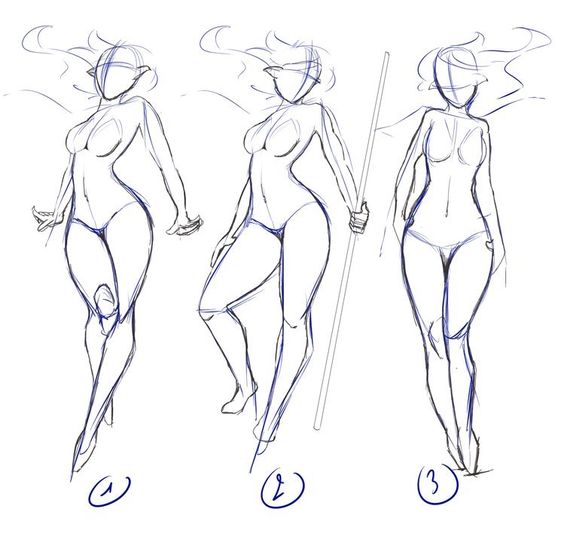
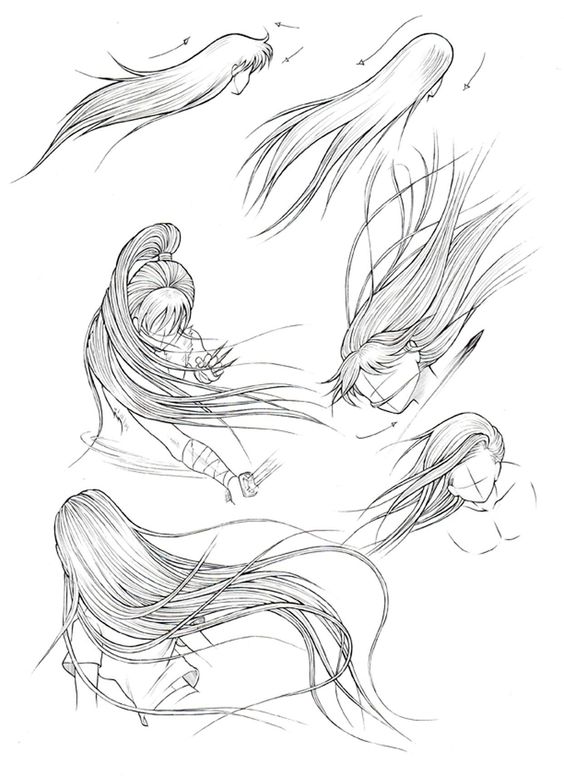
Hair is to a figure what a scarf is, but more personal — it’s a secondary element that’s part of the body, responds to the body’s motion, and carries enormous character information. A gesture drawing that includes long hair well tells you what the figure just did (the hair’s direction shows the motion’s trajectory), what they’re feeling (the hair’s behavior reflects the energy level of the action), and something about who they are (the hair’s style, texture, and movement quality).
The most common mistake in drawing long hair is treating it as a flat shape that falls from the head. Hair has volume — it’s a three-dimensional mass that flows and separates based on physics. In a moving pose, the hair lifts, separates into flowing strands, and trails behind or around the figure depending on the movement direction. In a still pose, it falls in specific ways based on gravity and the hair’s own weight and texture.
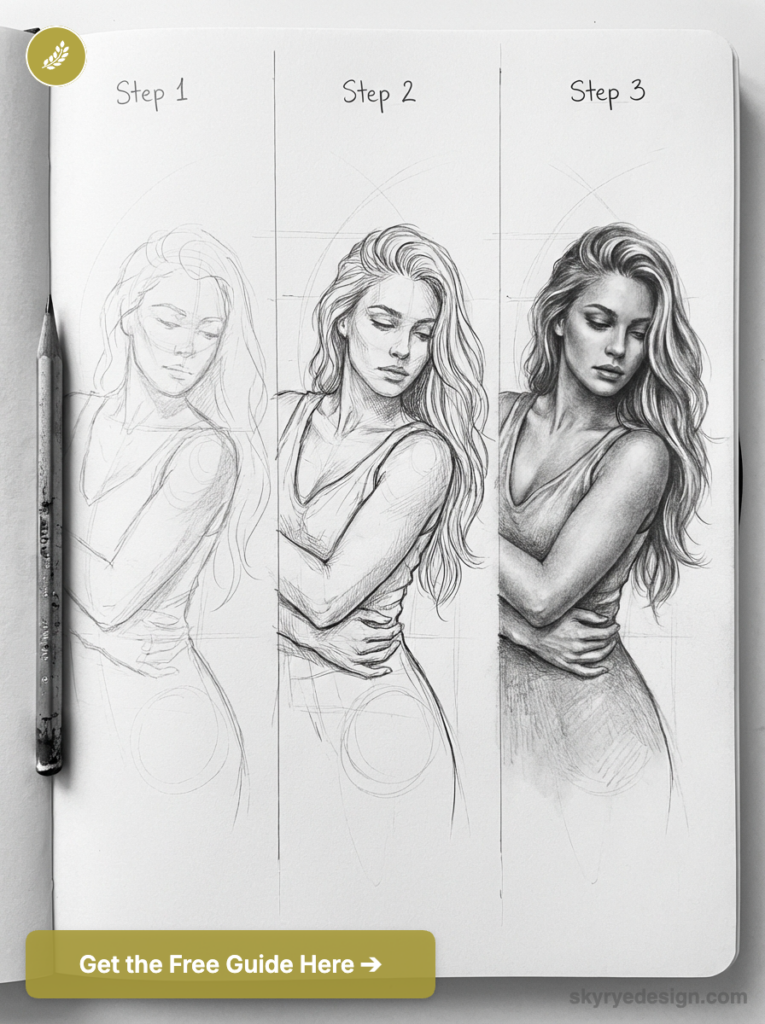
For gesture drawing, the primary goal is capturing the overall movement arc of the hair as a single shape — a large, unified mass moving in a specific direction — before adding any internal detail. The gesture of the hair, like the gesture of the body, is about the big shape first.
- Hair direction follows the inverse of the figure’s primary movement — the faster the movement, the more dramatically it trails.
- Different hair textures move differently: straight hair falls in smooth, heavy curves; curly hair has volume and bounce that creates a more complex overall shape; braided hair moves as a single unit.
- In still poses, observe the part: hair falls in two directions away from the part line, creating distinct planes of surface.
✏ Pro tip: Draw the hair as one large shape first (like drawing a cloud or a leaf cluster) before adding any internal lines — the overall shape of the hair mass is more important than individual strands.
20) Overhead Stretch Pose
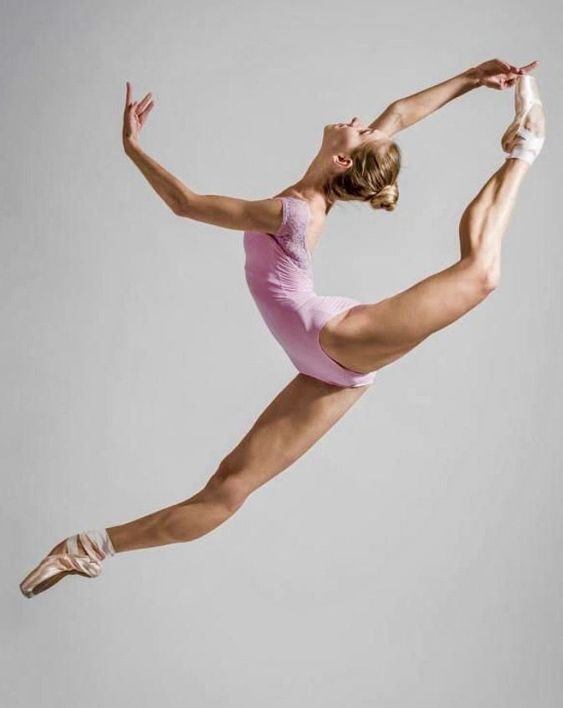
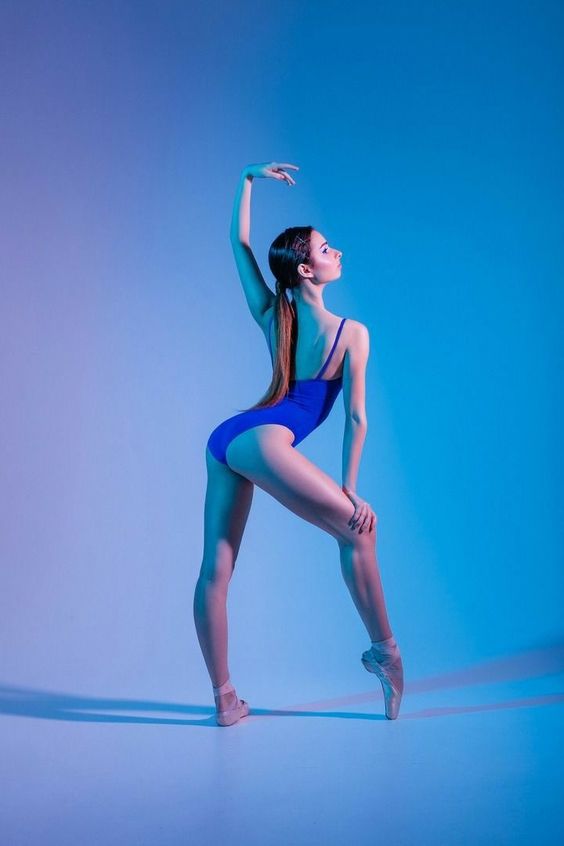
The overhead stretch is the closing pose for a reason — it synthesizes every skill this list has been building toward. You need the full-body line of action from standing poses. You need the joint-extension reading from the yoga section. You need the symmetry awareness from the jumping jack. And you need the surface-and-volume thinking from the torso twist. The overhead stretch forces all of these to work together.
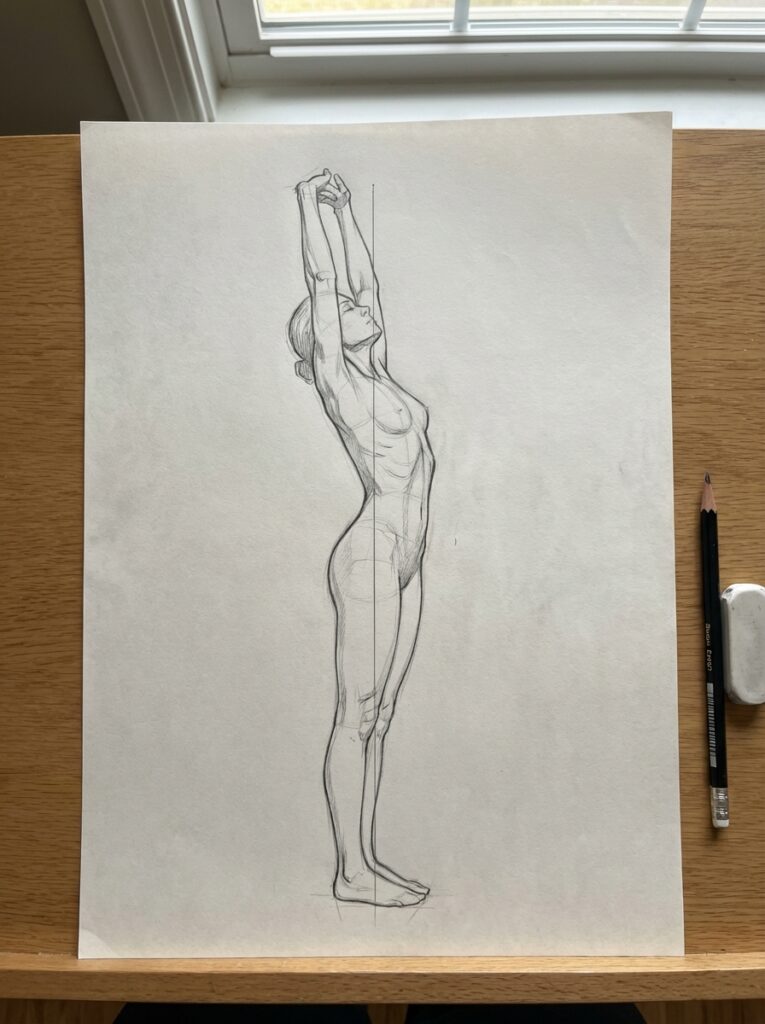
What makes the overhead stretch specifically valuable is what it does to the torso. When both arms extend upward, the entire ribcage lifts with them — the ribs pull up, the obliques stretch along the sides, the lower back arches slightly to accommodate the upward reach. This creates a specific elongated-torso shape that you rarely see in neutral or seated poses. Drawing this correctly means you understand that the torso isn’t a fixed shape — it changes with the position of the arms.
The pose also creates one of the most pleasing and photogenic figure silhouettes available: the clean vertical from foot through outstretched fingers, with the slight lean and arch giving it rhythm. It’s one of those poses where good gesture drawing and beautiful design language happen to coincide exactly.
- The ribcage lifts: in a full overhead stretch, the lower ribs become visible at the sides, and the torso elongates noticeably compared to a relaxed standing pose.
- The slight backward arch: the spine doesn’t stay perfectly straight — a natural stretch arches the lumbar spine slightly, creating a subtle forward curve of the hips.
- Both arms slightly ahead of the body’s centerline in a full stretch — the natural reaching motion pulls arms slightly forward rather than straight overhead.
After working through all 20 poses, your practice session should close the same way it opened: with energy and attention. The overhead stretch is both a gesture drawing pose and, if you’re working from a live or video reference, a chance to stretch your own body before returning to detailed work. The best gesture sessions move between your body and the page — drawing what you’ve just physically experienced creates a connection that reference photos alone can’t fully provide.
✏ Pro tip: On your last sketch of any session, draw the overhead stretch from memory — no reference. If you can capture the elongated torso, the lifted ribcage, and the slight arch, your observation from the session has transferred to memory. That’s when the practice is working.
Understanding Gesture Drawing
What Is Gesture Drawing?
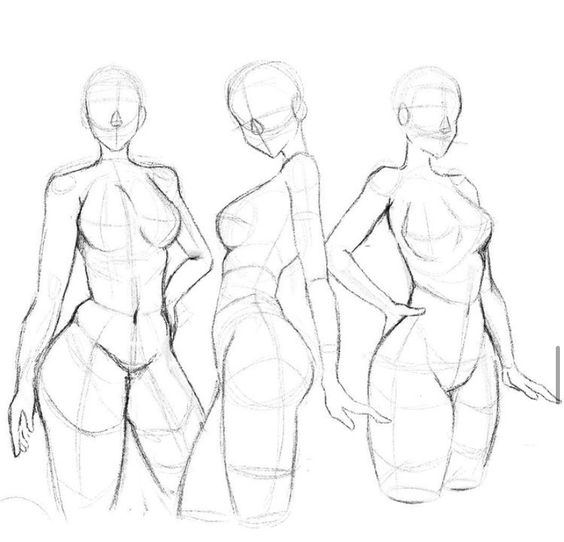
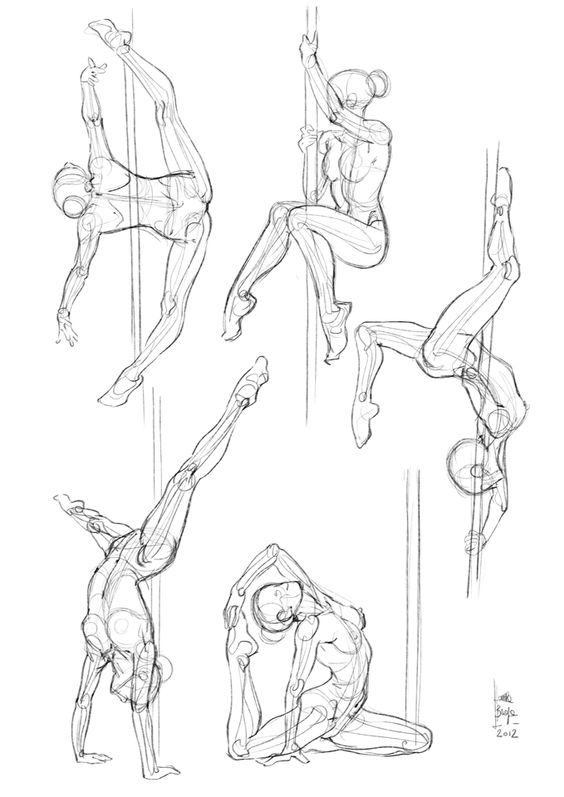
Gesture drawing is a method of quick figure sketching that prioritizes the energy, movement, and overall form of a subject over anatomical precision or detailed rendering. A gesture drawing session typically runs from 20 seconds to 5 minutes per pose — short enough that you’re forced to make decisions about what matters and skip what doesn’t. The lines you commit to are the ones that carry the most essential information about the pose.
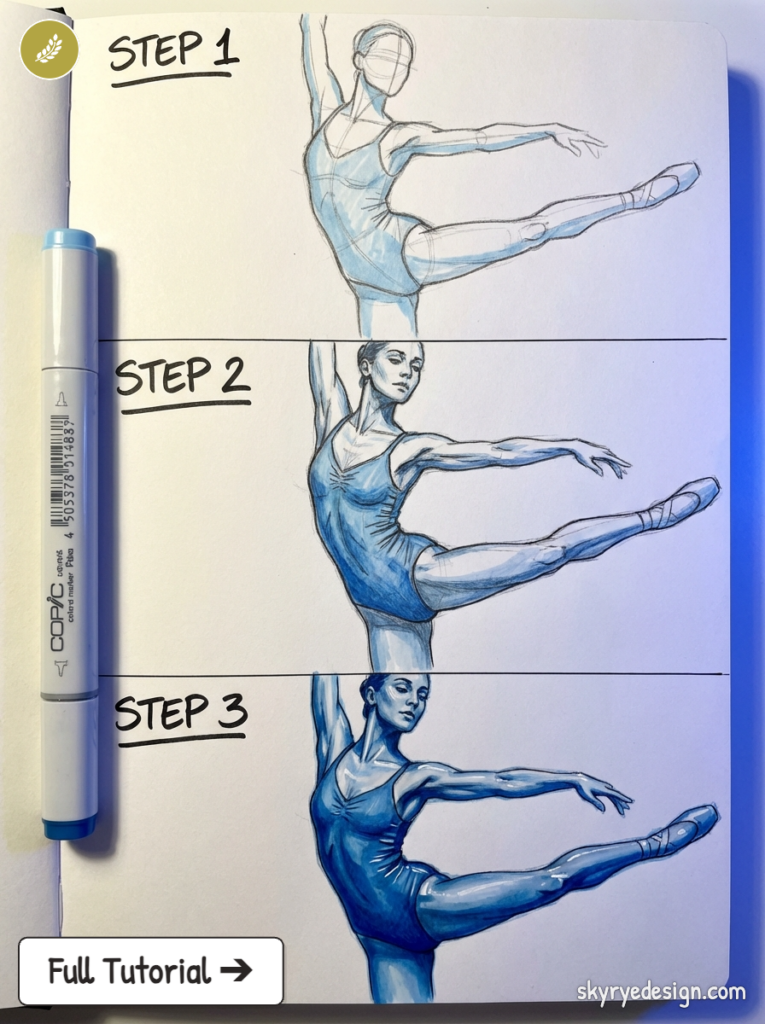
The goal isn’t a finished drawing. The goal is to train your visual processing — to build the neural pathways that let you look at a figure and immediately see the line of action, the weight distribution, and the emotional content before you pick up your pencil. Consistent gesture drawing practice makes this perceptual shift happen automatically, which is why figure drawers who practice daily look fundamentally different from those who don’t.
Tools for practice: Quickposes (quickposes.com) and Line of Action (line-of-action.com) are both free, offer timer functionality, and have extensive image libraries. For 20-second to 2-minute poses, these are the industry-standard tools.
A Brief History
Gesture drawing as a formal pedagogical method was codified in the early 20th century, most influentially through Kimon Nicolaïdes’ 1941 book ‘The Natural Way to Draw.’ Nicolaïdes argued that learning to draw required not copying appearances but experiencing form — feeling the gesture of the figure rather than analyzing its outlines. His timed-session approach became the foundation of virtually all contemporary figure drawing instruction.
Before Nicolaïdes, gesture-style drawing existed in the warm-up sketches of Renaissance masters — you can see rapid, energetic figure studies in the sketchbooks of Leonardo, Raphael, and Michelangelo that prioritize capture over finish. Nicolaïdes formalized what master artists had always done informally.
Techniques for Effective Gesture Drawing
The Line of Action
The line of action is the single most important concept in gesture drawing. It’s a single imaginary line — often curved — that runs through the main body of the pose and expresses its primary direction and energy. Find this line before you draw any other mark. In a leaping figure, it’s the arc of the jump. In a warrior stance, it’s the diagonal from back foot to front fist. In a sitting figure, it’s the curve of the spine. A gesture drawing that correctly establishes the line of action reads as dynamic and alive even when unfinished. A gesture drawing without one reads as static no matter how detailed it becomes.
Quick Sketching Techniques
Time pressure is the point, not the obstacle. Set your timer deliberately: 30 seconds forces you to find only the most essential line. 60 seconds lets you establish primary masses. 2 minutes allows secondary elements. 5 minutes is the threshold where you can add meaningful detail while retaining gesture quality. Work at all these time scales — different durations train different perceptual skills. The most experienced figure drawers do the most work at the shortest timescales, not the longest.
Use your whole arm for the longest lines — the line of action, the shoulder line, the primary limb directions. Switch to wrist movement only for the smallest details at the end of a longer session. Arm-drawn lines have energy; wrist-drawn lines are precise. Gesture work is arm work.
Capturing Emotion Through Form
The body communicates emotional state through posture before it communicates it through facial expression. A figure whose shoulders are raised and curled forward is anxious or cold or protective — you know this before you see their face. A figure with open, extended arms is welcoming or triumphant. Learning to read and draw these body-emotion relationships is one of the deepest skills gesture drawing builds — it’s directly applicable to character design, storytelling illustration, and any figure drawing where you want the viewer to feel something specific.
Pay attention to the chin: where a figure’s chin points tells you their direction of attention and intention. A chin that tilts downward toward the action suggests focus and engagement. A chin raised above the horizon line suggests defiance, pride, or looking upward at something larger. These small head-position details are easy to include in gesture drawings and have outsized impact on emotional readability.
Benefits of Consistent Gesture Drawing Practice
Fluidity and Confidence
Artists who practice gesture drawing daily for three months consistently report the same change: their lines become more decisive. They stop second-guessing the first mark and start trusting it. This isn’t just psychological — it’s the result of having built a library of successful gestures that the hand can reference. The more successful gestures you’ve drawn, the more your hand knows what a successful line feels like before the brain has finished analyzing the reference.
Anatomical Understanding That Sticks
Gesture drawing builds anatomical understanding differently than anatomy study does. Anatomy study gives you facts about the structure of the body. Gesture drawing gives you a felt sense of how that structure moves and behaves — which muscles compress, which joints limit range, how weight distribution shifts in different positions. This embodied understanding of anatomy produces more convincing figures than factual memorization, because it operates during drawing rather than requiring you to stop and consciously recall information.
Transferable to Everything Else
Every drawing skill sharpens with gesture practice: proportion, perspective, line quality, compositional thinking, and the ability to make decisions quickly under time pressure. Artists who use gesture as a daily warm-up consistently find that their ‘real’ work — illustrations, character designs, portraits, figure paintings — improves in ways they didn’t specifically practice. The reason is that gesture drawing improves visual processing speed and decisiveness, which underlies all drawing, regardless of style or subject.
Frequently Asked Questions
How can I improve my gesture drawing technique?
Practice with time pressure — it’s the single most effective accelerant. Set your timer to 60 seconds per pose and do at least 20 poses per session. Prioritize the line of action in every pose before adding any other element. Review your work after each session: identify the three gestures that worked best and ask what those drawings have in common. Build on what works rather than only analyzing what doesn’t.
What tools are best for timed gesture drawing practice?
Quickposes (quickposes.com) and Line of Action (line-of-action.com) are both free and excellent. Both offer timer functionality and large reference libraries. For physical materials: a 0.5mm mechanical pencil on cheap layout paper is ideal — the low stakes of inexpensive paper encourages commitment rather than careful caution. Ballpoint pen is also a strong choice because it doesn’t erase, which forces you to commit to each line. Avoid using expensive sketchbooks for timed gesture practice.
How do I use a gesture drawing generator effectively?
Use generators with fixed timers rather than untimed free drawing. Choose a time limit that forces discomfort: if 60 seconds feels manageable, use 30. If 30 feels easy, use 20. The generator should be showing you the next pose before you feel ready — that pressure is doing the training. Do full sessions (20+ poses minimum) rather than a few casual sketches. Track your sessions in a sketchbook rather than digitally, so you can see your own progress across weeks and months.
Where can I find diverse gesture drawing references?
Beyond Quickposes and Line of Action, good sources include: SenshiStock on DeviantArt (thousands of figure photos organized by pose type), AdorkaStock (artists’ reference photos, well-curated), Pinterest boards for specific pose types (search ‘dynamic pose reference,’ ‘ballet pose reference,’ ‘gesture drawing poses’), and photograph books of dance, sports, and figure studies. For dynamic action poses specifically, sports photography is underrated — athletes in competition produce extraordinary gesture reference.
How do professionals incorporate gesture drawing into their practice?
Most working illustrators, character designers, and concept artists do some form of gesture warm-up before production work — typically 15-30 minutes of timed poses. They’re not improving as fast as a student would with the same practice; they’re maintaining the perceptual sharpness and line decisiveness that daily gesture work keeps calibrated. Think of it the way a musician does scales: not because scales are interesting, but because the fingers need to be warmed up before the music can happen.
Which artists should I study for gesture drawing inspiration?
Glenn Vilppu’s instructional drawings (and his book ‘The Vilppu Drawing Manual’) show how a master gesture approach works in practice — his drawings are loose, energetic, and structurally correct simultaneously. Mike Mattesi’s ‘Force: Dynamic Life Drawing’ series is specifically about the energy principles underlying gesture. Bridgman’s ‘Complete Guide to Drawing from Life’ shows how anatomy and gesture integrate. Among contemporary working artists, look at the sketchbooks of James Jean, Kim Jung Gi (his live demonstrations are particularly instructive), and any professional animator whose sketchbook work is publicly available.
Now Go Draw
Two sets of timed poses this morning. That’s it. Not a finished illustration, not an anatomy study, not a character design — just 20 minutes of gesture drawing before anything else.
The change is slow at first. Then suddenly it isn’t. Your figures start to have weight. Your lines start to mean something. The stiff, frozen people in your drawings begin to move.
That’s the whole promise of regular gesture drawing poses practice — not that you’ll nail every pose perfectly, but that your eye and hand will get faster at finding the thing that makes a pose alive. The line of action, the weight shift, the emotional load of a body in space.
Find your poses. Set your timer. Draw.