Inside the Paleontology Preparation Lab: A Rare Historical Glimpse into Fossil Preparation Techniques in the Early 20th-Century Museum Workshop

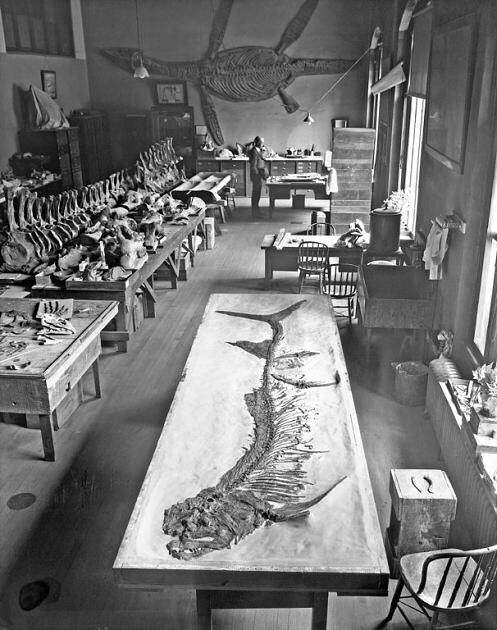
Step back in time with this captivating black-and-white archival photograph that captures the essence of early paleontological work—a bustling museum laboratory dedicated to uncovering, preparing, and studying the remains of prehistoric marine giants. This image, likely dating to the 1920s or earlier (based on similar historical collections from institutions like the United States National Museum, now the Smithsonian’s National Museum of Natural History), offers an authentic window into the meticulous, hands-on science that transformed fragmented fossils into windows on deep time.
At the center of the frame lies an impressive, fully laid-out skeleton of a large ichthyosaur—an extinct Mesozoic marine reptile often nicknamed the “fish lizard” for its dolphin-like body and powerful swimming adaptations. The specimen is meticulously arranged on a long wooden workbench that dominates the room, its elongated skull, toothy jaws, ribcage, flipper-like limbs, and tapering tail preserved in near-complete articulation. The fossil’s dark, mineralized bones contrast sharply against the pale wood surface, showcasing the painstaking cleaning and assembly that paleontologists performed by hand with chisels, brushes, and glue. Surrounding the main table are additional preparation stations overflowing with smaller fossils: scattered skulls, vertebrae, limb bones, and isolated elements from various extinct species, illustrating the volume of material handled in such workshops.
In the background, a massive suspended skeleton—likely a plesiosaur or early whale (marine reptile or mammal)—hangs dramatically from the ceiling, its long neck (if plesiosaur) or streamlined body creating a striking overhead presence that fills the tall room. This hanging mount served both practical storage and inspirational display, reminding workers of the larger evolutionary stories their daily labor contributed to. Tools of the trade are everywhere: workbenches cluttered with drawers, boxes, chairs, and miscellaneous equipment; shelves lined with specimen trays; and a lone researcher standing amid the organized chaos, providing human scale to the prehistoric bounty.
The photograph’s composition highlights the era’s laboratory aesthetic—high ceilings, large windows for natural light, wooden floors worn by decades of foot traffic, and an atmosphere of dedicated, solitary craftsmanship before modern CT scanning, 3D modeling, or automated preparation techniques existed. It evokes the golden age of vertebrate paleontology, when discoveries from Jurassic and Cretaceous marine deposits (such as those in England, Germany, or the American West) were painstakingly revealed one layer of matrix at a time.
Tutorial-Style Guide: Understanding and Appreciating This Historical Paleontology Scene
- Identifying the Key Specimens
- Ichthyosaur on the Table: These dolphin-shaped reptiles thrived from the Early Triassic (~250 million years ago) to the Late Cretaceous (~90 million years ago). The layout here shows a classic, near-complete skeleton, ideal for studying locomotion (tail-fin propulsion), feeding (sharp conical teeth for fish and cephalopods), and adaptations to fully aquatic life (large eyes for deep-sea vision, streamlined body). Preparation involved removing surrounding rock (matrix) while preserving delicate bones—often using acid baths or mechanical tools in later decades.
- Suspended Overhead Skeleton: The ceiling mount is probably a plesiosaur (long-necked marine reptile) or an early archaeocete whale. Such mounts freed floor space and allowed study from multiple angles, a common practice in early museums to showcase evolutionary transitions from land to sea in marine tetrapods.
- The Preparation Process Depicted
- Fossils arrived as field jackets (plaster-wrapped blocks). In the lab: jackets were opened, matrix removed with pneumatic tools or hand picks, bones consolidated with adhesives, and missing parts reconstructed with casts. The scattered elements around the room show active sorting and cataloging.
- Safety and environment: No modern ventilation hoods or PPE—workers relied on natural light and fresh air from windows, highlighting how far lab safety has advanced.
- Historical Context and Significance This scene reflects the post-19th-century boom in marine reptile studies, fueled by finds from Lyme Regis (Mary Anning’s era) and later expeditions. Institutions built dedicated prep labs to handle the influx of specimens, turning raw rock into museum exhibits that educated the public about extinction, adaptation, and Earth’s ancient oceans. Images like this document the human effort behind iconic displays we see today in places like the Smithsonian, Natural History Museum (London), or Royal Tyrrell Museum.
- Modern Parallels and Lessons Today’s labs use lasers, micro-CT scanners, and digital reconstruction, but the core remains the same: patience, precision, and curiosity. This photo reminds us that every mounted skeleton in a museum began as fragments on a workbench like this one.
Whether you’re a student of paleontology, a history enthusiast, or simply fascinated by the detective work of resurrecting extinct life, this photograph celebrates the quiet, transformative labor that bridges millions of years. It stands as a tribute to the unsung preparators whose skilled hands made the prehistoric world visible to us all.
Explore more archival paleontology images, share your thoughts in the comments, and consider visiting a natural history museum to see these ancient mariners brought to life in full 3D glory.