Encrusted in Time: A Remarkable Ammonite Fossil with Attached Bivalves – A Window into Ancient Seafloor Ecology
This eye-catching fossil specimen captures a moment frozen from the Mesozoic seas: a large, coiled ammonite shell that became a hard substrate for encrusting bivalves after the cephalopod’s death. Ammonites—extinct relatives of modern squid, octopuses, and nautiluses—were free-swimming marine predators and scavengers that dominated ocean ecosystems for over 300 million years before their extinction at the end of the Cretaceous period around 66 million years ago. Their chambered shells, divided by septa and regulated by gas for buoyancy, allowed them to drift and hunt in ancient oceans teeming with life.

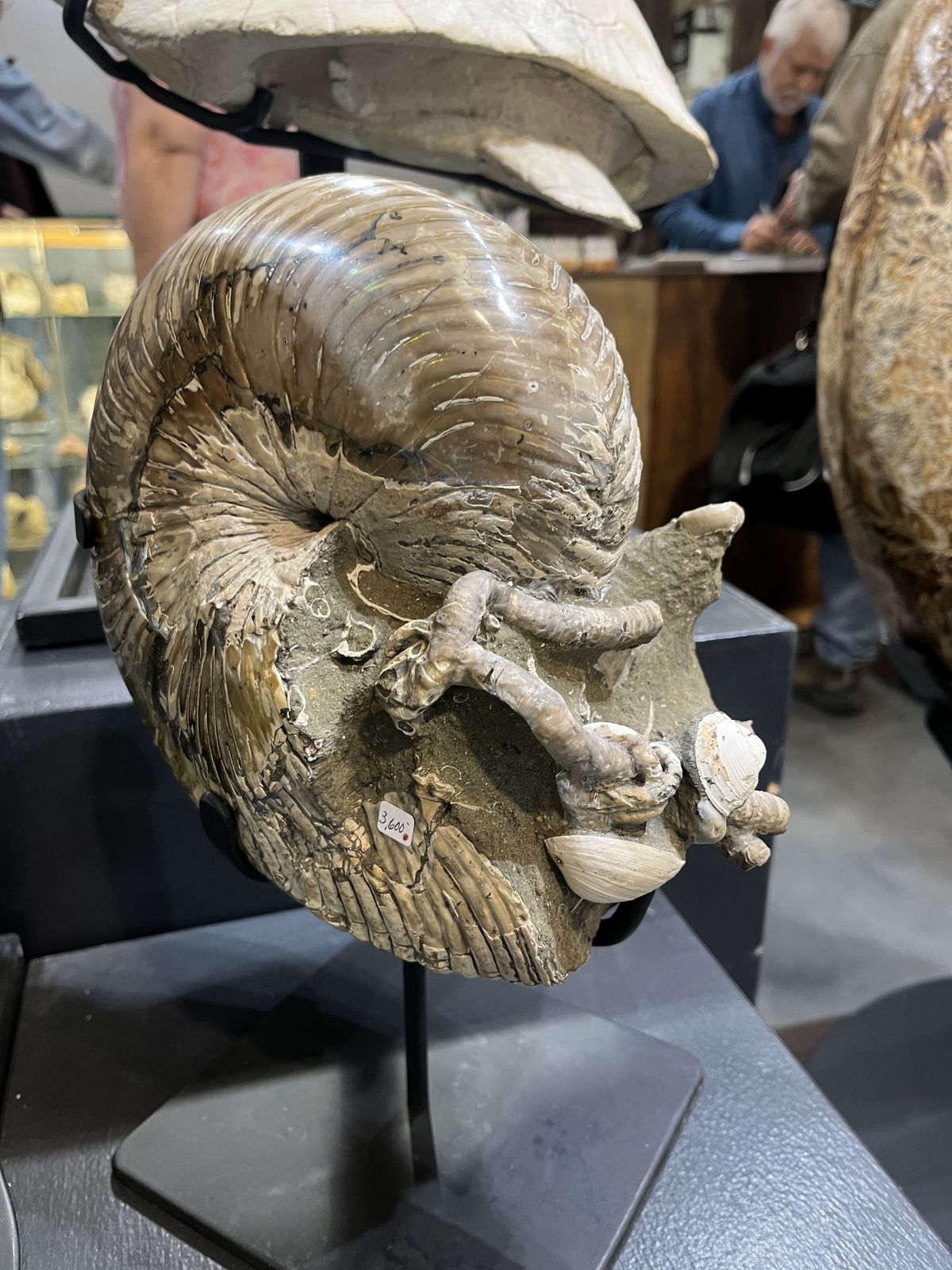
The ammonite in the photograph exhibits classic features: a tightly coiled, evolute shell with prominent ribbing and suture lines visible in the polished cross-sections. The surface gleams with natural mineralization—likely calcite or aragonite replacement—producing warm beige, brown, and golden tones interspersed with darker cracks and mineral veins that give it an almost sculptural quality. The shell’s aperture (opening) flares outward, and the body chamber shows detailed growth lines and wear patterns from its lifetime of swimming and feeding.
What makes this piece truly exceptional is the cluster of attached bivalves preserved in place on the lower flank and underside. Several small to medium-sized clams or oysters (possibly belonging to genera like Ostrea, Liostrea, or similar cemented epifaunal species) are cemented firmly to the ammonite’s surface. Their shells appear partially embedded, with visible umbos (hinge areas), radial ribs, and irregular growth forms adapted to the curved substrate. One prominent bivalve sits near the edge with its valves slightly agape, while others cluster like opportunistic settlers on a rocky outcrop. Tendril-like or root-like structures (possibly remnants of byssal threads or cementation scars) and small additional shells or fragments complete the scene, evoking a miniature ancient reef growing on a floating or fallen shell “island.”
Such encrustations are not uncommon in the fossil record but are prized when preserved in three-dimensional detail like this. In life, ammonites often died and settled to the seafloor, their durable aragonitic shells providing ideal hard surfaces in otherwise soft, muddy environments. Larval bivalves (especially oysters and other cementing forms) would drift in the plankton, settle, and attach permanently using calcite cement or byssal threads. Once attached, they grew opportunistically, sometimes deforming slightly to conform to the curved ammonite whorls. In many cases—particularly in Cretaceous deposits from regions like Texas, the Western Interior Seaway, or Morocco—the ammonite shell itself dissolved over time (aragonite is less stable than calcite), leaving behind a steinkern (internal mold) still bearing the impressions or direct attachments of the epifauna. Here, the ammonite shell appears largely preserved, suggesting favorable mineralization conditions that retained both the host and its hitchhikers.
Paleontologists value these “epibiont-host” associations because they reveal paleoecology: the timing of attachment (post-mortem in most cases, as live ammonites likely shed or outgrew encrusters), seafloor conditions (currents, sedimentation rates), and community dynamics. Encrusting bivalves indicate hardground-like conditions or shell pavements where hard substrates were scarce. Some studies show oysters attaching preferentially to ammonite flanks or venter, taking advantage of the shell’s elevation above the sediment to filter-feed more efficiently in oxygenated water.
This specimen, priced at $3,600, reflects its status as a high-end collector’s item. Such large, polished, multi-organism fossils command premium prices due to the labor-intensive preparation required to expose delicate details without damage, combined with aesthetic appeal—the glossy polish accentuates the contrast between the ammonite’s elegant spirals and the rugged, organic irregularity of the bivalves. It likely originates from classic ammonite-rich deposits, such as those in Madagascar, Morocco, or Russia, where similar iridescent or well-preserved examples (including Caloceras or Pavlovia species with bivalve encrusters) are recovered.
Beyond its monetary value, this fossil tells a profound story of impermanence and opportunism in deep time. An ammonite that once jetted through prehistoric waters became, in death, a foundation for new life. The bivalves that colonized it lived, grew, and were entombed together, preserving a tiny ecosystem snapshot from millions of years ago. In a world where modern oceans face rapid change, such specimens remind us of the intricate interconnections that have shaped marine biodiversity across eons—predator and filter-feeder linked forever in stone.
Whether admired in a private collection, fossil shop, or eventual museum display, this ammonite with its bivalve companions stands as a testament to nature’s artistry and the enduring allure of paleontology. It invites viewers to imagine the ancient seafloor currents, the larval clouds settling on a vacant shell, and the quiet persistence of life turning tragedy into opportunity.