Windows into Jurassic Patagonia: The Extraordinary Fossil Pine Cones of Araucaria mirabilis
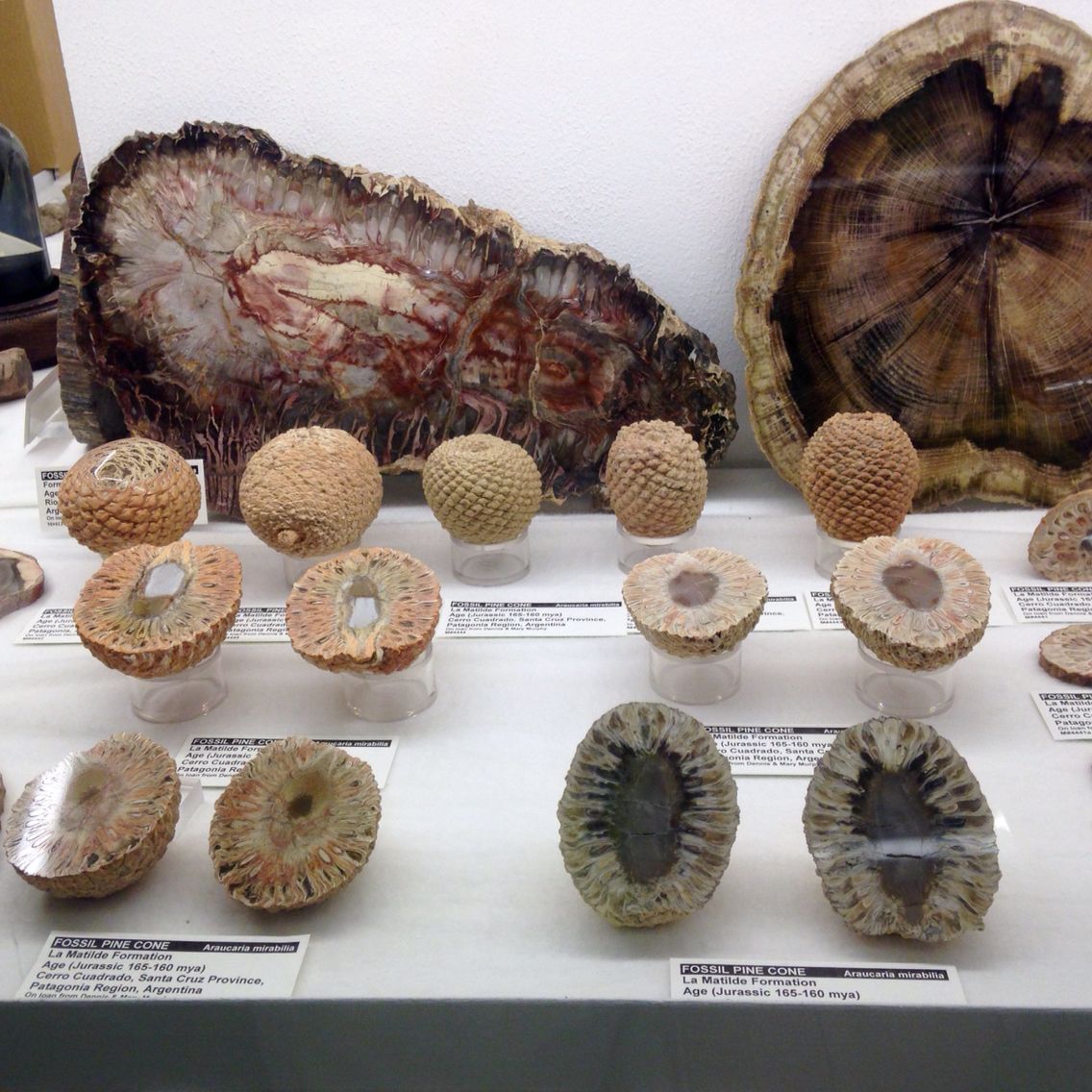
Nestled within the stark, windswept landscapes of southern Patagonia lies one of the world’s most remarkable paleontological treasures: the petrified forests of the Cerro Cuadrado region in Santa Cruz Province, Argentina. The photograph captures a segment of this ancient wonder on exhibit, showcasing a collection of fossilized pine cones and massive cross-sections of petrified tree trunks belonging to Araucaria mirabilis, an extinct species of araucarian conifer that dominated Gondwanan forests during the Jurassic period.

At the forefront of the display are numerous spherical to ovoid fossil cones, ranging from intact specimens to beautifully sectioned halves mounted on clear stands. These cones exhibit the classic araucarian morphology: tightly packed, spirally arranged bract-scale complexes with a rugged, pineapple-like exterior that has been faithfully replicated in silica. The exteriors appear textured and weathered in shades of beige, brown, and gray, while the cut surfaces reveal darker interiors with radial patterns, preserved seed cavities, and intricate vascular tissues. Labels repeatedly identify them as “Fossil Pine Cone – Araucaria mirabilis” from the La Matilde Formation, Cerro Cuadrado region, with ages listed consistently in the 165–160 million-year range (Jurassic).
Dominating the background are two impressive slices of petrified wood trunks. The larger piece on the left displays a dramatic, irregular outline with vivid reddish-brown and dark mineral staining, revealing the tree’s internal growth rings, resin canals, and cellular structure in exquisite detail. This represents the massive trunks of A. mirabilis, which in life could tower up to 100 meters (about 330 feet) tall—true giants of the Jurassic canopy. The right-hand slab shows a near-perfect circular cross-section with concentric growth rings radiating outward like a prehistoric bullseye, the wood’s rich brown tones contrasting beautifully against the museum backdrop.
These fossils tell a dramatic story of sudden catastrophe and exceptional preservation. During the Middle Jurassic, a lush coniferous forest thrived in what is now Patagonia. Volcanic eruptions—likely from nearby vents—blanketed the area in ash and silica-rich debris, rapidly burying trees, branches, and fallen cones. Groundwater carrying dissolved silica percolated through the buried organic matter, gradually replacing cell walls with quartz while preserving fine anatomical details. The result is some of the most three-dimensionally preserved plant fossils known to science, including entire trunks standing in situ at the original sites and thousands of cones scattered across the petrified forest floor.
Araucaria mirabilis belongs to the Araucariaceae family, a group of conifers that today survives in the Southern Hemisphere (e.g., monkey puzzle trees in Chile and Argentina, Norfolk Island pines, and bunya pines in Australia). While the species itself is extinct, its close relatives hint at what these ancient forests might have looked like: towering evergreens with broad, spiraling branches and large, edible seeds in massive cones. The fossil cones in the image—some split open—would have once released winged seeds, contributing to the regeneration of these prehistoric woodlands alongside other plants like ferns and cycads.
The display highlights the scientific and aesthetic value of these specimens. Paleobotanists study them to reconstruct Jurassic ecosystems, climate conditions, and evolutionary relationships within conifers. The exceptional preservation allows detailed examination of cone anatomy, growth patterns, and even evidence of branching architecture (following models like Massart’s in many araucarian trees). Collectors and museums prize them for their beauty: the natural polish of silicified surfaces, the symmetry of the cones, and the warm earth tones make them appear almost sculpted.
This particular exhibit—likely from a natural history museum or educational collection—serves as a tangible link to a world long vanished, when dinosaurs roamed beneath these towering araucarias and the supercontinent Gondwana was still intact. It reminds us of the fragility and resilience of life: forests obliterated in an instant by volcanic fury, yet immortalized in stone for millions of years. Visitors gazing at these fossils can almost hear the rustle of ancient winds through Jurassic branches and imagine the seeds that once fell from these very cones, seeding a landscape now frozen in time.
In an era of rapid environmental change, such fossils underscore the deep history of plant life on Earth and the importance of preserving both living ecosystems and the geological records that reveal their past. Araucaria mirabilis may be gone, but its petrified remains continue to inspire awe, scientific inquiry, and a profound sense of connection across eons.