A Detailed Guide to Identifying Sturgeon Scute Fragments from the Yorktown Formation – Pliocene Fossils of Acipenser oxyrinchus

Description:
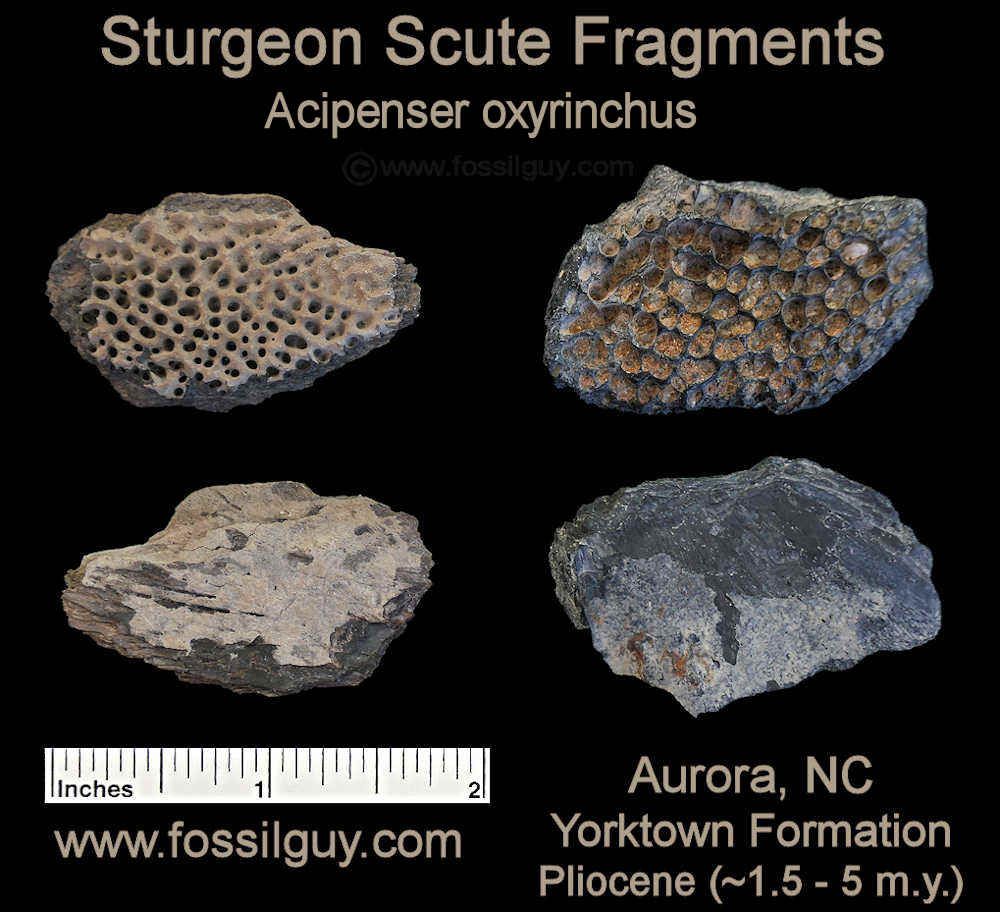
This tutorial provides an in-depth look at fossil sturgeon scute (dermal bone) fragments from the Pliocene Yorktown Formation, one of the most characteristic and frequently collected vertebrate fossils found at the famous Aurora, North Carolina phosphate mine and surrounding exposures. The accompanying photographs show four representative scute fragments of the Atlantic sturgeon, Acipenser oxyrinchus, ranging in size from approximately 1.5 to 5 cm, displaying the classic honeycomb-like surface texture that makes these fossils instantly recognizable to collectors.
Sturgeon scutes are among the most durable and abundant large vertebrate fossils in Pliocene marine and estuarine deposits along the Atlantic Coastal Plain. This guide is designed for fossil enthusiasts, students, educators, and serious collectors who want to confidently identify, understand, and appreciate these distinctive remains.
1. Geological and Stratigraphic Context
- Location: Aurora, North Carolina (primarily the PCS Phosphate mine and adjacent spoil piles and river exposures along the Pamlico River)
- Formation: Yorktown Formation (upper Pliocene)
- Age: Approximately 5 to 1.5 million years old (late Early Pliocene to early Late Pliocene, roughly Zanclean to Piacenzian stages)
- Depositional environment: Shallow marine to marginal marine (estuarine–lagoonal–open shelf) with significant terrigenous input. The Yorktown Formation at Aurora is famous for its rich phosphate-rich sands, abundant mollusks (especially Chesapecten, Mercenaria, and Isognomon), and diverse vertebrate fauna including sharks, rays, whales, dolphins, sea turtles, and bony fish.
Sturgeon remains in this formation are interpreted to represent individuals that inhabited nearshore, brackish, and estuarine environments, similar to the habitat preferences of modern Atlantic sturgeon.
2. Anatomy of Sturgeon Scutes
Modern sturgeons (family Acipenseridae) are armored with five longitudinal rows of large, bony scutes (dermal ossifications) along the body:
- One dorsal row
- Two lateral rows
- Two ventral rows
The scutes shown in the image are almost certainly from the dorsal or lateral rows, as these tend to be the largest and most robust.
Key anatomical features visible in the fossils:
- External (dorsal) surface: Distinctive honeycomb or polygonal–pitted texture formed by closely packed, raised, rounded to hexagonal ossicles or tubercles. Each “cell” in the pattern is a small, rounded to polygonal elevation, often with a slightly depressed or perforated center.
- Size and shape of scutes: Highly variable even on a single individual; larger dorsal scutes can reach 10+ cm in modern specimens, though Pliocene fragments are typically 2–6 cm due to breakage and transport.
- Color and preservation: Usually tan, gray, brown, or dark gray–black due to phosphatization and iron/manganese staining common in the Yorktown Formation.
- Thickness: Sturgeon scutes are relatively thick (often 4–10 mm), contributing to their excellent preservation potential compared to most fish bones.
3. Step-by-Step Identification Tutorial
Step 1 – Look for the signature honeycomb texture The single most diagnostic feature is the regular, closely spaced pattern of rounded pits, bumps, or polygonal cells on one surface. No other common vertebrate fossil from the Yorktown Formation displays this exact pattern.
Step 2 – Evaluate surface detail
- Well-preserved examples show a very regular arrangement of nearly circular to hexagonal elevations (see the two central specimens in the image).
- More worn or water-rolled specimens (bottom two) retain the overall pattern but appear smoother or more eroded.
Step 3 – Check thickness and cross-section Sturgeon scutes are substantially thicker than most shark vertebrae, ray dental plates, or turtle scutes. If you can view a broken edge, note the dense, compact bone structure with little to no cancellous (spongy) interior.
Step 4 – Rule out look-alikes Common misidentifications in the Aurora area include:
- Crocodile osteoderms → Usually flatter, with a more rectangular pitted pattern and sharper ridges.
- Turtle costal or peripheral fragments → Typically thinner, smoother, and lacking the raised honeycomb texture.
- Large fish skull or jaw fragments → Lack the organized polygonal pattern.
- Phosphate nodules or concretions → No biological surface texture.
Step 5 – Size and context clues Fragments 2–5 cm are typical; anything significantly larger is noteworthy and may represent a very large individual.
4. Paleoecological and Evolutionary Significance
Acipenser oxyrinchus is one of the few living fossil lineages that has remained morphologically conservative for tens of millions of years. Fossils nearly identical to modern Atlantic sturgeon scutes appear as far back as the Late Cretaceous, demonstrating remarkable evolutionary stasis.
In the Pliocene Yorktown sea, sturgeon likely used the shallow, nutrient-rich, brackish-influenced waters near river mouths and estuaries for feeding and spawning, much like their modern counterparts along the Atlantic and Gulf coasts.
5. Collecting and Ethical Notes for Aurora, NC
- Most specimens come from surface collecting on spoil piles at the Aurora mine (with permission) or from river gravel bars.
- Always check current regulations: vertebrate fossils from state waters or mine property may require permits.
- Document find location and stratigraphic context when possible.
- Avoid unnecessary digging that could damage the site or expose others to hazards.
Summary – Quick Field Reference Checklist
- Honeycomb / polygonal pitted surface → almost certainly sturgeon scute
- Thick, dense bone
- Tan–gray–brown–black color
- Found in Yorktown Formation shell hash or phosphate sand
- Size usually 1.5–6 cm for fragments
These beautiful and instantly recognizable fossils offer a direct connection to one of Earth’s most ancient and enduring fish lineages. Whether you’re a casual beachcomber or a dedicated paleontologist, being able to identify sturgeon scutes adds significantly to the enjoyment and scientific value of collecting in the Aurora region.
(Photographs courtesy of www.fossilguy.com – used with permission for educational purposes.)
Happy fossil hunting!