Kosmoceratops richardsoni: The Most Ornate Horned Dinosaur Skull – A Museum-Mounted Skeletal Display

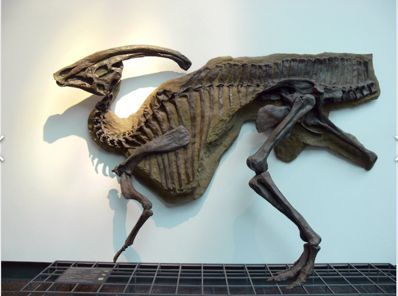
This captivating museum photograph showcases a mounted skeletal reconstruction of Kosmoceratops richardsoni, one of the most elaborately ornamented dinosaurs ever discovered. The specimen is wall-mounted in a dynamic, life-like pose against a clean, light blue exhibit wall, illuminated to highlight every bony detail. The quadrupedal stance captures the animal in mid-stride: robust forelimbs planted firmly, powerful hind legs extended, and a slightly arched back emphasizing its heavily built frame. The long tail balances the body, while the neck curves gracefully upward toward the extraordinarily decorated skull.

The head is the undeniable star: a massive, broad skull dominated by an extravagant array of horns and hook-like projections. Prominent supraorbital (brow) horns curve dramatically upward and then downward in elegant hooks, ending in sharp points—a rare downward orientation unique among ceratopsids. A flattened, blade-like nasal horn rises from the snout, while the short, wide neck frill is edged with ten epiossifications (horn-like ossicles): eight curving forward along the top margin and two flaring sideways. Combined with additional protuberances, the skull boasts up to 15 well-developed horns and horn-like structures, earning Kosmoceratops the title of the most ornate ceratopsian skull known to science. The dark, fossilized bones contrast sharply with the mount’s metal armature and the grid flooring beneath, giving a sense of scale and scientific precision.
Here are several high-quality examples of Kosmoceratops skull reconstructions, skeletal mounts, and close-up views of its extraordinary horn ornamentation from museum displays and scientific illustrations to appreciate the complexity and uniqueness of this species:
Geological and Paleontological Context
Kosmoceratops richardsoni lived during the Late Cretaceous (~76–75.9 million years ago) in what is now southern Utah, within the Kaiparowits Formation of the Grand Staircase–Escalante National Monument. Discovered in 2006–2007, the holotype (an adult skull and partial postcranial skeleton) and subadult remains were named in 2010 to honor Scott Richardson, who found them. As a chasmosaurine ceratopsid, it was a herbivorous quadruped, estimated at 4.5 meters (15 feet) long and weighing about 1.2 tonnes (1.3 short tons). It had a heavily constructed skeleton with a large pelvis, shortened tail, and powerful limbs suited for a low-browsing lifestyle in a lush, floodplain environment teeming with other dinosaurs.
The elaborate cranial ornamentation—far exceeding that of relatives like Triceratops or Chasmosaurus—likely served multiple purposes: visual display for intraspecific communication (mate attraction or dominance), species recognition, or possibly limited combat. The downward-curving brow horns and forward-hooking frill epiossifications represent extreme evolutionary experimentation within ceratopsians.
Tutorial: How to Study and Appreciate Ceratopsian Skeletal Mounts Like This One
- Focus on Cranial Ornamentation — Count and trace the horns: identify the blade-like nasal horn, downward-curving supraorbital horns, and the ten epiossifications on the frill. Note how Kosmoceratops differs from blunt-horned forms (e.g., Triceratops) or forward-projecting relatives.
- Assess Postcranial Proportions — Observe the quadrupedal stance: forelimbs shorter than hindlimbs, barrel-shaped ribcage for gut fermentation of tough plants, and sturdy limbs for weight-bearing. Compare tail length (relatively short) to hadrosaurs or sauropods.
- Examine Preservation & Mounting — Real fossils show natural bone texture, cracks, and mineralization (often dark brown/black). Mounts use steel armatures for support; wall-mounting saves space while allowing dramatic posing.
- Interpret Paleoecology — Kosmoceratops lived in wet, subtropical floodplains alongside tyrannosaurs, hadrosaurs, and ankylosaurs. Its beak and dental batteries indicate shearing tough vegetation.
- Compare to Relatives — Contrast with Utahceratops (same formation, blunter horns) or Vagaceratops (similar frill hooks). Use phylogenetic trees to see chasmosaurine relationships.
- Display & Photography Tips — Angled lighting accentuates horn curves and frill edges. Wide-angle shots capture scale; avoid flash to prevent glare on bone surfaces.
This exhibit transforms dry bones into a vivid portrait of evolutionary creativity, showcasing how ceratopsians diversified their headgear in the final chapter of non-avian dinosaur history. It invites viewers to ponder the functions of such extravagant features in a world of predators and plentiful plants.
Perfect for paleontology enthusiasts, educators, or anyone fascinated by dinosaur diversity. Have you visited displays of ceratopsian skulls or marveled at Kosmoceratops reconstructions? Share your thoughts in the comments below!